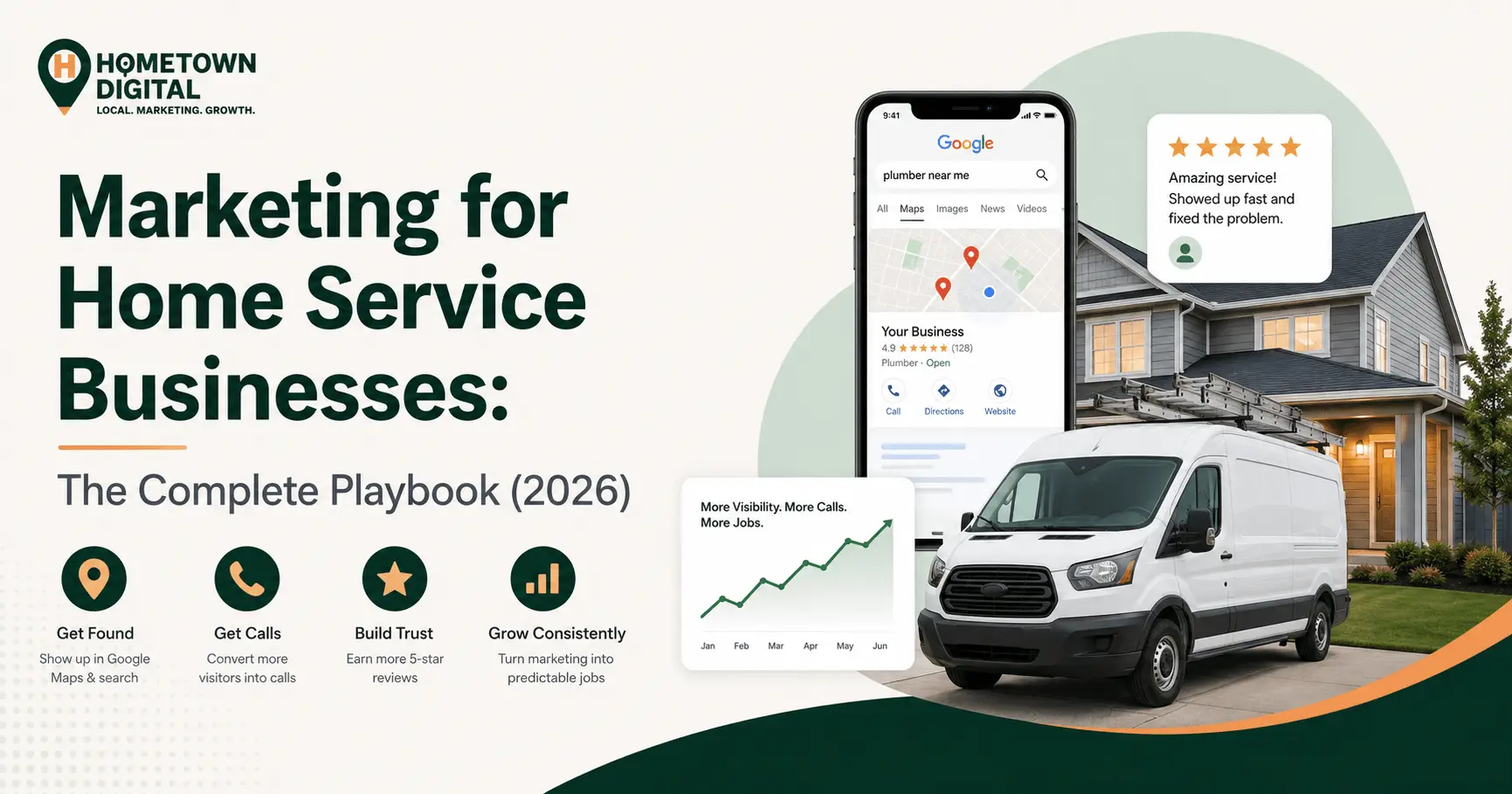
A homeowner’s water heater fails at 9pm on a Tuesday. They grab their phone, type “plumber near me,” and call whoever shows up first with decent reviews and a site that loads in under three seconds. That’s the whole sales cycle. No brochure. No long think-it-over phase. Just a fast decision based on whoever looks the most trustworthy in the next ninety seconds. If your business isn’t built to win that moment, and thousands of moments just like it, someone else in your market is winning it instead.
The Home Services Market Is Bigger Than Ever, and So Is the Competition
The U.S. home services market is worth somewhere between $460 billion and $600 billion depending on which research firm is counting, and every major 2026 report agrees on one thing, it’s still growing. That growth is exactly why winning calls in your specific market has gotten harder, not easier, over the last few years.
More money chasing the same homeowners means more contractors competing for the same searches, the same Map Pack spots, and the same leads. CallRail’s 2026 research found that 72% of home services businesses plan to increase their marketing budgets this year, and 75% expect revenue to grow. That’s good news for the industry overall. But it also means the business down the street is spending more to win the exact same jobs you are, which raises the bar for everyone who isn’t paying attention to how they show up online.
Because we’ve worked in the trades ourselves, we know this isn’t an abstract trend for most owners. It shows up as a slower phone during a season that used to be busy, or a competitor who seems to be everywhere on Google when you know for a fact their work isn’t better than yours. It usually isn’t better work. It’s better marketing.
How Do Homeowners Actually Find and Choose a Home Service Business in 2026?
Nearly all homeowners, 98% by most current counts, search online before hiring a home service business, and the majority pick whoever responds fastest with the strongest reviews rather than the cheapest quote. Response speed and trust signals now matter more than price for most jobs.
A few numbers worth sitting with. Research from CallRail shows 86% of homeowners won’t answer a call from a number they don’t recognize. Separate industry data puts the number of homeowners who hire the first contractor who responds at 85%, with response inside five minutes producing dramatically higher conversion rates than a slower callback. Meanwhile, reviews carry serious weight before anyone dials at all. BrightLocal’s 2025 consumer survey found 91% of people read local reviews, and most won’t consider a business rated under four stars.
Put those together and the pattern is obvious. Homeowners search, they scan reviews and a website in seconds, and they call the business that looks the most responsive and trustworthy right now. Everything in this playbook exists to win that specific moment.
Why Your Website Is Either Winning the Call or Losing It
Most contractor websites convert only 2 to 3% of visitors into a call or form fill, which means 97 to 98% of the people who land on a typical home services site leave without ever becoming a lead. That’s not a traffic problem. That’s a website that isn’t doing its one job.
A homeowner deciding between three plumbers open in three tabs isn’t reading your About page closely. They’re checking whether the site loads fast on their phone, whether it’s obvious what you do and where you serve, and whether there’s a phone number they can tap immediately. They’re also deciding whether the whole thing looks like a business that’s still going to be around next year. Fail any one of those in the first few seconds and they’re back on Google before you ever get the chance to make your case.
This is where we spend most of our time with home service clients, because it’s the highest-leverage fix available. A website built for a local business needs a tap-to-call number in the header, a fast mobile load time, service area and trade clearly stated above the fold, and real reviews displayed where a nervous homeowner can see them without hunting. None of that requires a redesign that takes months. Most of the time it requires fixing three or four specific things, not starting over.
Why Showing Up on Google Maps Matters More Than Ranking on Page One
For most home service searches, the Google Maps 3-pack gets seen and clicked long before anyone scrolls down to the traditional blue links below it. If your business isn’t in that top three for “[your trade] near me,” you’re often invisible for the exact searches that turn into same-day calls.
HVAC companies that appear in the Google Maps Pack receive 3 to 4 times more calls than those that don’t, according to research from Constellation HomeBuilder Systems, and that pattern holds across most emergency and seasonal trades. Photos on a complete Google Business Profile increase direction requests by 42%, and a complete profile earns roughly seven times more clicks than a partial one left half-finished for years. This is one of the few areas of marketing where a few hours of cleanup work produces an outsized return, and it’s often the very first thing we fix during an audit.
Local citation consistency, meaning your business name, address, and phone number match everywhere they appear online, still plays a real role in how Google ranks the Map Pack. It’s not glamorous work. But it’s foundational, and skipping it undercuts everything built on top of it.
The Real Cost of Buying Leads vs. Owning Them
Platforms like Angi and HomeAdvisor sell the same lead to multiple contractors at once, and current benchmarks put shared home services leads anywhere from $30 to over $250 depending on the trade, compared to $8 to $12 per lead from organic local search once it’s built and compounding. You’re not just paying more on the lead platforms. You’re racing two or three other contractors to the same phone call.
LocaliQ’s 2025 benchmark of over 3,200 U.S. home service search campaigns puts average cost per lead near $45 for HVAC, $52 for plumbing, and $79 for roofing, with online advertising costs for online businesses rising year over year for the majority of advertisers. Paid leads still have a place, especially when you’re new or need volume fast. But the businesses that win long-term treat organic local search as the asset they own, and lead platforms as a supplement, not the whole strategy.
This is the shift we push hardest with trade clients: stop renting your customers and start owning the channel that brings them to you. A solid local SEO foundation, built over months rather than bought by the click, is what eventually gets a business off the lead-gen treadmill entirely.
Reviews Decide the Job Before You Ever Pick Up the Phone
81% of homeowners say Google Reviews influence whether they’ll use a business, and 88% say they’d choose a business that responds to all of its reviews, according to CallRail’s 2026 data. Reviews aren’t a nice-to-have next to your marketing. For most trades, they are the deciding factor, full stop.
The math on this is unforgiving too. A drop from a 4.0 to a 3.0 star average has been shown to cost a business 5 to 9% of its revenue, and one bad, unanswered review can quietly turn away dozens of future customers who never even mention why they went elsewhere. On the flip side, businesses that respond to at least a quarter of their reviews earn meaningfully more revenue than those that stay silent.
None of this means chasing five stars at any cost. It means having a system, not a hope, for asking happy customers to leave a review and for responding to every review, good or bad, within a day or two. That’s reputation management, and for most home service businesses it’s one of the cheapest, highest-return pieces of this entire playbook.
Do You Need Paid Ads Too, or Is Organic Enough?
Most established home service businesses eventually run some paid advertising alongside local SEO, because organic growth is compounding but slow, and paid ads can fill a calendar gap or a slow season immediately. The two aren’t competitors. They’re different speeds of the same goal.
Google’s Local Service Ads, the ones with the Google Guaranteed badge, convert about 15% higher than standard text ads and are built specifically for home service trades. Roughly 75% of home service businesses now invest in some form of digital advertising, split mostly between Google and Meta formats, though a much smaller share, only about 37%, invest in SEO at all, according to recent industry benchmarking. That gap is an opportunity. The businesses doing both tend to pull ahead of the ones only doing the thing everyone else is already doing.
If you’re trying to fill a specific seasonal gap, Google Ads and Local Service Ads are usually the faster lever. If you’re trying to build long-term brand recognition in your service area with photos of real jobs, Meta Ads on Facebook and Instagram tend to fit better. Most home service businesses eventually use some combination of both, layered on top of a website and Google Business Profile that are already doing their job.
What This Looks Like by Trade
The fundamentals above apply to every home service trade, but the details, and the pain points, shift depending on what you do. A few of the patterns we see most often:
Plumbers, HVAC, and Electricians
These trades run on emergency and safety-driven searches. Most calls are urgent, which means whoever ranks first in the Map Pack when the AC dies during the first heat wave, or the power goes out, usually wins the job regardless of price. Speed, licensing, and a fast mobile site matter more here than almost anywhere else. See our HVAC industry page and plumbing industry page for trade-specific detail.
Roofing, Landscaping, and Tree Services
These trades are higher-ticket, more seasonal, and often storm-driven. Trust and proof of past work matter enormously, since a new roof or a major landscaping project is a once-in-a-decade decision for most homeowners. Our roofing industry page covers what actually builds that trust online.
Handyman and General Contractors
This is the most crowded, least differentiated corner of home services, where anyone with a truck and a tool bag can call themselves a pro. Standing out here comes down almost entirely to reviews, a real website instead of a Facebook page, and staying visible in the Map Pack when the market is this fragmented.
Whatever your trade, the order of operations is usually the same: fix the website so it converts, clean up and optimize the Google Business Profile, build a system for reviews, and only then layer paid ads on top. Skipping straight to ads on a site that converts at 2% just means paying more to lose more visitors.
Common Questions About Marketing for Home Service Businesses
How much should a home service business spend on marketing?
It depends heavily on trade and market size, but most established home service businesses spend somewhere between $195 and $1,000+ per month once ads are included, on top of an owned website and local SEO foundation. Start with the fundamentals (website, Google Business Profile, reviews) before adding paid spend on top.
Is Google Ads or local SEO better for a home service business?
Neither replaces the other. Local SEO is slower to build but keeps compounding and doesn’t stop when you stop paying for it. Google Ads and Local Service Ads deliver faster volume but cost money every single month. Most businesses eventually run both.
Do I still need a website if I already have great reviews?
Yes. Reviews get a homeowner interested, but the website is what confirms you’re a real, trustworthy business worth calling right now. A great review profile pointing to a slow or outdated site still loses the job.
How long does local SEO take to start working?
Most home service businesses start seeing measurable movement in the Map Pack within 60 to 90 days, with stronger results building over 6 to 12 months. It’s a compounding asset, not an overnight fix.
Should I stop using Angi or HomeAdvisor entirely?
Not necessarily right away. Shared lead platforms can still fill gaps, especially for newer businesses. The goal is to reduce dependence on them over time as organic local search starts producing leads you own outright, instead of leads you’re splitting with two other contractors.
What’s the single biggest marketing mistake home service businesses make?
Spending on ads before fixing the website and Google Business Profile those ads point to. Sending paid traffic to a site that only converts 2 to 3% of visitors means paying full price to lose most of the people you just paid to reach.
Ready to See Where Your Business Actually Stands?
If you run a home service business and want to see exactly where you stand online, get a free website audit from Hometown Digital. We’ll look at your site, your Google Business Profile, and your reviews, and tell you what we’d fix first. No pressure, just a real look at what’s working and what’s quietly costing you calls. If you’d rather talk it through first, book a free strategy call and we’ll walk through your market together.