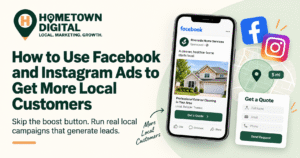
You boosted a post once. Facebook took your $40, showed it to a few hundred people who already follow you, and nothing happened. No calls, no bookings, maybe a like from your cousin. If that’s your whole experience with Facebook advertising, we understand the skepticism. But boosting a post and running a real Meta campaign are two completely different things.
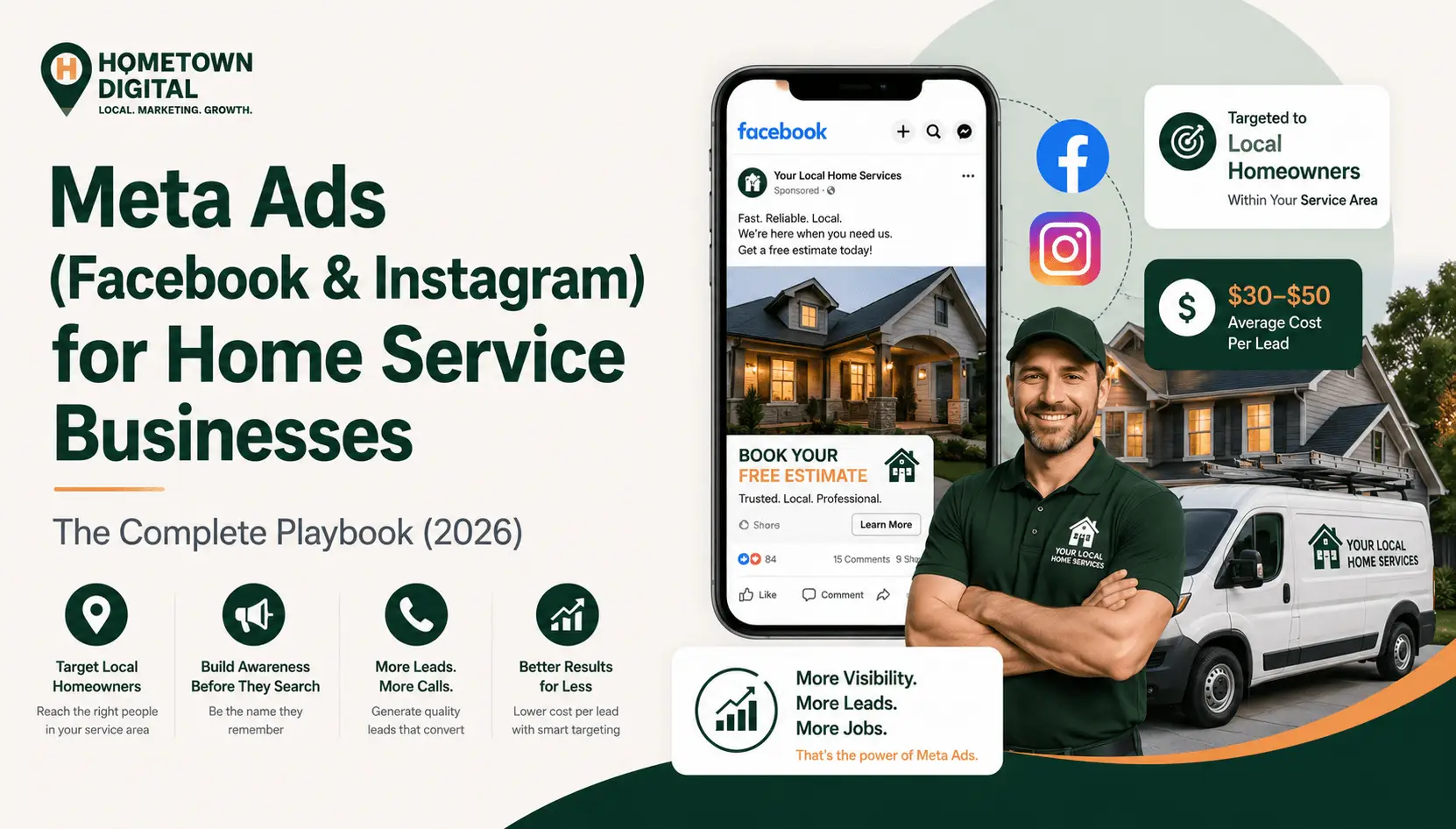
Meta Ads, the paid campaigns that run across Facebook and Instagram, put your local business in front of nearby customers before they ever go looking for you. For most local businesses in 2026, a well-built campaign generates leads at roughly $30 to $50 each, and home service companies tend to land in that range once the campaign is built around a conversion goal instead of a boosted post. This guide covers what Meta Ads actually cost, when they beat Google Ads, and why most local campaigns fail before they start.
What are Meta Ads, and how are they different from Google Ads?
Meta Ads are the paid campaigns you run across Facebook and Instagram through Meta’s Ads Manager. Google Ads catch people who are already searching for a service. Meta Ads do the opposite. They put your business in front of people who match your customer profile, based on location, age, interests, and behavior, before those people start looking.
Here’s the simplest way to think about it. Google is demand capture. Someone types “AC repair near me,” you show up, and they’re ready to call right now. Meta is demand generation. A homeowner is scrolling their feed, sees your before-and-after roof photo, and files you away for the day the leak starts. One catches people at the moment of need. The other builds recognition so you’re the name they remember when the need shows up.
Neither one is strictly better, and we’ll be honest about that throughout this guide. At Hometown Digital we run both for local businesses, because the mix depends on your trade, your margins, and how people actually find a business like yours. For a plumber handling burst pipes, search intent matters most. For a landscaper selling a spring cleanup package, reaching homeowners in February beats waiting for them to search in April.
Do Meta Ads actually work for local businesses?
Yes, when they’re set up as real campaigns instead of boosted posts. Facebook reaches about 3.07 billion monthly users and Instagram more than 2 billion (Meta, 2026), but that global number isn’t what matters to you. What matters is the small slice of those users who live within a few miles of your door. Meta’s geographic targeting is the whole reason it works for local.
The scale is almost hard to picture. Across its family of apps, Meta reported roughly 3.58 billion daily active people in early 2026 (Meta), and its ads reached about 2.28 billion people as of January 2025 (DataReportal). You’re not buying any of that reach, though. You’re buying the few thousand homeowners inside your service radius, which is why local campaigns can stay efficient even as overall ad costs climb.
And the radius really is the lever. One 2026 analysis from Sotros found that geo-fenced targeting around a tight service area, roughly a 15-mile radius, delivered a cost per lead about 40% lower than broad city-wide targeting. Tighter is usually cheaper and better. This is the same principle behind everything we cover in our guide to marketing for home service businesses: reach the right people nearby, not everyone everywhere.
How much do Meta Ads cost for a local business?
In 2026, most local businesses pay between $30 and $50 per lead on Meta, though tightly targeted service campaigns can run lower. The average cost per click sits near $1.70 to $1.90 across industries, and Facebook lead-form campaigns average roughly a 7.7% conversion rate at about a $27.66 cost per lead (Visible Factors, 2026). Your real number depends on your market, your offer, and your follow-up.
Breaking the pieces apart helps. Cost per click runs around $0.70 for traffic campaigns and closer to $1.92 for lead-generation campaigns (WordStream data via Visible Factors, 2026). Cost to reach a thousand people, the CPM, sits near a $13.48 median (Triple Whale, 2026). For home services specifically, recent benchmark work from AdAmigo puts cost per lead in a fairly predictable $30 to $50 band, and agencies managing these campaigns report $20 to $45 per lead when the campaign uses a proper conversion objective and pixel tracking (Creekside Marketing, 2026).
What should you actually budget?
The practical minimum is about $10 to $20 per day per ad set, because below that Meta’s algorithm never gathers enough data to optimize (Stackmatix, 2026). Most local businesses spend somewhere between a few hundred dollars and $1,500 a month, with $1,000 a common figure (Orange MonkE, 2026). Home service companies that want steady, reliable lead flow usually land in the $1,500 to $3,000 range (Creekside Marketing, 2026). Whatever the number, plan for a learning period. Meta needs roughly 50 conversions per ad set before delivery stabilizes.
One honest warning, because we’ve watched it burn people. A low cost per lead means nothing if those leads don’t close. Sotros ran the math in 2026: an HVAC company getting leads at $90 with a 10% close rate is paying $900 per booked customer, and if the average job is worth $800, they lose money on every single one. Watch your cost per booked job, not just your cost per lead. That’s the number that pays your bills.
Google Ads vs. Meta Ads: which should you run first?
If someone needs you right now, like an emergency plumber or a locked-out homeowner, start with Google Ads, because you’re capturing demand that already exists. If your service is planned, seasonal, or visual, like landscaping, remodeling, or a new HVAC install, Meta Ads build the pipeline earlier by reaching homeowners before they ever open a search bar.
Here’s how the two stack up for a local business in 2026:
| Factor | Google Ads | Meta Ads (Facebook & Instagram) |
|---|---|---|
| Buyer intent | Captures people already searching for you | Reaches people before they start searching |
| Best for | Emergency and urgent services | Planned, seasonal, and visual services |
| Cost per lead, home services (2026) | About $15 to $35 on high-intent keywords | About $30 to $50 in most local markets |
| Creative that wins | Tight, benefit-driven ad copy | Before/after photos and short video |
| Speed to first leads | Fast, the demand exists right now | Builds over days as the algorithm learns |
The real answer, though, is that they work best together. Google handles the demand that exists today, and Meta builds the pipeline of future customers and re-engages the people who visited your site but didn’t call. If you want the full breakdown of the search side of this equation, our guide to Google Ads for small businesses walks through budgets, costs, and what actually converts. Most of the local businesses we work with end up running both, just not always at the same time.
What kind of Meta Ads campaign should a local business run?
For most local businesses, a lead-generation campaign using Meta’s native lead forms is the simplest place to start. These forms let someone request a quote without leaving Facebook or Instagram, and they average a $34.10 cost per lead versus $45.80 for video ads (AdAmigo, 2026). Before-and-after photos and short project videos tend to outperform polished stock imagery every time.
A real campaign, the kind that actually produces calls, has a few non-negotiable parts:
- A conversion objective, not “boost” or “engagement,” so Meta optimizes toward leads instead of likes.
- Tight geographic targeting, a radius around your service area. A roughly 15-mile radius has delivered about 40% cheaper leads than city-wide targeting (Sotros, 2026).
- Real creative: your own before-and-after photos, a short video of the crew working, and one specific offer. Keep heavy text off the image, since Meta pulls back reach when text covers more than about 20% of it.
- A tracking pixel or the Conversions API, so Meta learns who converts and finds more people like them.
- A follow-up system. Contacting a new lead within five minutes can lift conversion by up to 7x (AdAmigo, 2026), and most local businesses lose leads simply by calling back too late.
That last one isn’t really an ad setting, and that’s the point. The best campaign in the world leaks money if the leads sit in an inbox for a day. It’s the setup we build when we run Meta Ads for local businesses, and the follow-up piece is the one owners underrate most.
Why do most local Facebook ad campaigns fail?
Most local Facebook campaigns fail for the same handful of reasons, and almost none of them are about budget. The biggest is boosting a post instead of running a campaign, which hands Meta no conversion goal to optimize toward. After that it’s the wrong objective, weak creative, no retargeting, and no system to follow up on the leads that do come in.
Boosting posts instead of running campaigns
A boosted post reaches people who already follow you, with no conversion tracking and no real targeting. Agencies that manage home-services campaigns call this the single biggest mistake owners make (Creekside Marketing, 2026). The blue “Boost” button is easy, and that’s exactly the trap. Real campaigns get built in Ads Manager.
The wrong objective and weak creative
If you optimize for reach or engagement, Meta will happily get you cheap likes that never turn into work. And generic stock photos get scrolled past. Your own project photos, a real face, a specific number like “new roof installed in one day,” that’s what stops the thumb.
No retargeting and no follow-up
Most people don’t convert the first time they see you. Retargeting the visitors who already checked out your site can cut cost per lead by 30% to 60% versus cold audiences (Stackmatix, 2026). Skip it and you’re paying full price to reach everyone from scratch, every time. Pair that with slow follow-up and even a well-built campaign quietly bleeds money.
What does a Meta Ads campaign look like in practice?
Picture a local HVAC company heading into spring, wanting to fill the shoulder-season gap before summer demand hits. Instead of boosting a post, they run a lead-generation campaign in Ads Manager targeting homeowners within a 20-mile radius. The creative is a short clip of a technician finishing a tune-up, paired with a specific offer: a pre-season AC tune-up at a set price. A native lead form captures the request, a pixel tracks conversions, and a text-back automation reaches every lead within minutes.
What could that produce? It varies by market, but the pattern is consistent. One Tennessee lawn care operation running project-specific creative reported over 1,500 conversions at roughly a $50 average cost per conversion across a multi-channel effort, alongside a strong return on investment (Creekside Marketing, 2026). We share that as an industry example, not a guarantee, because your market, offer, and follow-up will move the number. But the structure is the same one that works: a conversion objective, tight local targeting, honest creative, and fast follow-up.
Common Questions About Meta Ads for Local Businesses
How much should a local business budget for Meta Ads to start?
A practical starting point is $10 to $20 per day per ad set, or roughly $500 to $1,000 a month (Orange MonkE, 2026). That’s enough for Meta’s algorithm to gather the 50 or so conversions it needs to exit the learning phase and stabilize. Home service businesses that want steady lead flow usually run $1,500 to $3,000 a month.
Are Facebook ads or Instagram ads better for local businesses?
You don’t have to choose. Meta runs both through the same Ads Manager, and its Advantage+ placements spread your budget across Facebook, Instagram, Reels, and Stories to find the cheapest conversions. For most local businesses, letting Meta optimize placements beats trying to guess which one your customers use.
How is boosting a post different from running a Meta ad?
Boosting shows a post to people who already follow you, with no conversion tracking and no real targeting. A campaign built in Ads Manager uses a conversion objective, geographic targeting, a tracking pixel, and lead capture. That difference is why boosted posts rarely produce calls and real campaigns do.
How long before Meta Ads start working?
Expect a learning period. Meta needs roughly 50 conversions per ad set before delivery stabilizes, which can take one to three weeks depending on budget and lead volume. Judging a campaign in its first few days is the fastest way to kill one that would have worked.
Do Meta Ads work for service businesses that aren’t very visual?
They can, though visual trades like landscaping, remodeling, and cleaning have an edge because before-and-after photos stop the scroll. For less visual services, a specific offer, a clear local angle, and social proof like your Google reviews carry the ad instead of the imagery.
Ready to Find Out If Meta Ads Make Sense for You?
Not sure if paid advertising makes sense for your business right now? Book a free 30-minute strategy call and we’ll look at your market, your margins, and give you an honest answer. Sometimes that answer is Google first, sometimes it’s Meta, and sometimes it’s neither one yet. We’ve spent years running both channels for local businesses, and we’d rather tell you the truth than sell you a campaign you’re not ready for.