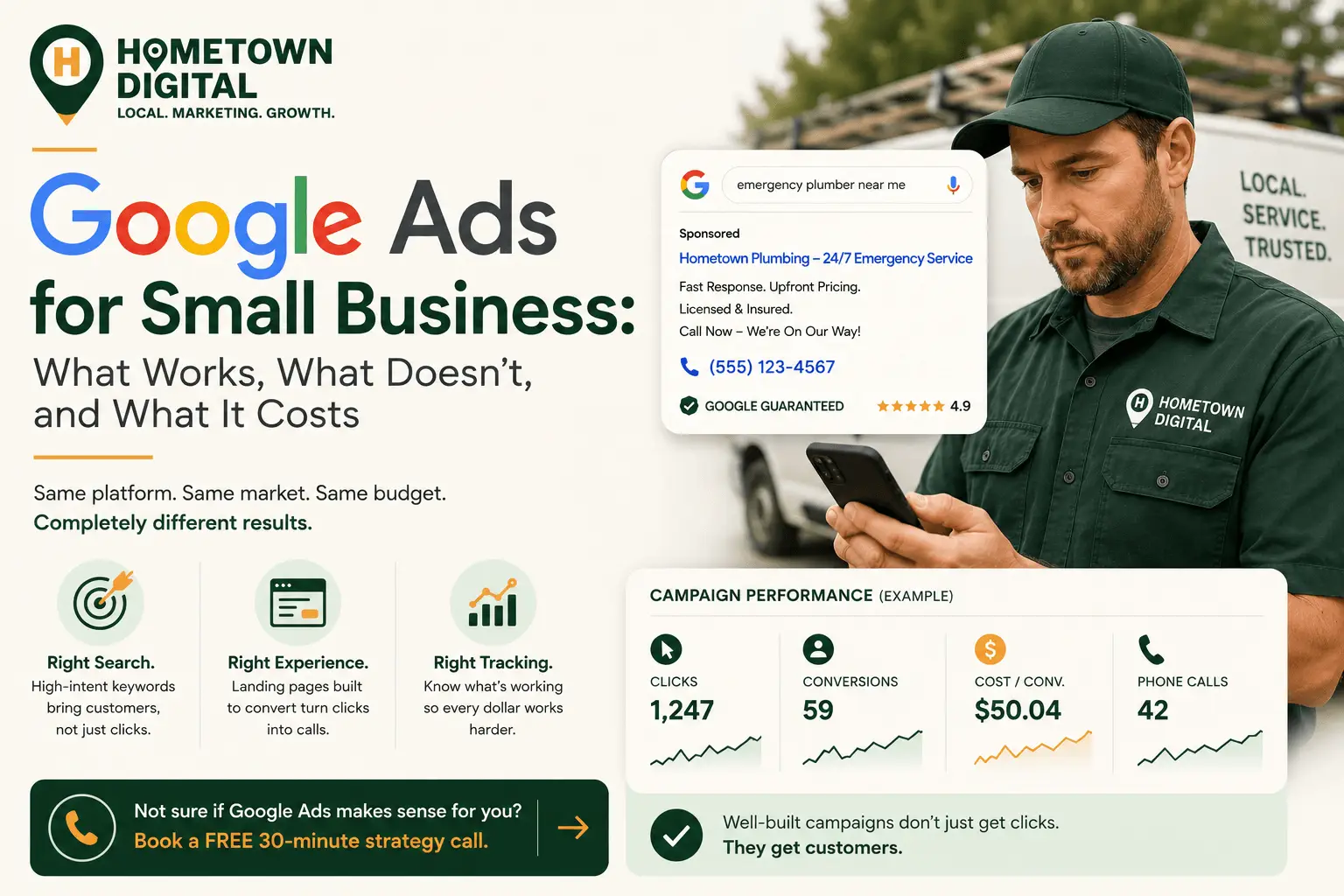
A local plumber spends $2,000 on Google Ads in March and books eleven jobs. His competitor across town spends the same $2,000 and books thirty one. Same platform, same market, same budget. The difference isn’t luck, and it isn’t some secret keyword list. It’s whether the campaign was actually built to convert, or just built to spend.
Why Google Ads Feels Like a Gamble for So Many Small Businesses
Most small business owners have a Google Ads story, and it’s usually not a good one. They set up a campaign, watched the budget disappear, and never quite figured out whether it worked. That’s not because Google Ads doesn’t work. It’s because most small business accounts are set up with default settings, broad keywords, and zero conversion tracking, which is a recipe for burning money without ever knowing why.
Here’s the direct answer: Google Ads works well for small businesses when there’s clear intent behind the search (someone typing “emergency plumber near me,” not “plumbing tips”), a landing page built to convert that specific search, and tracking in place to know which keywords actually turn into calls. Skip any one of those three things and the budget mostly disappears into clicks that never become customers.
What Does Google Ads Actually Cost for a Small Business in 2026?
Across all industries, the average cost per click on Google Ads in 2026 sits around $5.42, with an average cost per lead near $66.69, according to WordStream’s 2026 benchmark report covering more than 13,000 campaigns. But that average hides a lot. Home services businesses, plumbers, HVAC companies, roofers, tend to pay more per click, often north of $8, because those searches are high-intent and the competition to show up first is fierce.
For monthly budgets, current industry estimates put typical small business Google Ads spend somewhere between $500 and $5,000 a month, with most local service businesses landing closer to the lower half of that range once they’re running a focused campaign rather than trying to cover every keyword under the sun. Attorneys and Legal Services, Home and Home Improvement, and Dentists and Dental Services currently carry some of the highest costs per click in the country, which is worth knowing before you set a budget expecting bargain rates.
None of these numbers mean much on their own. A $6 click that turns into a $3,000 roofing job is cheap. A $2 click that never turns into anything is expensive no matter what the invoice says. That’s the number that actually matters, and it’s the one most small business dashboards don’t show unless someone sets it up. Before committing ad budget, it’s worth checking whether your site and Google Business Profile are even ready to convert that traffic. A free website audit will tell you that in a few minutes, before you spend a dollar on clicks.
What’s a Good Conversion Rate for Google Ads?
Most 2026 benchmarking reports put average Google Ads search conversion rates somewhere between 3% and 5% across industries, with lead-generation businesses (the category most home service and local businesses fall into) often performing toward the higher end of that range. That means for every 100 people who click your ad, somewhere between three and five should be calling, booking, or filling out a form.
If you’re converting well under 3%, the problem usually isn’t the ad. It’s what happens after the click. A slow-loading landing page, a phone number buried below the fold, or a page that doesn’t match what the ad promised will tank conversion rate no matter how well the ad itself is written. We see this constantly when we audit small business ad accounts: the ad is fine. The page it sends people to is the leak.
Do Local Service Ads Work Better Than Regular Search Ads?
For home service businesses specifically, yes, usually. Local Service Ads, the ones that carry the Google Guaranteed badge and show up above regular search ads, convert about 15% higher than standard text ads, and by late 2025 they were already appearing on roughly 31% of home service search queries, according to Sterling Sky’s research. That share has almost certainly grown since.
The tradeoff is that Local Service Ads only exist for a specific set of trades (think plumbing, HVAC, electrical, locksmiths, and similar categories) and require a background check and license verification to get the badge in the first place. If your trade qualifies, skipping LSAs and running standard search ads only is leaving an easier, often cheaper, path to the same customer on the table.
Google Ads vs. Local SEO: Which Should Come First?
This is probably the most common question we get from small business owners, and the honest answer is that it depends on how fast you need results. Google Ads produces calls the day the campaign goes live. Local SEO takes months to build but keeps producing calls long after you stop paying for clicks. The businesses that grow steadiest usually run both eventually, using ads to fill the gap while SEO compounds in the background.
If your margins are thin on the jobs you’re advertising for, run the math before you commit real budget. Google Ads earns businesses roughly $2 back for every $1 spent on average, but that figure varies enormously by industry and by how tight the campaign actually is. A well-run account beats that average by a wide margin. A sloppy one loses money at any spend level.
Why Do Most Small Business Google Ads Campaigns Fail?
Almost every failed small business Google Ads account we’ve reviewed has the same handful of problems, and none of them are exotic. Broad match keywords that show ads for searches with nothing to do with the business. No negative keywords, so the account pays for clicks from people looking for something else entirely (free, DIY, jobs, careers are common budget-drainers). No call tracking, so there’s no way to tell which keyword actually produced a customer. And a generic landing page, often just the homepage, instead of one built around the specific service being advertised.
Fix those four things, and most underperforming accounts turn around within a month or two. It’s rarely about spending more. It’s almost always about spending the same money more precisely.
What This Looks Like in Practice
Picture an HVAC company heading into shoulder season, that slow stretch between the last heat wave and the first cold snap, when the phone goes quiet and the crew has open hours on the calendar. Running a tightly targeted Google Ads campaign for “emergency AC repair” and “HVAC maintenance plan” searches, pointed at a landing page built specifically around fast scheduling and a clear price range, can fill exactly that gap. The campaign doesn’t need to run all year. It needs to run hard for six to eight weeks, with a landing page that matches the urgency of the search, and a phone number a homeowner can tap without hunting for it.
That’s a very different setup than a roofer running a broad “roofing company” campaign year round with no seasonal focus and a homepage as the landing page. Same platform. Completely different results, for reasons that have nothing to do with luck.
Common Questions About Google Ads for Small Business
How much should a small business budget for Google Ads?
Most local service businesses see reasonable results starting somewhere between $500 and $1,500 a month, though high-cost trades like legal or home improvement services may need more to compete. Start with a focused budget on your highest-intent keywords rather than spreading a small budget across too many search terms.
Is Google Ads better than Local SEO for a small business?
They solve different problems. Google Ads produces calls immediately but stops the moment you stop paying. Local SEO takes longer to build but keeps working in the background for free once it’s established. Most businesses eventually need both.
What’s a good cost per click for my industry?
It depends entirely on your trade. Cross-industry averages sit around $5.42, but home services, legal, and dental categories often run higher, sometimes $8 or more. The right question isn’t whether your CPC is average. It’s whether the clicks you’re paying for are turning into paying customers.
Should I use Local Service Ads instead of regular search ads?
If your trade qualifies (most home service categories do), yes, usually. Local Service Ads convert around 15% higher than standard search ads and come with the Google Guaranteed badge, which builds trust with homeowners before they ever click.
Why isn’t my Google Ads campaign converting even though I’m getting clicks?
This almost always comes down to what happens after the click, not the ad itself. Check your landing page speed, whether your phone number is visible immediately, and whether the page actually matches what the ad promised. Clicks without conversions are usually a landing page problem, not an ad problem.
Ready to Find Out If Google Ads Makes Sense for You?
Not sure if paid advertising makes sense for your business right now? Book a free 30-minute strategy call, and we’ll look at your market, your margins, and give you an honest answer. If Google Ads isn’t the right move yet, we’ll tell you that too.