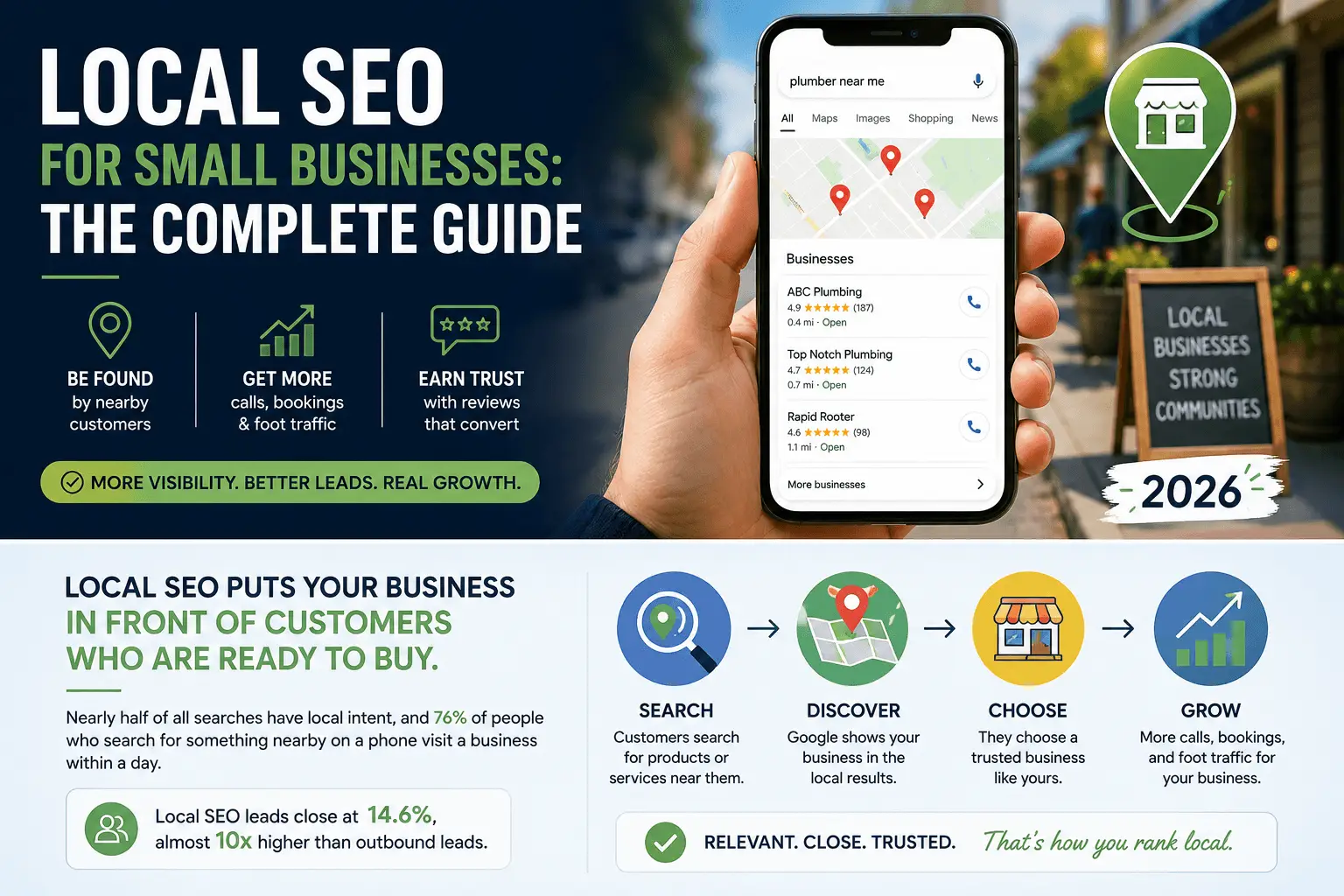
Type “plumber near me” or “best tacos near me” into Google and you’ll see the same thing: a little map with three businesses pinned to the top. Most people pick one of those three. If your business isn’t in that box, you’re not losing to a better company. You’re losing to one that set up its local search better than you did.
Local SEO is how you get into that box. It’s the practice of optimizing your business so it shows up when nearby customers search for what you sell. For a local small business, it’s the highest-return marketing you can do, because the people searching already want what you offer and just need to find you. This guide covers how local search actually works in 2026, what to fix first, and how AI search is quietly changing the rules.
What is local SEO, and why does it matter for a small business?
Local SEO is the process of optimizing your online presence so your business appears when people nearby search for what you sell. It covers your Google Business Profile, your website, your reviews, and your listings across the web. The payoff is simple: more calls, more bookings, and more foot traffic from people in your area who are ready to act.
Here’s why it matters more than most owners realize. According to Google, about 46% of all searches have local intent, meaning nearly half the time someone is looking for something near them. And Google has found that 76% of people who search for something nearby on a phone visit a business within a day. These aren’t browsers killing time. They’re buyers.
The quality of those leads is the part that surprises people. HubSpot reports that local SEO leads close at around 14.6%, compared to roughly 1.7% for outbound leads like cold calls. So a customer who finds you on Google is almost ten times more likely to become a paying job than someone you chase. That’s the whole case for local SEO in one sentence. It’s the bulk of what we do for clients with our local SEO services and it’s where most small businesses see the fastest return.
How does local search actually work?
Google ranks local results using three main factors: relevance, distance, and prominence. Relevance is how well you match the search. Distance is how close you are to the searcher. Prominence is how well known and trusted your business is. You can’t move your shop closer to everyone, but you can heavily influence the other two.
Most owners assume distance is everything, that the closest business always wins. It isn’t, and it doesn’t. A shop two miles away with a complete profile and 200 strong reviews will routinely outrank the one next door that never claimed its listing. Here’s how the three factors break down and where your effort actually pays off:
| Factor | What It Means | What You Can Do |
| Relevance | How closely your profile and site match the search | Right categories, complete service descriptions, keyword-natural content |
| Distance | Physical proximity to the searcher | Limited control — define service area accurately |
| Prominence | How trusted and well-known Google thinks you are | Reviews, citations, backlinks, and profile activity |
Why does this matter so much? Because the top results take almost all the clicks. Moz found that the top three Google Map Pack results capture about 44% of all local search clicks, and Backlinko reports that 92% of searchers pick a business on the first page of results. Page two might as well not exist. The goal isn’t “get on Google.” The goal is to get into that top group.
How do I optimize my Google Business Profile?
Your Google Business Profile is the single most important asset in local SEO. It’s the free listing that feeds the map, the 3-pack, and increasingly the AI answers. Claim it, fill out every field, keep it current, and treat it like a living page rather than a set-it-and-forget-it form. A complete profile does most of the heavy lifting.
The numbers back this up. Research compiled by Bazaarvoice found that complete Google Business Profiles get about 7x more clicks than partial ones, and Google reports that listings with photos see 42% more requests for directions. Filling out your profile properly is the highest-leverage hour you’ll spend on local search. Here’s the short version of what to do:
- Claim and verify the listing so you actually control it, not a stale auto-generated version.
- Pick the most accurate primary category, then add relevant secondary categories. This is one of the strongest relevance signals you control.
- Get your name, address, and phone exactly right, matching how they appear on your website.
- Add real photos of your team, your work, and your storefront, and keep adding them over time.
- List your services and service areas, and use the description to plainly say what you do and where.
- Keep hours accurate (including holidays) and post updates regularly so the profile looks active.
That’s the foundation. There’s real depth to each of these steps, which is why we offer dedicated Google Business Profile management for owners who’d rather hand it off. But even doing the basics well puts you ahead of most of your competitors, because plenty of them never finished step one.
Not sure how your profile stacks up right now? Run it through our free GBP checker and see exactly where you stand.
How do I get into the Google Maps 3-Pack?
The Google Maps 3-Pack is the box of three businesses Google shows at the top of local results, above the regular blue links. Getting in comes down to the same three factors: be relevant (right categories and services), be reasonably close to the searcher, and be prominent (more and better reviews, consistent listings, and steady activity). Prominence is usually the deciding tiebreaker between similar businesses.
You can’t control how close you are to every person searching. So if two competitors are roughly the same distance away, the one with stronger reviews and a more complete, more active profile tends to win the spot. That’s good news for a small business willing to do the unglamorous work, because it means you can out-earn a bigger competitor that’s coasting on its name.
How much do online reviews matter for local SEO?
Reviews matter twice over. They’re a ranking signal that helps Google decide who belongs in the 3-pack, and they’re the deciding factor for the human reading them. BrightLocal found that 87% of consumers read online reviews for local businesses, so your star rating and your recent reviews are often the first impression a customer gets, long before they reach your website.
Rating drives clicks, not just trust. The Bazaarvoice data shows that listings with a 4.5-star rating or higher earn about 70% more clicks than lower-rated ones. And responding matters too: BrightLocal reports that replying to reviews increases trust for 45% of shoppers. So the move is straightforward, even if it isn’t easy. Ask happy customers for reviews consistently, and reply to every review you get, good or bad. (Yes, even the unfair one-star from the person who was never actually a customer. Especially that one.)
Do local citations still matter in 2026?
Yes, though their job has shifted. A local citation is any online mention of your business’s name, address, and phone number, on directories like Yelp, Apple Maps, Bing Places, and industry-specific sites. They matter less as a direct ranking lever than they used to, and more as a consistency check. Google wants to see the same details everywhere before it trusts and promotes your business.
What does NAP consistency mean?
NAP stands for Name, Address, and Phone number. NAP consistency means those three details are identical everywhere your business appears online. Moz’s local search ranking research consistently shows that businesses with consistent citations rank higher in local results. Mismatched listings (an old address here, a different phone number there) make Google less confident about who you are, and that uncertainty can quietly hold you back.
The practical takeaway: pick one exact format for your business details and use it everywhere, down to whether you write “Street” or “St.” It’s tedious. It also genuinely moves the needle.
What are the most common local SEO mistakes?
The most common local SEO mistakes are simple and fixable: leaving your Google Business Profile unclaimed or half-finished, inconsistent business details across the web, ignoring reviews, and running a slow or non-mobile website. None of these require a big budget to fix. They mostly require someone to actually do them, which is exactly why so many businesses leave the opportunity on the table.
- Treating the Google Business Profile as a one-time setup. An active profile beats a finished-and-forgotten one.
- Inconsistent name, address, and phone across listings, which erodes Google’s confidence.
- Ignoring reviews, both failing to ask for them and failing to respond.
- A slow or hard-to-use website. Google says 53% of mobile visitors abandon a site that takes more than three seconds to load, and Statista reports that about 60% of all web traffic is now mobile.
- Renting leads instead of owning them, by pouring money into lead-gen apps while never building a presence that brings in customers for free.
That fourth one matters more than owners expect, because your website and your Google presence work together. A great profile that sends people to a slow, clunky site still loses the job. If your site is the weak link, our conversion-focused website design is built to fix exactly that. If you’re not sure what a new site would actually cost, this article breaks down what a small business website can cost in 2026.
How is AI search changing local SEO?
AI search is adding a new layer on top of Google, and local businesses need to be findable in both. When someone asks ChatGPT “who’s a good electrician near me?” or reads Google’s AI Overview, the AI gives a direct answer and names specific businesses. If you’re not one of the names it pulls, you’re invisible to a fast-growing slice of customers, even if you rank fine on traditional Google.
This isn’t a someday problem. BrightEdge data from early 2026 shows Google AI Overviews now appear on roughly 48% of all tracked searches, and ChatGPT is handling billions of prompts a day, a large share of them search behavior. The way to win here overlaps with everything above but adds a twist: AI engines lean heavily on reviews, clear structured information, and mentions of your business on trusted third-party sites. The old saying was that SEO gets you ranked. The new one is that this kind of optimization gets you cited.
The good news is that the fundamentals don’t change. A complete profile, strong reviews, consistent listings, and a clear website are exactly what both Google and the AI engines reward. Do the local SEO work well and you’re already most of the way to showing up in AI answers too. Helping local businesses get found in both places at once is the core of what Hometown Digital does.
What does this look like in practice?
Picture a two-truck HVAC company in a competitive suburb. Their website is fine, but they’re stuck on page two for “AC repair near me,” and the first heat wave of summer sends every panicked homeowner to whichever company shows up in the 3-pack. They’re not in it, so the phone stays quiet while a competitor books out for two weeks.
The fix isn’t exotic. They claim and fully build out their Google Business Profile, fix a phone number that was wrong on three directories, start asking every satisfied customer for a review, and speed up their mobile site. Over the following weeks they climb into the local results for their core searches, and the seasonal rush starts landing on their calendar instead of the competitor’s. That’s the pattern we see across the trades, which is why we build dedicated local strategies for home service businesses. The specifics change by industry. The playbook rarely does.
Common Questions About Local SEO
How long does local SEO take to work?
Some changes work fast and some take time. Claiming and completing your Google Business Profile can lift visibility within days or a few weeks. Climbing into the 3-pack for competitive searches usually takes a few months of steady review-building and consistency. It’s a compounding effort, not an overnight switch.
How much does local SEO cost for a small business?
It ranges widely. You can do the foundational work yourself for the cost of your time. Ongoing managed local SEO from an agency typically starts in the few-hundred-dollars-a-month range and rises with how competitive your market is. The honest answer for any specific business is that it depends on your trade, your city, and how far behind your listings currently are.
Can I do local SEO myself?
Yes, especially the basics. Claiming your profile, fixing your business details, asking for reviews, and keeping your information current are all things an owner can do. The trade-off is time and consistency. Most owners can get started alone but eventually hand off the ongoing upkeep so it doesn’t fall to the bottom of the to-do list.
Is local SEO worth it for a very small or brand-new business?
Often it’s the best first marketing investment a small business can make, because it targets people who are actively searching for what you sell. A brand-new business with a complete profile and a handful of genuine reviews can compete with established names that have neglected their local presence.
Do I still need a website if I have a Google Business Profile?
Yes. Your profile gets you found, but your website is where people decide whether to trust and contact you, and it’s a ranking signal in its own right. The two work together. A strong profile pointing to a slow or confusing site still loses customers at the final step. If you want to see what a proper local business site looks like, check our portfolio page.
Does local SEO still matter now that people use AI like ChatGPT?
It matters more, not less. AI tools pull from the same signals that drive local search, your reviews, your listings, and trusted mentions of your business. Doing local SEO well is what makes you eligible to be named in an AI answer in the first place, so the two reinforce each other.
Want to know where you actually stand in local search?
Reading about local SEO is one thing. Knowing exactly what’s keeping your business off the first page is another. Grab a free website audit and we’ll review your Google presence, your reviews, and your site, then tell you plainly what to fix first and what it’s costing you to leave it alone. Or if you want a quick read on your Google Business Profile specifically, get your free GBP analysis, it only takes about 30 seconds.