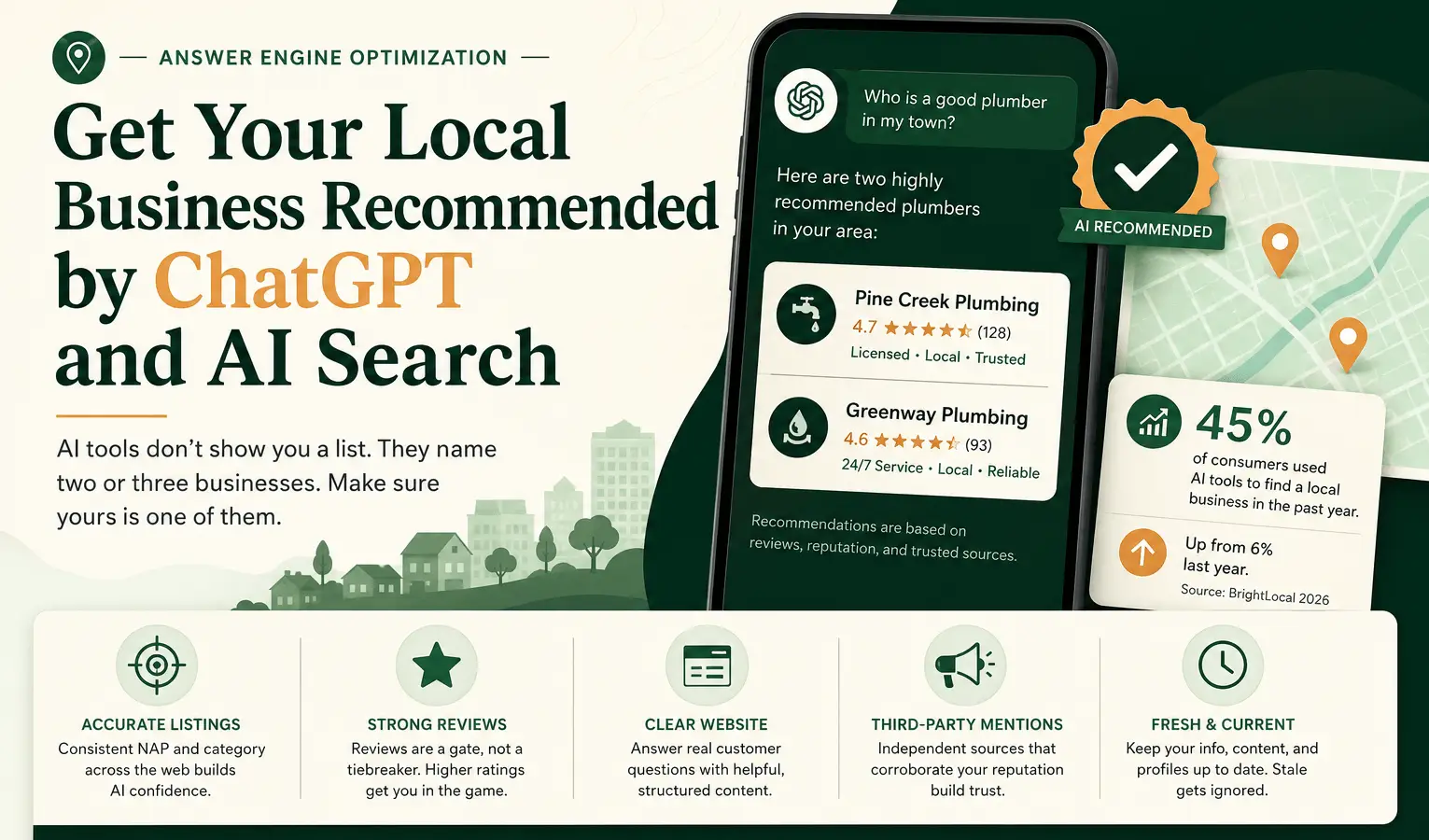
Ask ChatGPT for a good plumber in your town. It will name two or three businesses. Not ten. Not a map full of pins. Two or three. If yours is not one of them, you did not lose a ranking. You lost the entire search, and nothing in your analytics will ever tell you it happened.
Here is the short answer. Answer engine optimization for a local business means making it easy for AI tools to trust you: accurate listings everywhere the AI looks, a strong review profile, a website that answers real customer questions in plain language, and mentions on third-party sites the model already trusts. Do those four things and you become eligible to be recommended. Skip them and you are invisible, no matter how well you rank on Google.
The rest of this post covers exactly how AI assistants pick, what signals they weigh, and what to fix first.
Why isn’t ChatGPT recommending my business?
Because AI assistants are far more selective than Google. SOCi’s 2026 Local Visibility Index analyzed more than 350,000 business locations across 2,751 brands and found ChatGPT recommended only 1.2% of them. Gemini recommended 11%. Perplexity, 7.4%. Those same businesses showed up in Google’s local 3-pack 35.9% of the time.
Read that again. A business can be winning in Google Maps and still not exist as far as ChatGPT is concerned. SOCi put the gap at roughly three to thirty times harder, depending on the platform. And this is not a niche audience anymore. BrightLocal’s 2026 Local Consumer Review Survey found that 45% of consumers used an AI tool like ChatGPT, Gemini, or Perplexity to find a local business in the past year, up from 6% the year before. That makes AI the third most-used source for local recommendations, behind only Google and Facebook. It has already passed Yelp.
The behavior shift is sharpest among people aged 30 to 44, where adoption hit 64%. If you run an HVAC company, a plumbing business, or a roofing crew, that is your homeowner. That is the person deciding who to call at 9pm when the water heater goes.
But here is the part that should actually get your attention. Google gives you a list. AI gives you a name. When the list disappears, so does second place.
What is answer engine optimization for a local business?
Answer engine optimization (AEO) is the practice of structuring your business information, website content, and online reputation so that AI assistants select and cite you when someone asks for a recommendation. Traditional SEO competes for a position on a results page. Answer engine optimization competes to be the answer itself. You will also see it called generative engine optimization, or GEO. Same idea.
The distinction matters because the mechanics are different. Google’s crawler indexes pages and ranks them. An AI assistant assembles a picture of your business from dozens of scattered sources, decides how confident it is that the picture is accurate, and then either says your name or does not. It is not ranking you. It is deciding whether to vouch for you.
That is a trust problem, not a keyword problem. And trust problems get solved differently.
How do AI tools decide which local businesses to recommend?
AI assistants weigh five things: how consistent your business data is across the web, how strong your reviews are, how clearly your website answers questions, whether independent third-party sources corroborate what you claim, and how recently any of it was updated. Confidence is the currency. Every inconsistency spends some of it.
SOCi found that business profile information was only about 68% accurate on ChatGPT and Perplexity, compared with essentially perfect accuracy on Gemini, which pulls directly from Google Maps. Roughly a third of what these tools believe about local businesses is wrong. Some of that is the model’s fault. A lot of it is because the source data genuinely conflicts.
| Signal | What the AI is actually checking |
| Listing accuracy | Does your name, address, phone number, and category match across Google, Bing, Apple Maps, Yelp, Foursquare, and the BBB? Mismatches lower confidence. |
| Review quality | Star rating and sentiment. Not review count alone. AI treats reviews as a gate, not a tiebreaker. |
| Website structure | Can the model extract a clear answer from your service pages? Vague copy gives it nothing to quote. |
| Third-party mentions | Do independent sources say the same things about you? Directories, local news, community forums, roundup lists. |
| Freshness | Has anything on your site or profile changed recently? Stale pages fall out of the citation pool. |
Reviews are a gate, not a tiebreaker
This is the single most misunderstood piece. In Google Maps, a business with a 3.8-star average can still rank on proximity and category relevance. In AI recommendations, that business frequently gets excluded entirely. SOCi found locations recommended by ChatGPT averaged 4.3 stars. Gemini-recommended locations averaged 3.9, Perplexity 4.1.
AI systems are optimizing to avoid embarrassing the user. Recommending a poorly reviewed business is a risk, and models are conservative about risk. Below a certain rating, you are simply not in the running. In their financial services data, SOCi found businesses with ratings near 3.4 stars and review response rates under 5% were effectively invisible in AI recommendations.
Your website is a bigger source than you think
BrightLocal’s analysis of ChatGPT Search sources found that business websites accounted for 58% of the local sources it pulled from, followed by business mentions at 27% and online directories at 15%. Your site is not decoration. It is the primary document the model reads about you. If your service pages are three paragraphs of atmosphere and a phone number, there is nothing there to extract.
What can you do in the next 30 days?
Start with the signals you fully control: listing accuracy, review flow, and website clarity. Most local businesses have never audited their citations outside of Google, have no system for requesting reviews, and have service pages that answer no actual questions. Fixing those three closes most of the gap.
- Audit your listings beyond Google. Check your name, address, phone, hours, and category on Bing Places, Apple Maps, Yelp, Foursquare, and the Better Business Bureau. Not just Google. AI assistants cross-reference, and a wrong suite number on a listing you forgot about in 2019 is quietly costing you confidence.
- Complete and maintain your Google Business Profile. It feeds Gemini directly and gets republished across the web, which means it feeds the others indirectly. Photos, services, hours, holiday hours, posts. All of it.
- Get your rating above 4.3 and keep it there. Ask every satisfied customer, every time, right after the job. Respond to every review, good and bad. Review response rate is itself a signal.
- Rewrite your service pages to answer questions. One page per service. Open each section with a direct, plain-English answer to the question a customer would actually ask. What does an AC replacement cost in this area? How fast can you get here? Are you licensed and insured? Short paragraphs. Real numbers.
- Add LocalBusiness schema markup. This is a technical, one-time job for whoever manages your website. It tells machines, unambiguously, what your business is and where it operates.
- Build a third-party footprint. Local news mentions, chamber of commerce listings, industry directories, community forums. Independent corroboration is what turns “this business claims to be a roofer” into “multiple sources agree this is a well-regarded roofer.”
- Test it yourself. Open ChatGPT, Gemini, and Perplexity. Ask each one to recommend businesses in your category and your city. Ask five times. See who shows up. That is your competitive set, and it may not be who you thought.
At Hometown Digital, this is the work we do alongside traditional local SEO for home services companies, restaurants, salons, and professional practices. The tactics overlap heavily. The measurement does not.
Does traditional local SEO still matter in 2026?
Yes, and more than the hype suggests. Answer engine optimization does not replace local SEO. It sits on top of it. The same fundamentals that win the Map Pack (accurate listings, strong reviews, a fast crawlable site, real local relevance) are the raw material AI assistants use to build confidence. You cannot skip the foundation and optimize the roof.
What has changed is that the foundation is no longer sufficient on its own. SOCi found only about 45% of retail brands leading in traditional local search also appeared among the most-recommended in AI results. Winning one system does not hand you the other. Whitespark’s 2026 Local Search Ranking Factors report added AI search signals to its survey for the first time, which tells you where the industry consensus is landing. If you are starting from scratch, start with our complete guide to local SEO for small businesses and build from there.
We have worked with enough contractors to know the temptation here. The new thing sounds exciting and the old thing sounds boring. But the businesses getting named by ChatGPT right now are, overwhelmingly, the ones who kept their listings clean and their reviews flowing for years. They optimized for a machine they never knew was coming.
What this looks like for a real business
Take a plumbing company in a mid-sized market. Solid reputation, twelve years in business, ranks third in the Map Pack for “plumber near me.” By every traditional measure, they are doing fine. Then the owner asks ChatGPT to recommend a plumber in their city and gets three names, none of them his. He checks Perplexity. Same result.
So we look. The Google profile is strong: 4.6 stars, 180 reviews. But the Yelp listing has the old office address from before they moved. Bing Places lists a disconnected phone number. Apple Maps has them categorized as “Contractor” instead of “Plumber.” Their website has one page called Services that lists nine offerings in a bulleted column with no detail on any of them. There is no schema markup. Nobody has responded to a review in fourteen months.
None of that hurts their Google ranking much. Google has enough signal to figure it out. But an AI assistant, trying to decide whether to put this company’s name in front of a stranger, sees three conflicting phone numbers, two addresses, and a website that cannot tell it whether they do water heaters. So it recommends someone else.
The fix took about six weeks. Citation cleanup across eleven platforms, a review request system tied to job completion, seven new service pages written to answer specific homeowner questions, and LocalBusiness schema. Nothing exotic. This is the same groundwork we cover in our marketing playbook for home service businesses, applied to a plumbing business specifically.
Common Questions About Getting Recommended by AI Search
How long does answer engine optimization take to work?
Most businesses start seeing AI mentions within two to three months of cleaning up listings and improving review flow, with meaningful change closer to the six-month mark. It moves slower than paid ads and faster than traditional SEO on competitive terms. The lag exists because AI systems need to see consistent signals across multiple sources before their confidence rises.
Do I need a different website for AI search?
No. You need a clearer one. The same content changes that help AI extract answers (question-based headings, direct answers up front, real specifics instead of vague marketing copy) also help human visitors decide to call you. There is no separate AI website. There is just a website that says something useful.
Does my Google Business Profile affect ChatGPT?
Indirectly, yes. Gemini pulls straight from Google Maps, so your profile is a direct input there. ChatGPT does not use Google’s local data the same way, but your profile information gets republished across directories and aggregators that ChatGPT does read. Treat it as necessary but not sufficient. You can check yours with our free Google Business Profile checker.
Should I stop investing in Google rankings?
Absolutely not. Google still drives the overwhelming majority of local search volume, and its own AI Overviews sit on top of those results. According to BrightEdge, AI Overviews appear on roughly 48% of tracked queries as of early 2026. Abandoning Google to chase ChatGPT would be trading a large certain audience for a small growing one. Do both.
How do I know if AI is recommending my business?
Ask it. Open ChatGPT, Gemini, and Perplexity and run the same query a customer would: “recommend a good [your service] in [your city].” Run it several times, because these tools are probabilistic and give different answers on repeat asks. Track how often your name appears. There are paid tools that automate this, but for a single-location business, doing it manually once a month is enough.
Are AI recommendations actually trusted by customers?
Partly. BrightLocal found that 42% of consumers trust AI recommendations as much as traditional review platforms, but 88% of AI users still fact-check the results by reading reviews or checking sources. AI is becoming the first step in the decision, not the last one. Which means getting recommended is only half the job. What they find when they look you up is the other half.
Ready to Find Out Where You Stand?
Most local business owners have no idea whether AI search knows they exist, and there is no dashboard that will tell them. Want to see where you actually stand? Grab a free website audit. We will review your Google presence, your listings, and your site, and tell you exactly what is keeping you out of the answer.