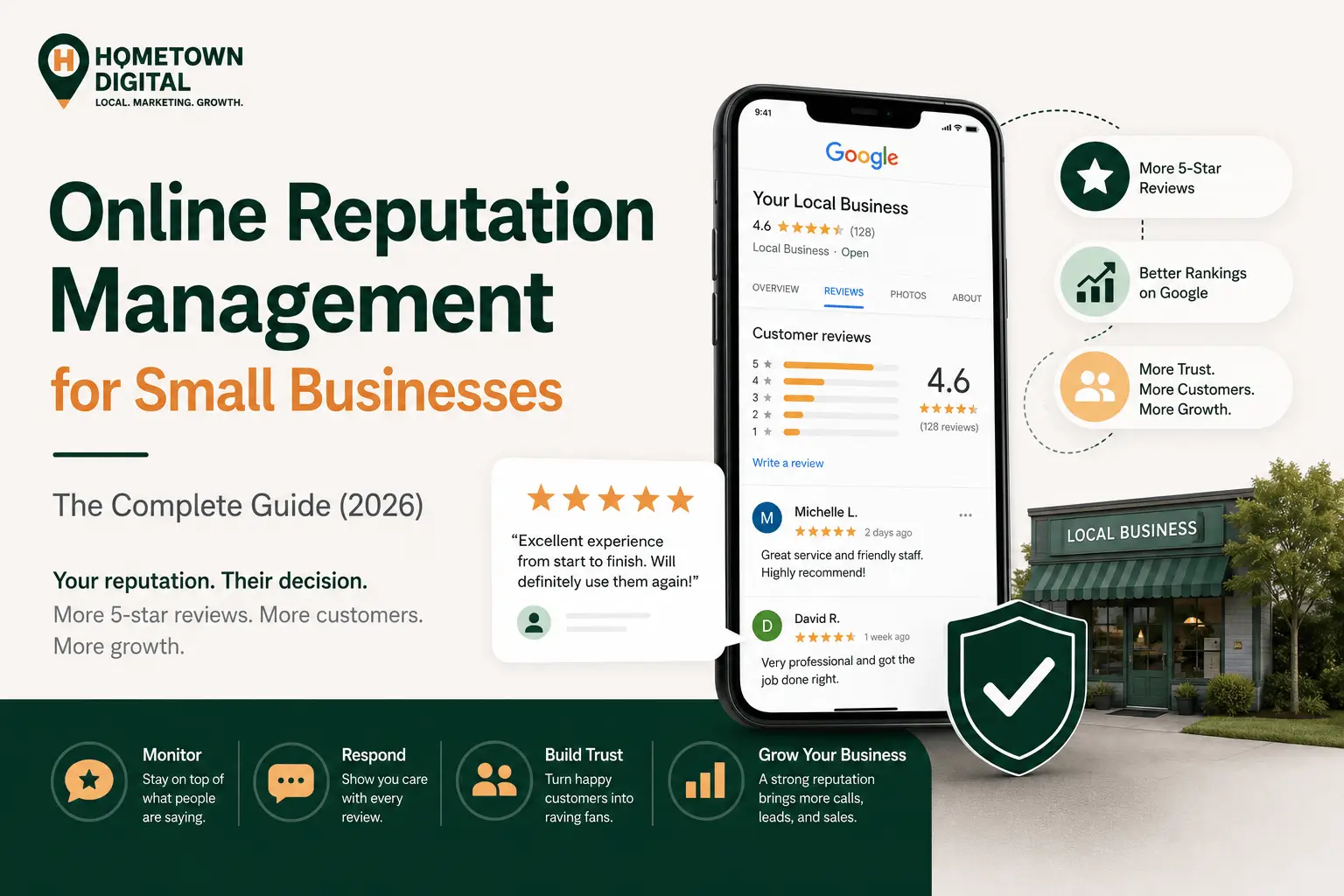
Someone in your town is deciding right now whether to call you or your competitor. Before they pick up the phone, they read your reviews. Online reputation management for small businesses is the work of shaping what those people find when they look you up: your star rating, your reviews, how you respond to them, and the overall impression you make across Google, Facebook, and now AI tools like ChatGPT. Get it right and the phone rings. Get it wrong and it doesn’t. This guide covers what a local business owner needs to know to take control of it in 2026.
What is online reputation management?
Online reputation management is the ongoing work of monitoring, influencing, and improving how your business shows up online. For a local business, that mostly means your reviews and star ratings on Google, Facebook, and other platforms, how you respond to that feedback, and the impression a potential customer forms before they ever contact you.
It’s not spin, and it’s not about hiding bad feedback. The truth is, you can’t delete honest reviews, and trying to game the system will get you in trouble (more on that below). Real reputation management is both simpler and harder than that: do good work, ask happy customers to say so, respond like a professional when someone’s unhappy, and keep an eye on every place your name shows up. We’ve worked with enough local business owners to know this feels like one more job on an already full plate. But it’s one of the few marketing investments that builds trust and improves your search rankings at the same time.
Why does your online reputation matter so much in 2026?
Your reputation matters because reviews now decide who gets the call. According to BrightLocal’s 2026 Local Consumer Review Survey, 97% of consumers read reviews when evaluating a local business, and 41% say they always do, up sharply from 29% just a year earlier. Your star rating and recent reviews are often the first impression you get to make.
And expectations are climbing fast. That same BrightLocal survey found 68% of consumers will only use a business rated four stars or higher, up from 55% in 2025. Nearly a third, 31%, now hold out for 4.5 stars or better, almost double the 17% who felt that way a year ago. Read that again. In a single year, the bar to even be considered jumped. A rating that was perfectly fine in 2025 can quietly put you out of the running in 2026.
Then there’s the volume question. Nearly half of consumers, 47%, won’t consider a business with fewer than 20 reviews, per BrightLocal. So a spotless five-star rating built on three reviews isn’t doing the work you think it is. People want to see that other people, plenty of them, trusted you first.
How much can bad reviews actually cost you?
Bad reviews cost real money, and there’s research to prove it. A well-known Harvard Business School study by Michael Luca found that a one-star increase in a business’s Yelp rating led to a 5 to 9 percent increase in revenue. Run that in reverse and the math gets uncomfortable: slipping from 4 stars to 3 can pull a meaningful chunk of revenue straight out the door.
That study looked at independent restaurants, so the exact numbers won’t map perfectly onto an HVAC company or a hair salon. But the pattern holds across local business: your rating is a direct input into how much people are willing to spend with you. BrightLocal’s 2026 data backs this up from the customer side, with 77% of people saying negative reviews put them off a business and 86% deterred by listings sitting at one or two stars.
Here’s the part owners miss. One angry review isn’t the disaster. Every business gets one eventually, and most customers know that. What actually hurts is a low overall rating with no response from the owner, because that tells a shopper two things at once: the experience was bad, and nobody cared enough to answer. That combination is what sends people to your competitor.
How do online reviews affect your Google rankings?
Reviews don’t just influence customers. They influence Google. In Whitespark’s 2025 and 2026 Local Search Ranking Factors surveys, review signals account for roughly a fifth of what determines your spot in the local map pack, about 16 to 20 percent, making them one of the strongest ranking factors you can actually control.
The biggest shift lately is recency. Whitespark’s expert panel now ranks review recency as the single most influential individual factor for local pack rankings, up from around 20th place a few years ago. In plain terms: a business with 50 reviews and a steady trickle of new ones will often outrank a business with 300 reviews that all stopped two years ago. Fresh reviews signal a business that’s active and trusted right now.
Google Business Profile signals still carry the most weight overall, around 32% of local pack ranking factors per Whitespark, which is why review generation and profile management go hand in hand. If you want the full picture of how these pieces fit together, our guide to local SEO for small businesses walks through the whole system. You can also run your listing through our free Google Business Profile checker to see where you stand.
How do you get more customer reviews without breaking the rules?
The best way to get more reviews is the most boring one: ask every satisfied customer, at the right moment, and make it easy. What you can’t do is pay for reviews, offer discounts in exchange for them, or write them yourself. Asking is fine and encouraged. Incentivizing crosses a legal line.
That line got a lot sharper recently. The Federal Trade Commission’s rule banning fake and deceptive reviews took effect in October 2024, and in December 2025 the agency sent its first enforcement warning letters to companies. The rule covers buying reviews, reviews from people who never used your service, and undisclosed reviews from employees or family. Penalties can run into the tens of thousands of dollars per violation. Tactics some owners still treat as harmless, like asking a cousin for a five-star review, now carry real risk.
Here’s a simple, compliant approach that works:
1. Ask in person, right after the win. The best time to ask is the moment a customer is happy, when you’ve just finished the job or they’ve told you they’re thrilled. A quick verbal heads-up lands far better than a cold email a week later.
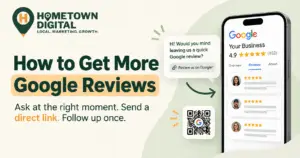
2. Follow up with a direct link. Send a text or email with a link that opens straight to your Google review form. Every extra click loses people. Make it a two-tap process.
3. Ask consistently, not in bursts. Because recency matters so much for rankings and trust, a steady stream of a few reviews a week beats a one-time push of 30. Build the ask into your normal routine.
4. Respond to the ones you get. Nothing encourages the next reviewer like seeing the owner actually reply to the last one. We’ll cover responses next.
5. Never buy, trade, or fake them. Beyond the legal risk, consumers are getting good at spotting fakes. BrightLocal found shoppers now distrust perfect, review-stuffed profiles almost as much as bad ones.
How should you respond to reviews, good and bad?
Respond to every review you can, and do it quickly. BrightLocal’s 2026 survey found 89% of consumers expect business owners to respond to reviews, and 80% say they’re more likely to use a business that responds to all of them. Just as telling, 42% say they’re unlikely to use a business that never replies at all.
Speed is becoming its own signal. In 2026, 19% of consumers expect a response the same day, up from just 6% a year earlier, and most expect one within a week. But don’t let speed turn your replies into copy-paste. Half of consumers, 50%, say a generic, templated response makes them less likely to choose a business. A real reply, even a short one, beats a fast robotic one.
The approach is different for each kind of review:
• For positive reviews: keep it short, specific, and human. Thank them, mention something from their review, and invite them back. “Thanks, Maria. Glad we got your AC back up before the weekend. Call us anytime.” That’s it.
• For negative reviews: don’t get defensive, and never argue the facts in public. Acknowledge the frustration, own your part, and move the conversation offline. A calm, professional reply to a bad review isn’t really for the person who left it. It’s for the dozens of future customers reading it and deciding whether you’re the kind of business that handles problems well.
Where does your reputation live beyond Google?
Google is still the biggest player, but it’s no longer the only one that matters. BrightLocal’s 2026 survey found consumers now check an average of six review sites before choosing a business, and Google’s share of review reading actually dropped from 83% in 2025 to 71% in 2026 as people spread out across more platforms.
Where those other reviews live depends on your industry. Restaurants get vetted on Yelp and increasingly on TikTok and Instagram. Contractors show up on Google, Facebook, Angi, and the Better Business Bureau. Dentists and doctors get reviewed on Healthgrades. Video platforms like YouTube and TikTok are climbing fast as places people go for real, visual opinions of local businesses.
The practical takeaway: figure out the two or three platforms your specific customers actually use, and keep those consistent and active. You don’t need to be everywhere. But a strong Google profile paired with a dead Facebook page holding an unanswered one-star review from 2022 sends a mixed signal. Consistency across the handful of places that matter beats a token presence everywhere.
How does your online reputation affect AI search?
This is the newest piece, and most owners haven’t caught up to it yet. When someone asks ChatGPT or Google’s AI for “a good plumber near me,” the AI builds its answer partly from the reviews, ratings, and business information it pulls from around the web. Your reputation is now a direct input into whether an AI recommends you at all.
The shift is happening quickly. BrightLocal’s 2026 survey found that using ChatGPT and similar AI tools for local recommendations jumped from 6% of consumers to 45% in a single year, making it the third most popular way people find local businesses. And according to SOCi’s Local Visibility Index, fewer than half of the businesses that rank well in traditional local search also show up in AI-generated local recommendations. Ranking on Google no longer guarantees the AI will mention you.
Reviews are a big reason why. AI engines lean on reviews and ratings as trust signals, the same way a human shopper does. A business with consistent, recent, positive reviews across multiple platforms gives the AI more reason to recommend it confidently. Reputation is only one piece of the AI-visibility puzzle, though. Our guide on getting your business recommended by ChatGPT and AI search covers the full approach. But reputation is where most local businesses should start, because it feeds two search systems at once, and the newer one is growing fast.
What does reputation management look like in practice?
Here’s what this looks like for a real local business. Picture a plumbing company sitting at 3.8 stars with 22 reviews, most of them over a year old, and three unanswered one-star complaints near the top of the page. They’re getting fewer calls than the competitor down the road, who sits at 4.7 stars. Nothing about their actual work is worse. Their reputation just tells a different story.
The fix isn’t complicated, and it isn’t fast. It’s consistent. Over 90 days, they start asking every happy customer for a review right after the job, with a texted link. They respond to all three old complaints calmly and professionally, then reply to every new review within a day. The trickle of fresh, positive reviews pushes the rating up and pushes the old complaints down the page. Within a few months the profile looks active, recent, and trustworthy, and the call volume follows.
That’s the kind of work we do at Hometown Digital. Because we’ve spent years working in the trades ourselves, we know an owner doesn’t have time to chase reviews and write thoughtful replies between jobs. Our reputation management service handles the asking, monitoring, and responding, so your online reputation reflects the quality of work you’re already doing.
Common Questions About Online Reputation Management
What’s the difference between reputation management and just getting reviews?
Getting reviews is one piece of it. Reputation management is the whole picture: generating new reviews, monitoring what shows up across platforms, responding to feedback, and keeping your business information accurate everywhere customers look. Think of reviews as the raw material and reputation management as the ongoing system around them.
Can I get a bad review removed from Google?
Usually no, unless it violates Google’s policies, such as fake reviews, spam, hate speech, or reviews unrelated to a real experience. You can flag those for removal, but honest negative reviews are here to stay. The better strategy is to respond well and bury old complaints under a steady stream of newer, positive reviews.
How many reviews does my small business need?
More than you probably have, and more recent than you think. BrightLocal found 47% of consumers won’t consider a business with fewer than 20 reviews, so 20 is a reasonable floor to aim for first. After that, focus on recency and consistency over hitting a big round number.
Should I respond to positive reviews too, or just the bad ones?
Both. About 89% of consumers expect responses, and replying to positive reviews encourages more of them while showing future customers you’re engaged. Keep positive replies short and specific, and save your most careful, thoughtful responses for the negative ones.
Is it worth paying someone to manage my reputation?
It depends on your time and your market. If you’re in a competitive local industry and can’t keep up with asking for and responding to reviews between jobs, outsourcing it usually pays for itself in call volume. If you have the time and a simple system, you can absolutely do it yourself. The real mistake is doing nothing.
Do fake reviews actually work?
No, and they’re now illegal under the FTC’s 2024 rule, with penalties in the tens of thousands of dollars per violation. Consumers are also getting good at spotting them, and a profile that looks too perfect creates its own suspicion. It’s not worth the risk to your business or your legal standing.
Where to Start With Your Reputation
You don’t have to overhaul everything at once. Start by looking at your business the way a customer would. Search your name, read what comes up, and notice how it makes you feel. That’s the impression you’re making on every potential customer in your town.
Want to know where your reputation stands and what it might be costing you? Start with a free website audit. We’ll take a look at your reviews, your Google profile, and what’s driving customers toward you or away.