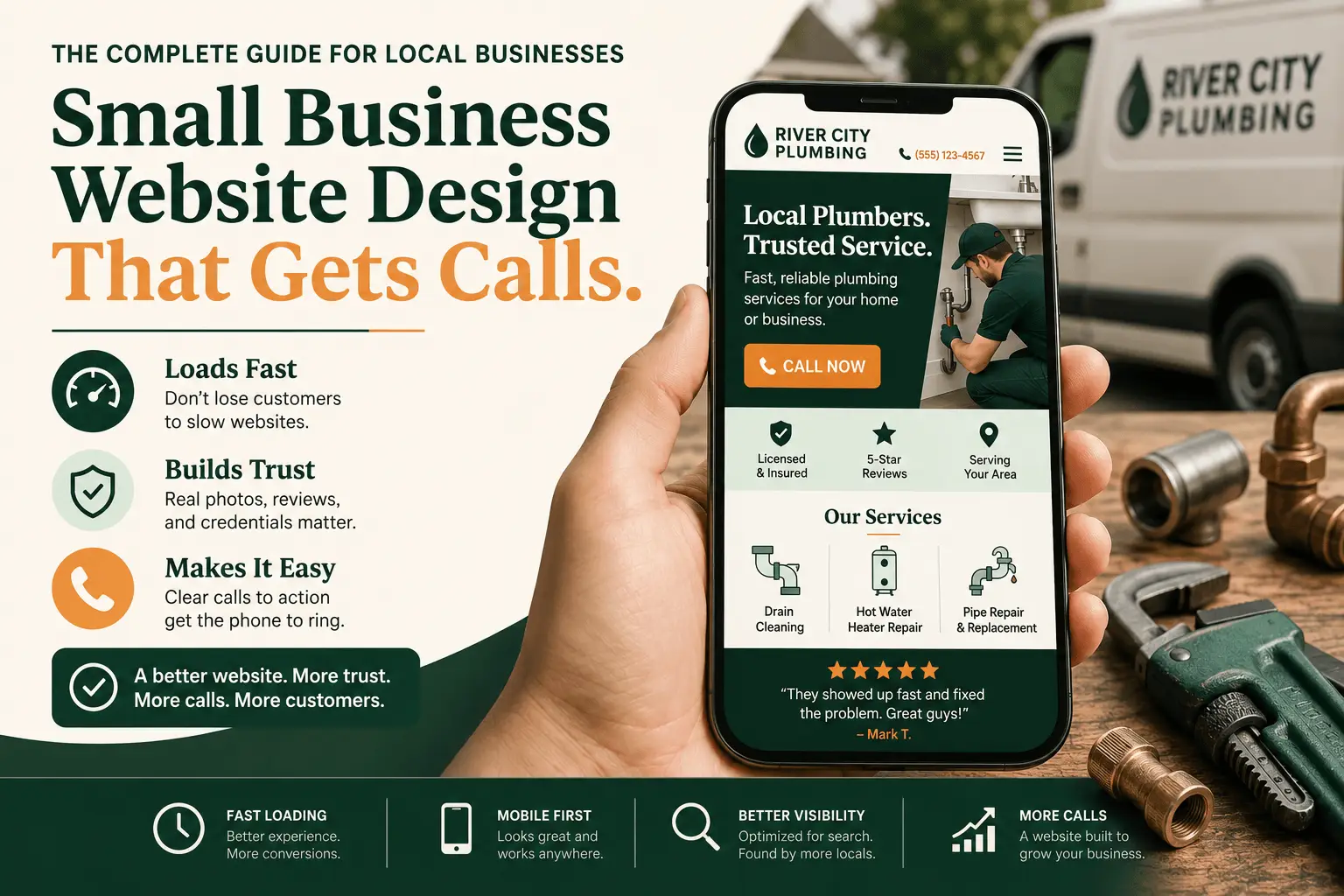
A homeowner with a leaking pipe pulls up three plumbers on their phone. One site loads instantly, shows real photos, and has a clickable phone number right at the top. The other two take six seconds to load and bury their contact info behind a hamburger menu. The homeowner calls the first one. Nobody on the other two sites did anything wrong on purpose. They just built a website instead of a tool that gets the phone to ring.
A good small business website does three things: it loads fast, it builds trust in the first few seconds, and it makes the next step obvious. Get those three right and the rest, the colors, the fonts, the clever copy, matters far less than most owners think. This guide covers what actually makes a local business site work in 2026, what it should cost, and where to focus first if your current site isn’t pulling its weight.
What makes a small business website actually work?
A small business website works when it does three things well: loads fast (especially on mobile), establishes trust within seconds, and makes the next step, calling, booking, or messaging, obvious to the user without extra effort. Everything else, the design trends, the stock photography, the clever taglines, is secondary to those three. A site can look perfectly professional and still fail at all three jobs.
Trust is the piece owners underestimate most. According to Stanford’s Web Credibility Research, 75% of users judge a business’s credibility based on its website design alone, before they’ve read a word of copy or seen a single review. More recently, DreamHost’s 2026 Local Business Trust Index, a survey of over 1,200 U.S. consumers, found that businesses with a website are perceived as 41% more trustworthy than those without one, making a website the strongest credibility signal outside of online reviews. People decide whether to trust you before they decide whether to call you, and your website is usually doing that job.
Why does website design matter so much for a local business?
It matters because your website is competing directly against your competitor websites, not against some abstract standard of “good enough.” When someone searches for a plumber, an HVAC company, or a hair salon, they’re typically comparing two or three options side by side in different browser tabs. Whichever site looks more trustworthy and loads faster usually wins the call, even if the slower site belongs to the more experienced business.
This is especially true for home service businesses, where most searches happen under real pressure. A burst pipe or a dead AC unit in July doesn’t leave much patience for a site that takes its time. We’ve worked with enough trade business owners to know the phone rings for whoever shows up fastest and looks the most credible in that moment, not necessarily whoever does the best work. A great business with a bad website loses jobs it should win.
It also matters for search. Google has used mobile-first indexing for years now. This means it primarily evaluates the mobile version of your site for ranking purposes. A slow or poorly built mobile experience doesn’t just lose the visitor in front of you, it can quietly hold back your visibility for everyone who hasn’t found you yet. We cover how website performance ties into local search visibility in our guide to local SEO for small businesses.
What does a website actually need to convert visitors into customers?
A converting website needs five things: a clear statement of what you do and where, fast load times, an obvious and repeated call to action, real proof (photos, reviews, credentials), and a mobile experience that works as well as the desktop one. Miss any of these and you’re losing visitors who are ready to become customers.
Speed
Speed isn’t a nice-to-have, it’s the gatekeeper for everything else on the page. Google has found that 53% of mobile users abandon a site that takes longer than three seconds to load, and a separate Google study found that a one-second delay in load time reduces conversions by 7%. None of your trust signals, photos, or copy matter to a visitor who already left.
A clear, repeated call to action
Every page should make the next step obvious, whether that’s “Call Now,” “Book an Estimate,” or “Get a Free Quote.” HubSpot found that websites with clear calls to action generate roughly 2x more leads than those without. A visitor shouldn’t have to hunt for your phone number or guess what you want them to do next.
Real proof, not stock photography
Photos of your actual team, your actual trucks, and your actual completed jobs do more for trust than any amount of polished stock imagery. So do visible reviews and any licenses or certifications relevant to your trade. People are making a judgment call about whether to trust a stranger with their home, their health, or their money. Specificity is what earns that trust.
A clear explanation of what you do and where
Visitors decide whether they’re in the right place within seconds. The homepage should answer “what do you do” and “do you serve my area” immediately, without scrolling. This sounds obvious, but it’s one of the most common gaps we find when auditing local business sites: pages built around what the owner wants to say, not what the visitor needs to know first.
How much should a small business website cost?
Small business website costs vary widely, from a few hundred dollars for a basic do-it-yourself build to several thousand for a fully custom site. A professional small business website from Hometown Digital starts at $295 in setup costs plus $45 a month, which covers hosting, security, and ongoing maintenance, making it possible to get a real, conversion focused site without the unpredictable invoices that come with custom agency quotes.
The honest answer to “what should I pay” depends on what you actually need: a single-page presence, a multi-page site with service pages for each offering, or a fully custom build. We cover the full cost breakdown, including what drives the price up and what doesn’t, in How Much Does a Small Business Website Cost in 2026?. The short version: price should track what the site needs to do for your business, not how many design trends it includes.
Does my website need to work on mobile?
Yes, and for most local businesses, mobile is now the primary way customers find you, not a secondary consideration. Statista reports that mobile devices account for roughly 60% of all web traffic, and Sweor found that 57% of users won’t recommend a business with a poorly designed mobile site. If your site looks great on a laptop and falls apart on a phone, you’re failing the majority of the people who actually visit it.
Mobile-friendly doesn’t just mean the page doesn’t break on a small screen. It means buttons are large enough to tap accurately, the phone number is clickable, forms are short enough to fill out with one thumb, and nothing requires pinching or zooming to read. Most of the local business sites we audit pass a basic mobile check but fail a real one, the kind where someone actually tries to book an appointment standing in a parking lot.
Should I build my own website or hire someone?
Platforms like Wix, Squarespace, and Lovable make it possible to build a passable site yourself, and for a very early-stage business with almost no budget, that can be a reasonable starting point. The tradeoff is time, and usually performance. DIY builders are general-purpose tools, not built specifically for local service businesses, so getting genuinely fast load times, clean mobile behavior, and search-ready structure usually takes more tinkering than owners expect, or budget for.
Hiring a team that builds specifically for local businesses means the speed, mobile experience, and conversion structure are handled from the start instead of bolted on later. It’s also one less thing competing for an owner’s time, which for most trades and service businesses is the scarcest resource there is. The right call usually comes down to how much the owner’s own time is worth against the setup cost.
What does this look like in practice?
Picture a local landscaping company with a website built five years ago by a relative who was good with computers. It looks dated, takes nearly five seconds to load on a phone, and the contact form goes to an email address nobody checks anymore. The owner assumes the slow season is just the market. It isn’t. It’s the website.
The fix doesn’t require starting over. A rebuilt three-page site, homepage, services, contact, with a fast host, a visible phone number, and real project photos instead of stock images usually solves most of the leak. Add a clear call to action on every page and the same traffic the old site was already getting starts converting into actual estimate requests instead of bouncing. That’s the gap between a website that exists and one that works, and it’s the difference our website design services are built to close.
Common Questions About Small Business Website Design
How long does it take to build a small business website?
Most professional builds for a small business take one to three weeks from start to launch, assuming the business owner provides photos, service details, and any branding materials reasonably promptly. Fully custom builds with more pages or specific functionality can take longer.
Do I need a new website, or can I fix my current one?
It depends on the underlying problem. If your site is slow, not mobile-friendly, or built on an outdated platform, a rebuild is usually faster and cheaper than trying to patch around those issues. If the bones are solid and the problem is copy, photos, or a missing call to action, updates alone may be enough.
What’s the difference between a cheap website and an expensive one?
Price differences usually come down to the number of pages, the amount of custom design work, and whether ongoing hosting and maintenance are included. A higher price doesn’t automatically mean better performance. Plenty of expensive, heavily designed sites still load slowly and convert poorly because speed and structure were never prioritized.
Does my website need to match my logo and branding exactly?
It should be consistent, but consistency matters more than a perfect match. Using your actual colors, your actual name, and real photos of your business goes further toward building trust than matching a Pantone code precisely.
Will a new website actually bring in more customers?
A new website alone won’t generate traffic, but a well-built one converts a much higher share of the traffic you already get from Google, referrals, and word of mouth. Pairing a fast, trust-building site with local SEO is what turns existing visibility into actual calls and bookings.
Can I keep my current website and just improve parts of it?
Often, yes. Many of the biggest wins, like speeding up load times, adding clear calls to action, and updating photos, can be done without a full rebuild. A site audit is the fastest way to find out which fixes will move the needle most for your specific site.
Ready to See What Your Website Is Actually Doing?
If you’re not sure whether your current site is helping or quietly costing you customers, get a free website audit from Hometown Digital. We’ll look at your specific site, your speed, your mobile experience, and your conversion path, and tell you plainly what we’d fix first.