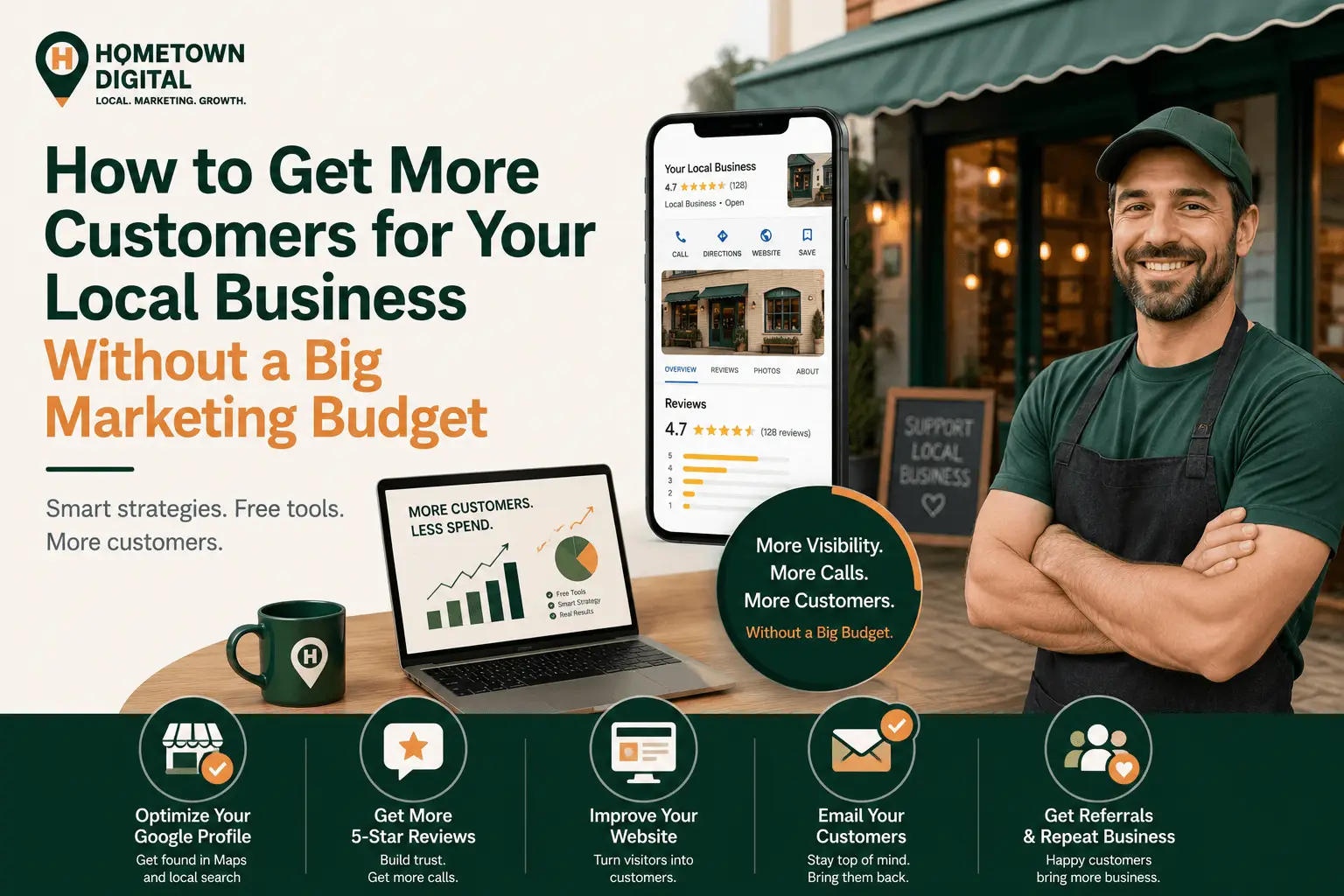
You don’t need a big marketing budget to get more customers. You need to spend in the right order. The local businesses that grow on a tight budget aren’t the ones dumping thousands into ads every month. They’re the ones who win the free channels first, their Google Business Profile, their reviews, their website, and the customers they already have, before they ever pay for a single click.
Most owners do it backwards. They buy ads to fix a problem that better reviews and a working website would have solved for free. Here’s the order that actually works, and how far a small budget can go when you follow it.
Why do so many local businesses waste money on marketing?
Most local businesses waste money because they buy the loudest channel first. Ads feel like action, so owners run them before their Google Profile, reviews, or website are ready to convert the traffic. The result is paid clicks landing on a page that can’t turn them into calls.
The confidence numbers back this up. According to Constant Contact’s Small Business Now research, 73% of small businesses worldwide weren’t confident their marketing strategy was actually working in 2024, and by 2025 only 18% called themselves “very confident” it was effective, down from 27% the year before. That’s not a spending problem. It’s a sequencing problem.
We’ve audited enough local businesses to see the same pattern on repeat: money going out the door on ads while a half-finished Google Business Profile sits there leaking free leads. Fix the order, and the same budget goes a lot further. That’s really what this whole guide is about.
What’s the cheapest way to get more customers right now?
The cheapest way to get more customers is a fully completed Google Business Profile. It’s free, it puts you on Google Maps, and for most local businesses it’s the single biggest source of calls and directions, ahead of the website. Filling it out completely costs nothing but an afternoon.
Here’s what most owners miss. The average Google Business Profile generates around 59 customer actions a month, roughly 20 website clicks, 16 direction requests, and 10 phone calls, according to BrightLocal’s 2026 data. A big share of those never touch your website at all. So a profile with missing hours, no photos, and the wrong category isn’t just underperforming online. It’s quietly losing you calls.
Complete, claimed profiles earn far more clicks than half-finished ones, and they show up more often when someone searches for what you do nearby. If you’re not sure how yours stacks up, our free Google Business Profile checker will show you what’s missing in a couple of minutes. And for the bigger picture of how local search actually works, our guide to local SEO for small businesses walks through the whole system.
How do reviews bring in customers without spending anything?
Reviews bring in customers because almost nobody hires a local business without reading them first. Asking happy customers for a review costs nothing, and a steady stream of recent 4 and 5 star reviews does more to win the next call than any ad. It’s the highest-return free marketing you have.
The numbers here are hard to argue with. BrightLocal’s 2026 research found that 87% of consumers read online reviews for local businesses, and a meaningful share won’t even consider one rated below 4 stars. Think about your own behavior. When was the last time you called the plumber with two reviews over the one with sixty?
Reviews also have a significant impact on your ranking, they’re one of the bigger local search signals, so they pull double duty: more trust and more visibility, for the price of asking. The trick is asking consistently, right after you’ve done good work, without offering anything in return (incentivized reviews break Google’s rules and can get your profile flagged). We cover the full system in our guide to online reputation management for small businesses.
Does your website really matter on a tight budget?
Yes, because your website is where all that free traffic decides whether to call you. Your Google Profile and reviews get people looking. Your site closes the deal. If it’s slow, hard to use on a phone, or looks dated, you’re paying to send people somewhere that talks them out of calling.
You don’t need an expensive website. You need one that loads fast, works on a phone, and makes it obvious how to get in touch. Most of the free traffic you just earned arrives on a phone, and if the number isn’t easy to tap or the page takes forever to load, that visitor is gone before they ever reach you.
This is the part owners underestimate. A clean, fast three-page site does more for a local business than a sprawling twenty-page one nobody can navigate. If your current site isn’t pulling its weight, our guide to small business website design covers what actually matters and what you can skip. And no, you usually don’t need a full rebuild. Most of what we flag in an audit are small fixes.
How do you get more business from the customers you already have?
The fastest low-budget growth comes from customers you’ve already earned. They cost nothing to reach, they spend more than new customers, and they refer their friends. A simple email list and a habit of asking for referrals will usually out-earn any ad campaign a small business can afford.
This is the channel almost everyone ignores. Research from Bain & Company found that increasing customer retention by just 5% can lift profits by 25% to 95%. And your happy customers are your cheapest sales team: Nielsen’s long-running research shows 92% of people trust recommendations from friends and family over any form of advertising. A referral costs you nothing and converts better than a paid lead.
Email ties it all together. It returns an estimated $36 to $42 for every $1 spent, the highest return of any marketing channel, according to Litmus. A monthly email to past customers reminding them you exist (seasonal tune-up, spring cleanup, whatever fits your trade) brings back repeat work for the price of an hour writing it. We break the whole system down in our guide to email marketing for local businesses, which is built specifically around getting more repeat customers.
When should you actually start paying for ads?
Start paying for ads once your free channels are working, not before. When your Google Profile is complete, your reviews are solid, and your website converts, ads pour fuel on a fire that’s already lit. Run them first, and you’re paying to send traffic to a business that isn’t ready to close it.
Ads do work when the foundation is there. Among small businesses that increased their marketing spend in 2025, 88% saw stable or improved revenue, according to Taradel, but the ones who win are spending on proven channels, not guessing. There’s a compounding effect too: Constant Contact’s 2025 research found multi-channel small businesses outperform single-channel ones by 53% in email results, 43% in paid social, and 21% in search. The point isn’t ads instead of the free stuff. It’s ads on top of it.
When you’re ready, the two main paid options for local businesses are Google Ads and Meta Ads, and they do different jobs:
| Google Ads | Meta Ads (Facebook and Instagram) | |
| Best for | Catching people already searching for what you do | Creating demand and staying top of mind |
| Buyer intent | High, they’re looking right now | Lower, you’re interrupting a scroll |
| Good fit | Emergency and high-intent services (plumbing, HVAC, electrical) | Visual work and awareness (landscaping, remodeling, salons) |
| How fast it works | Fast, as soon as the campaign goes live | Slower, needs testing and strong creative |
Our guides to Google Ads for small business and Meta Ads for local businesses go deep on budgets and what to expect from each.
How do you know if any of this is actually working?
You track where your calls and customers come from. On a tight budget, guessing is expensive. If you can’t tell whether a new customer found you on Google Maps, through a review, or from an ad, you can’t tell what to keep paying for and what to cut.
You don’t need fancy software to start. Ask every new customer how they found you and write it down. Watch your Google Business Profile insights, Google shows you calls, clicks, and direction requests for free. Note which emails bring back repeat work. After a couple of months you’ll see the pattern, and it’s almost always the free and low-cost channels carrying the load. (A quick aside: the owners who track this tend to spend less over time, not more, because they stop funding the channels that aren’t pulling.)
What this looks like for a business spending almost nothing
Here’s the order we’d put a tight-budget local business through: free channels first, owned channels next, paid ads last. It’s the same sequence whether you’re a landscaper, a dentist, or a barber. The only thing that changes is the timeline.
Say you run a two-person landscaping crew with maybe $200 a month to spend. Here’s the order that gets the most out of it:
- Weeks 1 to 2 (free): Claim and complete your Google Business Profile. Add every service, real photos of your work, accurate hours, and the right category. Start asking every finished customer for a review.
- Weeks 3 to 6 (free to cheap): Fix the website basics, fast load, an easy-to-tap phone number, and a clear list of services and service area. Keep the review requests going.
- Month 2 (cheap): Start a simple email list. Collect addresses at every job. Send one useful email a month to past customers.
- Month 3 and on (paid, once the above is humming): Put that $200 into the ad channel that fits your intent, usually Google Ads for a service people actively search for.
By the time you’re spending on ads, you’ve got a complete profile, real reviews, a site that converts, and a list of past customers feeding referrals. The ads work harder because everything underneath them is already working. That’s the order-of-operations we walk local businesses through at Hometown Digital, and it’s how a shop with almost no budget competes with the company spending ten times as much.
Common Questions About Marketing on a Small Budget
What’s the first thing I should do if I have almost no marketing budget?
Complete your Google Business Profile. It’s free, it’s the biggest source of calls for most local businesses, and you can do it in an afternoon. Add your services, real photos, accurate hours, and the correct category, then start asking customers for reviews.
How much should a small local business spend on marketing?
There’s no single number, but you don’t need much to start. Most of the highest-return moves, your Google Profile, reviews, and an email list, cost little more than time. When you do spend, put it toward proven channels rather than spreading a small budget thin across everything at once.
Are paid ads worth it for a small business?
They can be, but usually not first. Ads work best once your profile, reviews, and website are already converting. Among businesses that increased marketing spend in 2025, 88% saw stable or improved revenue per Taradel, but the winners spent on channels that were already working, not on guesses.
What’s the cheapest way to get more customers?
Ask your existing customers. Referrals cost nothing and convert better than paid leads, and 92% of people trust recommendations from friends and family over advertising, according to Nielsen. Pair that with a complete Google Profile and steady reviews and you’ve covered the cheapest, highest-return channels available.
Do I really need a website if I have a Google Business Profile?
Yes. Your profile gets people looking, but your website is where they decide to call. A lot of the free traffic your profile earns will check your site before reaching out, and if it’s slow or hard to use on a phone, you lose them. The two work together.
Where to start
Getting more customers on a small budget comes down to spending in the right order: free channels, then owned channels, then paid ads. Do it backwards and you’ll burn money. Do it in order and a tiny budget goes a surprisingly long way. If you want a full picture of where your marketing stands, start with a free website audit. It’s the fastest way to find out what’s working and what’s quietly costing you customers.