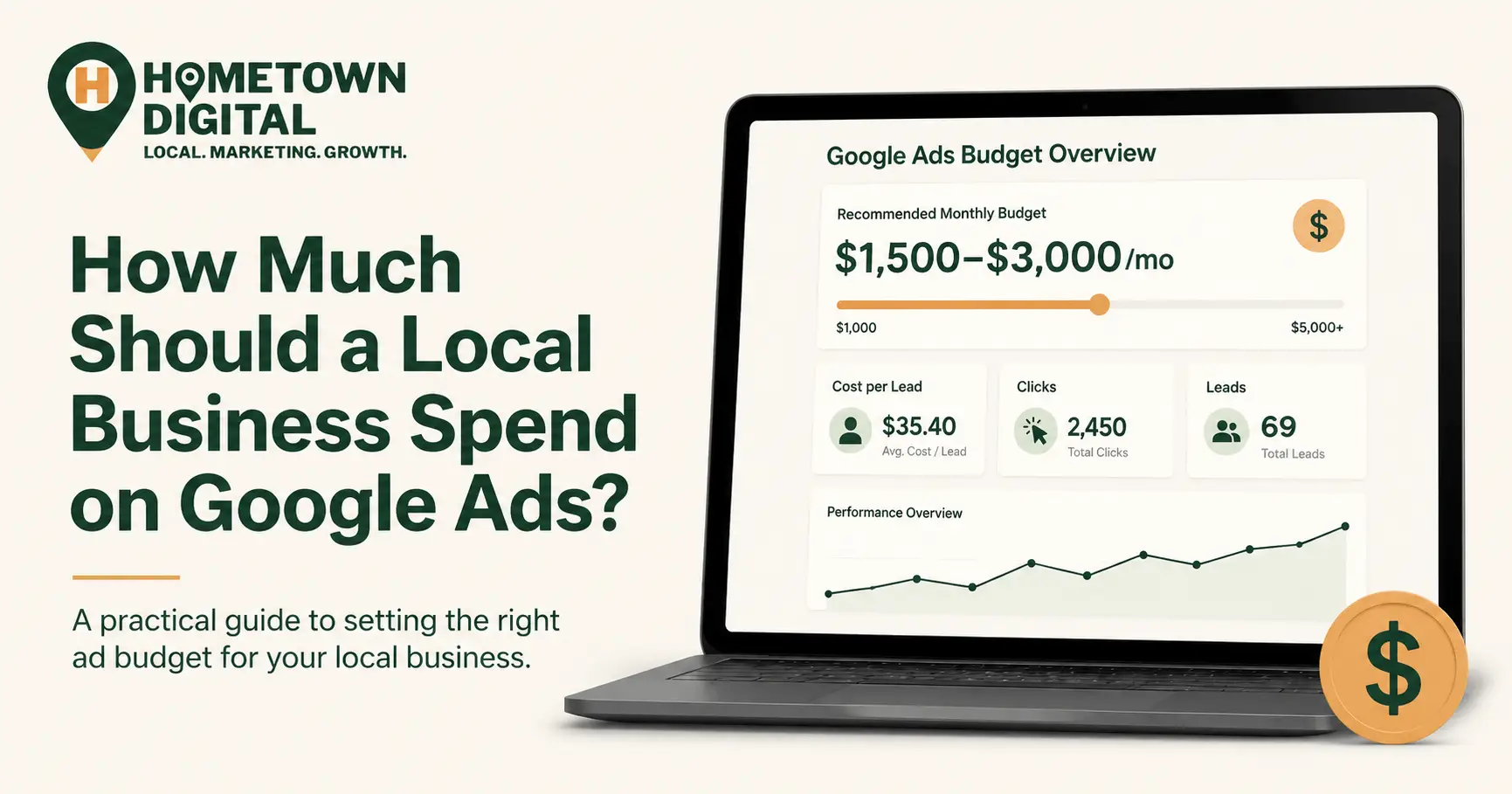
Ask ten agencies how much you should spend on Google Ads and you’ll get ten answers, most of them ending in “it depends.” That’s true, but it’s useless when you’re a plumber or a shop owner trying to decide between $500 and $5,000 a month. So here’s a real answer you can actually work with.
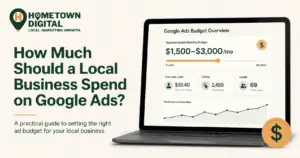
Most local businesses should plan to spend between $1,500 and $3,000 a month on Google Ads to see steady results, though a lower-competition business can start closer to $1,000. But the right number for you isn’t a flat figure. It’s driven by two things: what a lead costs in your industry, and how many leads you need to hit your goals. Get those two numbers right and the budget almost sets itself.
How much should a local business spend on Google Ads?
Most local businesses should budget $1,500 to $3,000 per month to generate consistent leads from Google Ads, based on 2026 home-services benchmarks. Lower-competition businesses in cheaper industries can start near $1,000. The exact figure depends on your cost per lead and how many leads you need each month, not a one-size-fits-all recommendation.
There’s a floor for a reason. Google’s system needs enough spend to gather data and optimize, and most home-service campaigns need somewhere in the $1,500 to $4,000 a month range before the algorithm has enough signal to work well. Go too thin and you get a trickle of clicks, no clear pattern, and a bad first impression of a channel that could have worked.
Now, not every local business needs that much. A boutique or a salon in a low-competition market can get real traction on $500 to $1,000 a month, because their clicks are cheap. But competitive trades like plumbing and HVAC almost always need more, because a single click can cost eight to ten times what a restaurant pays. If you want the full picture of how the channel works before you set a number, start with our complete guide to Google Ads for small businesses.
Why is there no single right budget for every business?
There’s no universal Google Ads budget because click costs swing wildly by industry. The average cost per click across all industries is $5.42 in 2026, according to WordStream by LocaliQ’s Search Advertising Benchmarks study of thousands of US campaigns. But that average hides enormous gaps. Two businesses spending the same $2,000 can end up with completely different numbers of clicks.
Here’s how a few common local industries compare, drawn from WordStream by LocaliQ’s recent benchmark data:
| Industry | Average Google Search cost per click |
| Restaurants and Food | $2.05 |
| All industries (average) | $5.42 |
| Home and Home Improvement | $7.85 |
| Attorneys and Legal Services | $9.87 |
Look at the spread. A restaurant pays about $2 a click, so $2,000 buys roughly 950 clicks. A home improvement business pays close to $8, so the same $2,000 buys around 250. That’s why a flat dollar recommendation is close to meaningless. The question isn’t “what should I spend,” it’s “what does it cost to get a customer in my business, and how many do I want?”
How do you calculate a Google Ads budget?
The cleanest way to set a Google Ads budget is to work backward from leads. Multiply the number of leads you want each month by your cost per lead. Want 20 leads at $75 each? You need about $1,500 a month. That one calculation beats any generic dollar figure, because it’s tied to your actual goals.
Four steps to get there:
- Decide how many new leads you need each month to hit your revenue goal. Be honest about it.
- Find your cost per lead, either from an industry benchmark or, better, from your own past campaign data.
- Multiply the two. That’s your baseline monthly budget.
- Add a 10 to 20 percent buffer for testing and for the seasons when everyone bids more and clicks get pricey.
The two numbers are connected through your conversion rate. At a $5.42 average click and the 2026 all-industry conversion rate of 8.18 percent (also from WordStream by LocaliQ), it takes roughly 12 clicks to produce one lead, which lands you near $66 per lead. That’s almost exactly the reported all-industry average. The formula isn’t magic. It just makes the math visible instead of hoping a round number works out.
What does a Google Ads lead actually cost?
The average cost per lead across all industries is $66.69 in 2026, the first decline in five years, per WordStream by LocaliQ. For home services, it usually runs higher. Non-branded search leads for HVAC and plumbing average about $149, while Google Local Service Ads come in far cheaper at roughly $53 per lead.
That Local Service Ads number is worth sitting with. SearchLight Digital tracked $6.72 million in Local Service Ads spend across 888 contractors and more than 126,000 leads in early 2026, and found an average cost per lead of $53. HVAC came in around $51, plumbing around $57, and electrical closer to $39. About 44 percent of those leads booked, the average cost per paying customer was $233, and the average ticket was $1,826. A $53 lead that turns into an $1,800 job is not expensive. It’s one of the best deals in local marketing right now.
One nuance that changes your budget math: branded versus non-branded search. When someone types your company name, that lead is cheap, because they already know you. SearchLight’s HVAC data put branded search leads at about $34 each, against roughly $149 for non-branded “AC repair near me” leads. If a chunk of your ad spend is quietly recapturing people who already searched your name, your blended cost per lead looks better than the real cost of winning a brand-new customer. Worth knowing before you read too much into a single average.
Google isn’t the only paid channel either. Facebook and Instagram ads can produce cheaper leads per click, but the intent is lower, since you’re interrupting someone’s scroll rather than catching them mid-search. For urgent, high-intent work, Google usually wins on lead quality. For awareness and slower-decision services, Meta can round out the mix.
Should you spend on Google Ads at all, or fix your free channels first?
Before you pay for a single click, make sure your free channels are pulling their weight. A fully optimized Google Business Profile generates calls and direction requests at zero ad cost. Birdeye’s 2026 report found that 86 percent of Google Business Profile impressions come from category searches like “HVAC near me,” not from people typing your business name. That’s free visibility you may be leaving on the table.
Here’s the hard truth we tell owners all the time: if you’re paying $149 for a non-branded search lead while your profile is half-filled out or sitting at 3.2 stars, you’re buying the most expensive leads to make up for ignoring the cheapest ones. Fix that first. Make sure you optimize your Google Business Profile before you scale ad spend. You can even run a free check on your Google Business Profile to see where it stands.
None of this means skip ads. It means sequence them right. Ads are the fastest way to turn on demand, but they work best on top of a solid free foundation. If you’re weighing whether Google Ads or local SEO deserves your money first, the honest answer is usually both, in the right order, at the right time.
What does a realistic Google Ads budget look like in practice?
Take a plumber who wants 20 new leads a month. On non-branded search alone, at roughly $150 per lead, that’s about $3,000 a month. But a smarter mix shifts some of that budget to Local Service Ads at $57 per lead, where the intent and book rate are both strong.
So the plan might look like this: put about $1,200 into Local Service Ads to capture roughly 20 booked-intent leads, and hold another $1,000 to $1,300 in search for the emergency “burst pipe now” queries that Local Service Ads don’t always catch. That’s around $2,200 to $2,500 a month for a healthy stream of leads. If 44 percent book and the average ticket sits near $1,800, that spend can turn into somewhere around ten jobs and $18,000 in revenue. Even after materials and labor, that math works. And it beats paying Angi or HomeAdvisor for the same leads shared with three competitors.
The piece most owners skip is tracking what happens after the click. It’s not enough to know you got 20 leads. You need to know how many booked, what they were worth, and which keywords produced them, so you can feed budget toward what works and starve what doesn’t. A campaign you can’t measure is just a guess with a monthly invoice attached.
Would every month look exactly like that? No. Summer AC emergencies spike costs, and slow weeks in shoulder season change the ratio. But the framework holds: start from leads, price them honestly, track what converts, and let the budget follow.
Common Questions About Google Ads Budgets
What’s the minimum I can spend on Google Ads and still see results?
For most competitive local trades, about $1,500 a month is the practical floor, because the campaign needs enough clicks for Google to optimize. Lower-competition businesses in cheaper industries can start around $500 to $1,000. Below that, you often get too little data to know whether the channel works.
How much do Google Ads cost per click for a local business?
It depends heavily on your industry. The 2026 all-industry average is $5.42 per click, per WordStream by LocaliQ, but restaurants pay around $2 while home improvement runs close to $8 and legal services near $10. Emergency home-service keywords can climb to $25 to $45 per click.
Are Local Service Ads cheaper than regular Google Ads?
Usually, yes, for home services. Local Service Ads averaged about $53 per lead in 2026 versus roughly $149 for non-branded search leads in HVAC and plumbing, according to SearchLight Digital. You also pay per lead instead of per click, and you get the Google Guaranteed badge, which builds trust.
How long before Google Ads start working?
Expect a learning period of two to four weeks while the campaign gathers data and settles. You may get leads in the first few days, but reliable, optimized performance takes a month or two. Pulling the plug after one slow week is the most common way local businesses waste ad money.
Should I hire someone to manage my Google Ads?
If you’re spending more than about $1,000 a month, professional management usually pays for itself by cutting wasted spend on the wrong keywords and clicks. A poorly managed campaign can burn half its budget on searches that never convert. Good management is often the difference between a channel that works and one that doesn’t.
Not sure what the right number is for your market?
Budgets are personal. What a plumber in a competitive metro needs is very different from what a boutique in a small town needs. At Hometown Digital, we’ve spent years around local businesses, including time in the trades ourselves, and we know how easy it is to overspend on the wrong clicks or underspend into invisibility. Not sure if paid advertising makes sense for your business right now? Book a free 30-minute strategy call. We’ll look at your market, your margins, and give you an honest answer, even if the answer is “not yet.”