You’ve got a marketing budget that only stretches so far, and you’re looking at two ways to spend it. Option one: run Google Ads and start getting calls this week. Option two: invest in local SEO and wait a few months for it to pay off. It’s one of the most common questions we get from local business owners, and here’s the honest answer. If you need leads right now, start with Google Ads. If you’re building something that keeps paying you back for years, start with local SEO. For most local service businesses, the smartest first move is to lock down your local SEO foundation first, then add paid ads on top when you need more volume or speed.
What’s the real difference between Google Ads and local SEO?
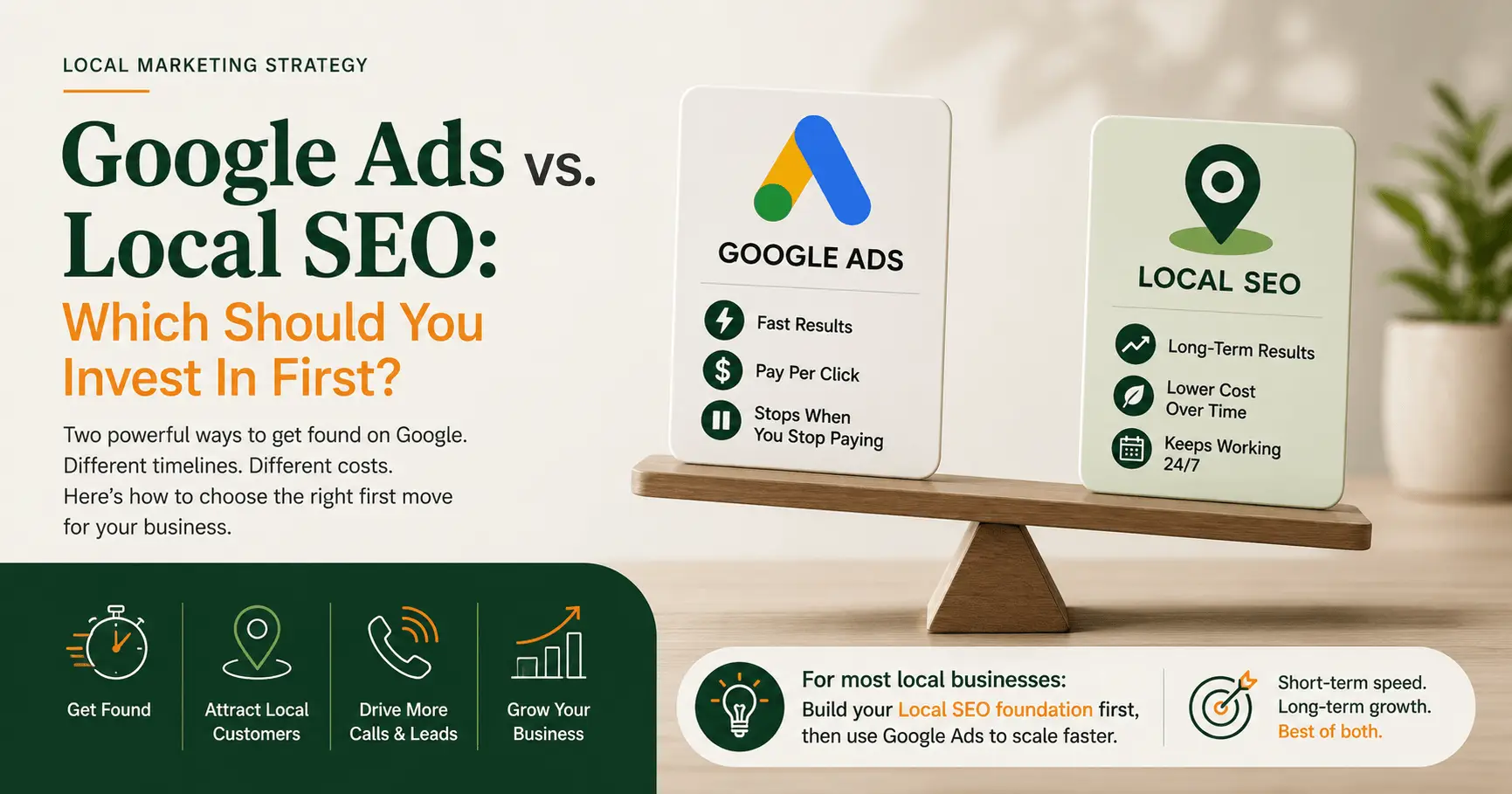
Google Ads is paid advertising. You bid on search terms, your ad shows at the top of Google, and you pay for every click. The day you stop paying, your visibility disappears. Local SEO is the work of earning your place in Google’s organic listings and the map results. It takes longer to build, but you’re not paying per click, and the results compound instead of resetting.
Both put your business in front of people who are actively searching for what you sell, and that’s the part that matters. A homeowner typing “water heater repair near me” already has their wallet halfway out. Whether they find you through an ad or through the map pack, they’re a good lead. The difference is in how you get there, how fast, and what it costs you over time.
We break down the paid side in detail in our guide to Google Ads for small businesses, and the organic side in our complete local SEO guide. But here’s the short version in one table.
| What to compare | Google Ads | Local SEO |
|---|---|---|
| How you show up | Paid ads at the top of the search results | Organic listings and the Google map pack |
| Speed to first leads | Same day to same week | Usually 3 to 6 months |
| What you pay for | Every click, whether it converts or not | Upfront and ongoing work, not per click |
| When you stop | Leads stop the day you pause | Rankings hold and keep working |
| Best for | Speed, slow seasons, brand-new businesses | Long-term growth and a lower cost per lead |
How fast does each one actually work?
Google Ads works almost immediately. You can launch a campaign today and have qualified calls coming in by the end of the week. Local SEO is slower. According to First Page Sage, most SEO campaigns take about four to six months to show real results, with rankings usually starting to move around the three-month mark.
That gap is the whole reason this question exists. When your phone isn’t ringing and payroll is due Friday, four to six months might as well be four to six years. Ads solve that problem. You’re buying your way to the top of the page today.
But speed cuts both ways. The moment you pause an ad campaign, the leads stop cold. Local SEO is the opposite. It takes patience to build, and then it keeps working while you sleep, during slow seasons, and long after you’ve stopped actively pushing on it. One is a faucet. The other is a well you dig once.
What does Google Ads actually cost a local business?
Across all industries, the average cost per lead in Google Ads is $66.69, with an average cost per click of $5.42, according to WordStream’s 2026 benchmarks study of more than 13,000 US campaigns. For home services it runs higher. LocaliQ’s data puts the average home services cost per click at $7.85, and clicks in trades like roofing, electrical, and painting regularly cost more.
Those numbers add up fast. In the Home and Home Improvement category, WordStream found an average cost per click of $8.33 and an average cost per lead of $90.92 in 2026. A single click from an electrical or painting prospect can run past $12, and not every click turns into a call.
That doesn’t make ads a bad deal. Google’s own economic impact research has long estimated that businesses earn around $2 in revenue for every $1 they spend on Google Ads, and the intent behind a search like “emergency plumber” is about as high as it gets. But it’s money out every month, and the second you stop, the calls stop. You’re renting the traffic, not owning it.
What does local SEO cost, and why is it different?
Local SEO doesn’t charge you per click. Instead of paying every time someone finds you, you invest in the work once and the results keep coming. That’s why the cost per lead from local SEO tends to fall over time while paid costs rise with competition. The tradeoff is patience, because you’re building an asset, not flipping a switch.
The single highest-leverage place to start is free: your Google Business Profile. It’s the biggest factor in whether you show up in the map pack, and for a local service business, the map pack is where the calls come from. We walk through the whole process in our guide to Google Business Profile optimization, and how the map results actually work in our post on getting into the Google Maps 3-Pack.
The intent is there too. Google’s own data shows that 46% of all searches have local intent, and research from Moz found the top three map pack results capture about 44% of local search clicks. Claiming one of those spots doesn’t cost you per lead the way an ad does. Once you’re there, you’re there.
Which one gives you a better return over time?
For long-term return, local SEO usually wins, because you’re building something you own instead of renting visibility month to month. Google Ads wins on speed and control. And the best answer for most local businesses isn’t one or the other. It’s using ads to buy time while your local SEO foundation gets built underneath you.
There’s a wrinkle worth being honest about. The search results page is getting more crowded, not less. An analysis of more than 10 billion Google searches by iPullRank found that nearly 47% of searches now end without a single click, as AI answers and other features pull attention away from both ads and organic listings. That affects everyone, and it’s another reason not to bet everything on one channel.
You’ll also see stats floating around claiming 80% or 90% of people “skip the ads.” Take those with a grain of salt. Recent data actually shows paid click share rising in some categories. The truth is less dramatic and more useful: different searches behave differently, and a business that shows up in both the ads and the map pack simply gets more chances to win the click.
So which should you invest in first?
If you have to pick one first, it comes down to your timeline and your cash. Need leads this month to keep the lights on? Start with Google Ads. Can you afford to wait a few months for something that compounds? Start with local SEO, beginning with your Google Business Profile. Most local service businesses are best served building the local SEO foundation first, then adding ads for speed and volume.
Start with Google Ads if:
- You need calls in the next few weeks, not months
- You are heading into a slow season and need to fill the schedule
- You just opened and have no organic presence yet
- You want to test which services or offers actually convert before investing in content
Start with local SEO if:
- You can wait three to six months for results to build
- You want to lower your cost per lead over the long run
- You are tired of paying for every single lead
- You are in a market where the map pack drives most of the calls
One warning, because we’ve watched it burn a lot of owners. Don’t pour money into ads if the place you’re sending clicks isn’t ready to convert them. If your website is slow, confusing, or doesn’t build trust, you’re paying $8 a click to send people to a page that loses them. We wrote a whole post on why a website isn’t bringing in customers because it’s that common. Fix the foundation first, then turn on the traffic.
What this looks like for a real local business
Picture a plumber in a competitive suburb. The phone’s quiet, and they need work now. The right move isn’t to sink three months into content and wait. It’s to turn on a tight Google Ads campaign around emergency and repair searches, get calls coming in this week, and use that revenue to stay afloat.
At the same time, in the background, they claim and optimize their Google Business Profile, start collecting reviews, and build out the local pages that will rank in a few months. Six months in, the map pack is bringing steady calls for free, and the ad budget can be dialed back or aimed only at the highest-value emergency jobs. That’s the pattern that works for most local service businesses. Ads for now, local SEO for later, and eventually both working together.
Common questions about Google Ads vs. local SEO
Is Google Ads or local SEO cheaper?
Local SEO is usually cheaper per lead over time, since you’re not paying for every click. But it costs you patience and upfront work. Google Ads costs more per lead on average, $66.69 across industries per WordStream’s 2026 data, but it delivers those leads immediately.
Can I run Google Ads and local SEO at the same time?
Yes, and for most local businesses that’s the ideal setup. Ads bring in leads while your local SEO builds. Showing up in both the ads and the map pack also gives you more chances to earn the click on the same search.
How long until local SEO pays off?
Most campaigns start showing results in about four to six months, according to First Page Sage, with rankings often moving around three months in. Local SEO focused on your Google Business Profile can move faster, sometimes within weeks in less competitive markets.
Do Google Ads help my SEO rankings?
No, running ads doesn’t directly improve your organic rankings. Google treats paid and organic separately. But ads can send early traffic and leads to a new site while your SEO catches up, which is useful in its own right.
Which is better for a home service business specifically?
Both, in sequence. Home service searches are high intent and often urgent, so ads capture the emergency jobs right away. Local SEO and a strong Google Business Profile then win the steady, lower-cost calls over time. Trades that lean only on ads tend to overpay, since home services clicks run higher than average.
Not sure which one your business needs first?
The right answer depends on your market, your margins, and how fast you need results, and that’s genuinely hard to figure out from the outside. If you’re weighing paid ads against local SEO and want an honest read, book a free 30-minute strategy call. We’ll look at your market and your numbers and tell you where your first dollar is best spent. Prefer to start with the full picture? Grab a free website audit and we’ll show you what’s working, what isn’t, and what we’d fix first.