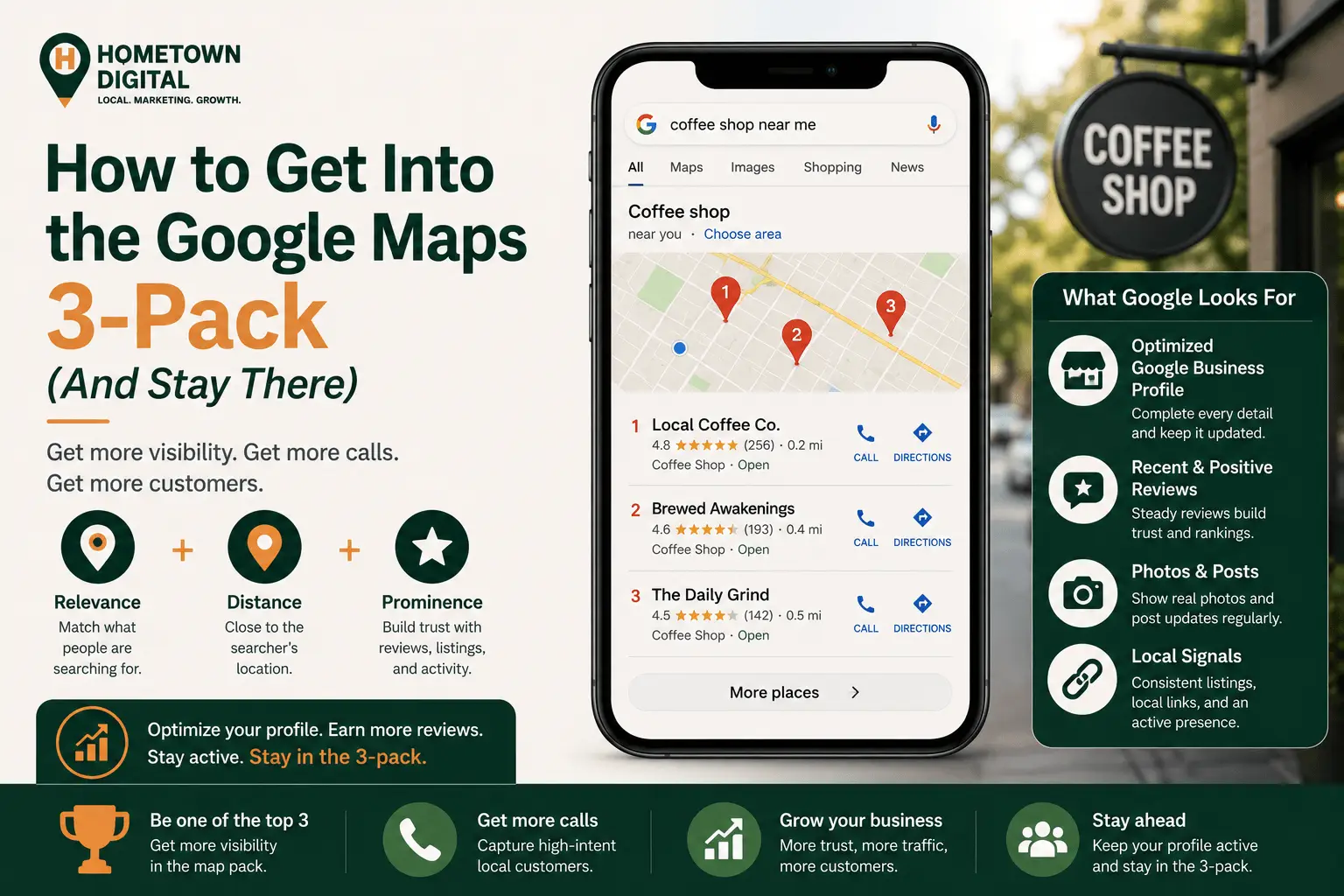
Search “coffee shop near me” from your phone right now. You’ll see a small map with three businesses under it, and almost everyone taps one of those three. That box is the Google Maps 3-pack, and for local searches it’s where the calls, the walk-ins, and the bookings come from.
Getting into the Google Maps 3-pack comes down to three things Google weighs: how relevant your business is to the search, how close you are to the person searching, and how established, or prominent, your business looks online. You can’t control distance. But you can control the two levers that decide most of it: a fully optimized Google Business Profile and a steady stream of recent reviews. Staying in the 3-pack is about keeping both active. Here’s how to do it.
What is the Google Maps 3-pack?
The Google Maps 3-pack is the block of three local business listings that appears at the top of Google’s results for a location-based search, right under a small map. It’s also called the local pack or the map pack. These are organic listings, not ads, pulled straight from Google Business Profiles. For most local searches, it’s the first thing people see and often the only thing they act on.
Is the 3-pack the same as ranking on Google?
Not quite, and the difference trips up a lot of owners. The 3-pack runs on a separate algorithm from Google’s regular organic results. You can sit at the top of the map pack for “plumber near me” and still be on page two of the standard blue-link results, or the other way around. They share some signals, like a fast, relevant website, but the pack leans heavily on your Google Business Profile, your reviews, and your proximity to the searcher. So ranking in the 3-pack is its own job, and for most local businesses it’s the more valuable one to win first, because it sits above the organic results and shows your phone number, rating, and directions right there.
Why is the Google Maps 3-pack worth fighting for?
The 3-pack is worth fighting for because it captures the bulk of attention on a local search, and there are only three spots. First Page Sage’s 2025 data puts the click-through rate at roughly 17.6% for the first pack listing, 15.4% for the second, and 15.1% for the third. Add those up, and the three visible spots pull close to half the clicks on the page.
Position four is a different story. It sits behind a “more places” tap that most people never make, so in practice the pack is a top-three-or-nothing game. That matters because 80% of US consumers search online for a local business every week (SOCi Consumer Behavior Index, 2024). The 3-pack is one piece of a bigger local search picture, which we cover in our complete guide to local SEO for small businesses. This post is about winning those three spots specifically.
The pack has also held its ground as AI features spread across search. For high-intent local searches, the kind where someone is ready to call, the map pack still sits right at the top, above the organic results and often above the AI summaries. When a homeowner needs a plumber tonight, that little map is still the first thing they reach for.
How does Google decide who gets into the 3-pack?
Google decides the 3-pack using three factors it names openly: relevance, distance, and prominence. Relevance is how well your profile matches the search. Distance is how close you are to the searcher. Prominence is how established and trusted your business looks online. Almost everything you can do to rank comes back to relevance and prominence, because distance is mostly out of your hands.
Where does the effort pay off most? According to Whitespark’s 2026 Local Search Ranking Factors survey of 47 local SEO experts, Google Business Profile signals make up roughly 32% of local pack ranking weight, the single largest category, and review signals another 20%, up from 16% in 2023. Those two, your profile and your reviews, are where nearly all of your controllable effort should go.
Here’s how those three official factors translate into action. You raise relevance by choosing the right primary category and describing your services clearly, so Google understands exactly what you do. You can’t change distance, but you can make sure your address and service area are set correctly so Google places you where you actually operate. And you build prominence over time through reviews, consistent listings across the web, local links, and an active profile. Relevance gets you eligible, prominence gets you ranked, and distance decides how far from your door that ranking holds.
How do you actually get into the 3-pack?
Getting into the 3-pack means strengthening the signals you control, in order of impact. Your primary category and a complete profile make you eligible. Reviews and consistent business information build your prominence. Local relevance on your website and a few quality local links reinforce it. Here’s the order that works.
- Set the most specific primary category. It’s the number-one individual ranking factor in Whitespark’s 2026 data, and it decides which searches you’re even eligible for. We break the whole process down in our guide to Google Business Profile optimization.
- Complete and verify every part of your profile. Name, address, phone, hours, services, description, and photos. A complete, verified profile is both more eligible to rank and more trusted by searchers.
- Build reviews consistently, and respond to them. Reviews are the second-heaviest ranking category, and recency counts more than raw total. A steady flow beats a big but stale pile.
- Keep your NAP consistent everywhere. Your name, address, and phone number should match exactly across your website, Google, and every directory. Inconsistent information confuses Google and erodes trust.
- Keep your hours accurate. Being open at the time of a search is a top-five ranking factor per Whitespark 2026, so wrong or missing hours can quietly cost you the spot.
- Strengthen your website for local relevance. Clear service pages, your city and service areas named naturally, and a fast, mobile-friendly site give Google more to match you on.
- Earn a few quality local links and mentions. A link from the local chamber of commerce, a supplier, or a community sponsorship does more than a pile of random directory listings.
Reviews deserve their own note, because they gate whether people even consider you. 97% of consumers read reviews before choosing a local business, and nearly half (47%) won’t use one with fewer than 20 reviews (BrightLocal Local Consumer Review Survey, 2026). What Google rewards is a steady, recent flow, never bought or incentivized reviews, which break Google’s rules and can get your profile penalized. We cover the full approach in our online reputation management guide.
Why does proximity matter so much, and what can you do about it?
Proximity is the heaviest single factor in the 3-pack, and it’s the one you can’t directly control. Google shows each searcher businesses near them, so the same search returns a different pack a few miles away. You can’t move your shop to the center of town. But you can widen the area where you show up by strengthening the signals you do control.
This matters most for service-area businesses like plumbers, electricians, and landscapers. Set an accurate service area, get reviews from customers across the different areas you serve, and build service or location content on your site so Google understands where you work. None of that beats proximity outright, but stronger relevance and prominence can pull you into packs a bit further from your front door. In a spread-out suburb, a strong profile might show you across several zip codes. In a dense downtown where competitors sit on every block, your radius shrinks and every review and signal counts more. The honest takeaway: you won’t win every pack across a whole metro, but you can win the ones near your actual customers.
How do you stay in the 3-pack once you’re in?
Staying in the 3-pack takes ongoing activity, because Google rewards businesses that look alive. Fresh reviews coming in, regular posts, new photos, quick responses, and accurate information all signal an active business. Whitespark’s 2026 data shows engagement signals like clicks, calls, and direction requests carry weight too. A profile you set up once and forget will slide as more active competitors pass you.
The upkeep is simpler than it sounds: ask every customer for a review, post a couple of times a month, add fresh photos, respond to reviews within a day or two, and keep an eye on what your top competitors are doing. And the same signals now feed AI search. 45% of consumers have used tools like ChatGPT, Gemini, or Perplexity to find a local business in the past year, up from just 6% the year before (BrightLocal, 2026), and the accurate, active profile that holds your 3-pack spot is exactly what helps those tools recommend you. We dig into that in our guide to getting recommended by ChatGPT and AI search.
What getting into the 3-pack looks like for a real local business
Take a landscaper who does sharp work but never cracks the 3-pack for “landscaping near me” in their town. When we look, the pattern is familiar. Their primary category is set to the generic “Landscaper” when most of their revenue is lawn maintenance and installs. Their profile is missing services and has three photos. They’ve got a dozen reviews, the newest from last spring. And their address and phone don’t match between their website and their older directory listings.
Fixing that isn’t a rebuild. A more specific category, a filled-out profile with real photos, cleaned-up business information, and a simple habit of asking every customer for a review moves the needle within weeks, not months. We’ve been in the trades ourselves, so we know a landscaper doesn’t have a spare afternoon for this. The good news is that it’s mostly consistency, not budget, which is the whole idea behind our guide to getting more customers without a big marketing budget.
Common Questions About the Google Maps 3-Pack
How long does it take to get into the 3-pack?
It depends on your market and where you’re starting. Fixing a wrong category or completing a thin profile can move you within days to a few weeks. Building enough reviews and consistency to hold a competitive spot usually takes a few months, and dense, competitive markets take longer.
Can I pay to be in the Google Maps 3-pack?
No. The 3-pack is organic, not paid. You may see a “Sponsored” listing near it, and ads can appear alongside the pack, but the three map results themselves are earned through relevance, distance, and prominence. You can’t buy a spot inside them.
Why do I show up in the 3-pack from home but not from across town?
That’s proximity at work. Google tailors the pack to each searcher’s location, so your listing can rank near your business and fade a few miles out. Strengthening your reviews, relevance, and profile widens the area where you appear, but distance always plays a role.
Do I need a website to rank in the 3-pack?
You can appear without one, but a website helps. It gives Google more relevance signals to match you on, supports your prominence, and gives searchers somewhere to learn more and convert. For competitive terms, businesses with strong local websites tend to hold their spots better.
How many reviews do I need to get into the 3-pack?
There’s no fixed number, and it varies by market. In many local categories, 15 to 20 recent reviews with a solid rating gets you competitive, while dense urban categories can need far more. Recency and a steady flow matter as much as the raw total.
I got into the 3-pack, then dropped out. Why?
Usually because the profile went quiet or a competitor got more active. Reviews slowed, hours went stale, or someone else started posting and gathering fresh reviews. The 3-pack rewards ongoing activity, so a spot you earn still needs regular upkeep to hold.
Does posting on my Google Business Profile help me rank in the 3-pack?
Posting doesn’t move your ranking directly, but it keeps your profile active, which supports the freshness and engagement signals Google looks at. Just as important, posts show searchers you’re open and working. A couple of posts a month, tied to real offers or recent jobs, is plenty for most local businesses.
Ready to claim your spot in the 3-pack?
Want to see why you’re in or out of the 3-pack right now? Run your listing through our free Google Business Profile checker for a quick read on what’s helping you and what’s holding you back. And if you want the full picture, grab a free website audit. We’ll look at your site, your Google presence, and tell you exactly what we’d fix first to get you more calls.