Ask a plumber where their best customers come from and you’ll almost always hear the same thing: somebody told them about us. Referral marketing for local businesses works. The problem is that most owners treat it like the weather. When referrals show up, great. When they don’t, they wait.
Here’s the short answer. A referral system is a simple, repeatable process where you ask your happiest customers at the right moment, make it easy for them to pass your name along, thank or reward them when it works, and track where every referred lead came from. Most local businesses already get referrals. Very few have a system that makes them happen on purpose.
Why do most local businesses leave referrals to chance?
Most local businesses leave referrals to chance because they already get some without trying. The work is good, a customer tells a neighbor, and the phone rings. So nobody builds a process around it, and the business never finds out how many more referrals a consistent ask would bring in.
That’s an expensive blind spot. Research from Nielsen’s 2021 global Trust in Advertising study found that 88% of respondents trust recommendations from people they know more than any other channel, paid ads included. And in the trades, referrals aren’t a side channel. They’re the main one. Roofing Contractor’s 2026 homeowner survey found that 74% of homeowners find roofers through word of mouth, well ahead of the 54% who turn to online search engines.
We’ve been in the trades ourselves, and we’ve worked with enough contractors and shop owners since then to know how this usually goes. Ask an owner how many referrals came in last quarter and you’ll get a shrug. Ask who sent them and you’ll get a guess. That’s not a knock on anybody (you’re busy running the actual business). But it does mean one of the cheapest ways to win new work is running with nobody steering. When we help owners think through growing without a big marketing budget, referrals are usually one of the first places we look.
What is a referral system, and how is it different from word of mouth?
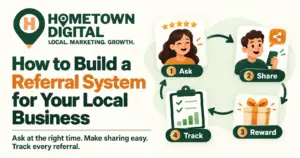
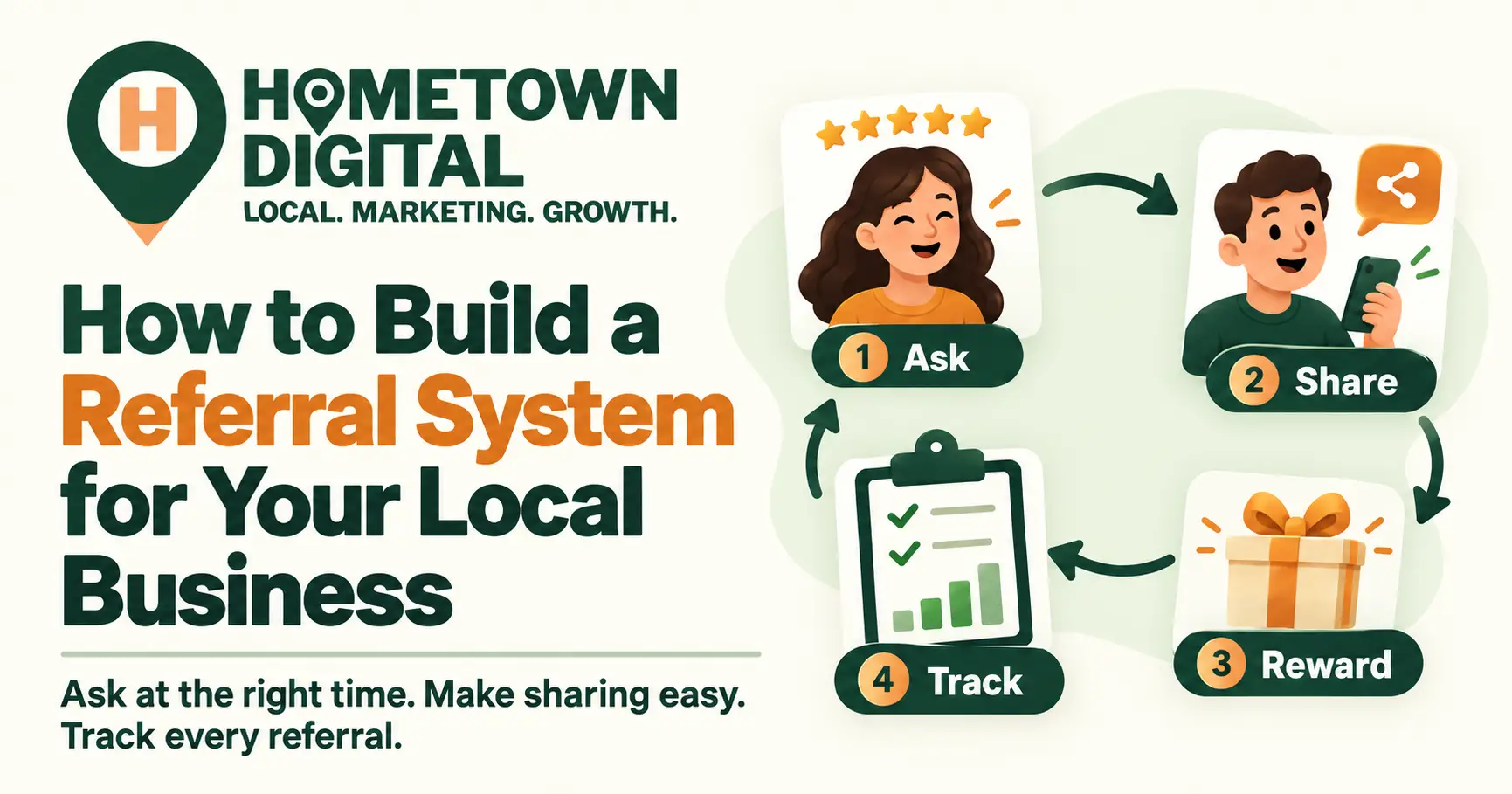
Word of mouth is what customers do on their own. A referral system is what your business does to make it happen more often. It’s a defined process with four parts: a planned ask, an easy way to share, a thank-you or reward, and a way to track which referrals turned into paying jobs.
The difference matters because word of mouth is passive. You can’t schedule it or measure it, and you definitely can’t grow it on purpose. A system turns it into something much closer to a real marketing channel, one you can check every month like your call volume. And it doesn’t need to be complicated. A short script, a text template, a spreadsheet, and a habit your team keeps will cover most local businesses.
Why are referred customers worth more than other leads?
Referred customers tend to be worth more because they arrive pre-sold and better matched to what you do. Someone they trust already vouched for you, so they’re less likely to shop on price alone and more likely to stick around. Academic research on referral programs backs this up with real numbers.
The most-cited study comes from researchers at Goethe University Frankfurt and the Wharton School, published in the Journal of Marketing in 2011. They tracked roughly 10,000 customers of a German bank for almost three years and found that referred customers were at least 16% more valuable than comparable customers who came in some other way. Referred customers brought in higher margins early on, and they stayed longer.
Sure, a bank isn’t a landscaping company. But the logic carries over locally. A homeowner whose neighbor raved about your crew isn’t lining up five quotes and picking the cheapest. And when they’re happy, they often refer someone too. One good referral is frequently the start of a chain.
How do you build a referral system for your local business?
You build a referral system in six steps: decide who to ask, pick the right moment, make sharing easy, choose a reward that fits your margins, track every referred lead, and close the loop with whoever sent it. None of these steps needs special software, and most take an afternoon to set up.
Step 1: Decide who to ask
Not every customer should get a referral ask. Start with the ones who are clearly happy: people who thanked you twice, left a 5-star review, booked a second time, or asked for an extra card to give a friend. The same Journal of Marketing study found the value gap varied across customer groups and recommended being selective about who you recruit. That lines up with common sense. Happy customers tend to send people like themselves.
Don’t stop at customers, either. An electrician and an HVAC company share customers constantly. So do a realtor and a roofer, or a salon and the boutique down the street. One or two reliable referral partners can send more work than a hundred customers who were never asked.
Step 2: Ask when the customer is happiest
Timing does most of the work. The best moment is right after the customer feels the result: the AC kicks on during the first heat wave, the new patio hosts its first cookout, the haircut gets compliments at work. For most service businesses, that means at job completion or within a day or two after.
We’d keep the review ask and the referral ask separate. Ask for the review first, while the job is fresh. Follow up a week or two later with the referral ask. Pack both into one message and you’ll usually get neither.
Step 3: Make it easy to pass your name along
If sharing takes effort, it won’t happen. Give people something they can forward in five seconds, like a short text with your business name, phone number, and website link, or a couple of referral cards left on the counter after the job. A simple script helps your team say it the same way every time:
“Glad the new water heater is working. Most of our work comes from neighbors telling neighbors, so if you know anyone who needs a plumber, we’d really appreciate you passing our number along.”
That’s it. No pressure and no pitch. If you already send follow-up messages after a job, a referral line fits naturally into the automated sequences we cover in our guide to email marketing for local businesses.
Step 4: Choose a reward that fits your margins
A reward isn’t required, since plenty of customers refer you simply because they like you. But a small, clear reward gives people a reason to act this week instead of someday. The right choice depends on your average job size and your margins. Here’s how the common options compare:
| Reward type | Best for | Watch out for |
|---|---|---|
| Account credit or service discount | Recurring services like lawn care, cleaning, salons, and barbershops | Only pays off if the referrer keeps coming back |
| Cash or gift card | High-ticket jobs like roofing, HVAC installs, and remodels | Can feel transactional; regulated professions may restrict it |
| Two-sided reward (both people get something) | Most local businesses, since the new customer has a reason to call now | Costs twice as much per referral, so set a cap |
| Donation to a local cause | Community-rooted shops, restaurants, and family businesses | Motivates some customers less than a personal reward |
| Personal thank-you (handwritten note, priority scheduling) | Everyone, on top of any other reward | Easy to forget without a set routine |
A simple rule of thumb: size the reward against what a new customer is worth to you over time, not against a single invoice. If a referred customer brings in thousands in profit over a few years, a modest thank-you is cheap. Compare that to paying a lead-gen app for a lead it also sold to three of your competitors.
Step 5: Track every referred lead
If you don’t track referrals, you can’t tell whether the system is working. At minimum, ask every new customer how they heard about you and write the answer down, whether that lives on your contact form, in your booking software, or in a spreadsheet column. Record the referrer’s name too, so you know who to thank.
Once a month, look at how many referred leads came in, how many turned into jobs, and who sent them. That last one shows you who your real advocates are. Treat those people well.
Step 6: Close the loop with the referrer
This is the step almost everyone skips. When someone sends you a customer, thank them within a day or two, whether the job closes or not. A quick text works. A handwritten note works better. If there’s a reward, deliver it fast. People keep recommending businesses that make them look good to their friends.
What happens after someone gets referred to you?
Almost every referred customer looks you up before they call. They’ll check your Google Business Profile, scan your reviews, and click through to your website. If what they find is thin, outdated, or hard to use on a phone, a warm referral can go cold in about thirty seconds.
A friend’s recommendation opens the door, but it rarely closes the sale by itself anymore. BrightLocal’s 2026 Local Consumer Review Survey found that 97% of consumers read reviews for local businesses and 47% won’t use a business with fewer than 20 reviews. The same survey found that after reading positive reviews, 54% of consumers go on to check the business’s website.
So picture the handoff. Your customer tells a coworker about you. The coworker searches your name and finds 11 reviews, the newest one from last spring, plus a site that won’t load properly on their phone. Maybe they still call. Or maybe they call the company down the road with 140 reviews and a clean, fast site.
That’s why a referral system works best alongside two other basics: a steady flow of new customer reviews and a website that actually turns visitors into calls. The referral gets you considered. Your online presence gets you chosen.
Is it legal to reward customers for referrals?
In most local industries, rewarding customers for referrals is legal. Problems start when referral rewards get tangled up with reviews, when a rewarded customer promotes you publicly without saying so, or when you work in a licensed profession with its own rules on referral fees. Here’s where to be careful.
Keep referral rewards and reviews completely separate. Google’s review policies prohibit offering incentives in exchange for reviews, and the FTC’s 2024 rule on consumer reviews bans offering incentives for positive ones. Thanking someone for sending you a customer is fine. Paying them for a 5-star review is a different thing entirely.
If a customer posts about you on social media while earning a referral reward, the FTC’s Endorsement Guides say that connection should be disclosed in the post. “I get a discount if you book through me” does the job. And in real estate, insurance, healthcare, legal, or financial services, check with your licensing board before offering anything of value for referrals, because several of those fields restrict it. We’re a marketing agency, not a law firm, so treat this as a heads-up rather than legal advice.
What does a referral system look like in practice?
In practice, a referral system for a small service business is a handful of habits built into the way jobs already wrap up. Here’s what that looks like for a two-truck lawn care company from start to finish, with no special software and no big budget.
When a crew finishes a first-time cleanup, the lead tech mentions that most of the company’s customers come from neighbors. That evening, an automated text thanks the homeowner and includes a link to leave a Google review. Two weeks later, a second text goes out: refer a neighbor and you both get a credit toward your next month of service.
Every new lead gets asked how they heard about the company, and the answer goes into a spreadsheet next to the referrer’s name. On the first Monday of each month, the owner spends fifteen minutes with it. Who sent someone? Did the job close? Has the thank-you note gone out?
After a full season, that owner knows which streets produce the most referrals, which customers are the real advocates, and roughly what each referred customer is worth. That’s a marketing channel, and it sits right at the end of the local business marketing funnel, where happy customers bring in the next ones. It’s also the kind of setup we help owners build at Hometown Digital, usually alongside review generation and email follow-up, since those three pieces feed each other.
Common Questions About Referral Marketing for Local Businesses
How much should I offer as a referral reward?
Base it on what a new customer is worth to you over time, not on what one job pays. Recurring services usually do fine with a modest service credit, while high-ticket work like roofing or HVAC installs can support a larger thank-you. Start small and adjust once your tracking shows how many referrals actually close.
Should I ask for a review and a referral at the same time?
Usually not. Ask for the review first, right after the job, then follow up with the referral ask a week or two later. And never attach a reward to the review itself, since Google’s policies and the FTC both prohibit incentivized positive reviews.
How do I ask for referrals without sounding pushy?
Frame the ask around helping their friends, not hitting your sales goals. A line like “if you know anyone who needs this, we’d appreciate you passing our name along” is plenty. Mention it once, make sharing easy, and let it go.
Do I need referral software to run a referral program?
No. A spreadsheet and a consistent habit will carry most local businesses a long way. Software starts to make sense once referral volume grows or tracking gets messy, and many booking tools and CRMs already include a lead source field you can use.
How long does it take for a referral system to start working?
Because you’re asking customers who are already happy, the first referrals can show up quickly. The bigger payoff builds over a few months, as your team makes the ask a habit and your tracking shows who your best advocates are.
Ready to Get More Customers From the Ones You Already Have?
Your next referred customer is going to look you up before they pick up the phone. If you want a full picture of where your marketing stands, start with a free website audit. It’s the fastest way to find out what’s working and what’s quietly costing you customers.