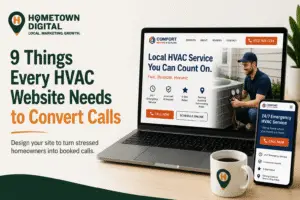
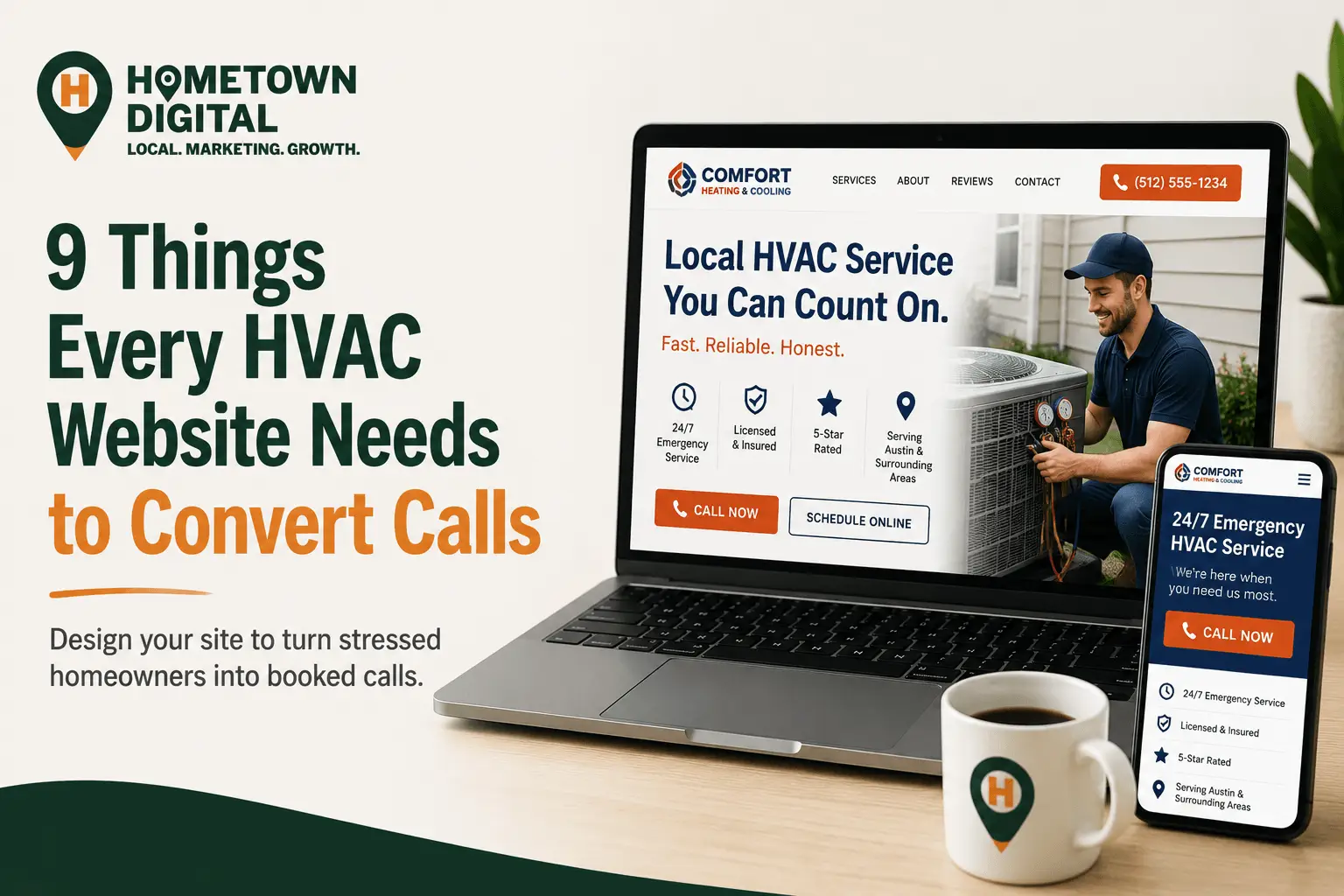
An HVAC homeowner with no cold air on the first 95 degree day of summer isn’t browsing. They’re stressed, phone in hand, ready to call the first company that looks like it can handle the job today. An HVAC website earns that call when it does nine things well: it puts a tap-to-call number up top, loads fast on a phone, says plainly what you do and where, proves you’re licensed and trusted, shows real reviews, lists your services, makes emergency help obvious, and gives more than one easy way to book. Miss those, and that homeowner dials the next company on the list.
We’ve built and audited enough contractor sites to know the pattern cold. Good design doesn’t lose the call. A buried phone number, a slow mobile page, and a wall of vague copy do.
Why do most HVAC websites lose the call?
Most HVAC websites lose the call because they’re built to look good, not to convert a stressed homeowner in under a minute. The phone number is stuck in the footer, the page crawls on a phone, and nothing on the screen answers the two questions every caller has: can you fix my problem, and can I trust you inside my house? The problem usually isn’t the design. It’s conversion.
Here’s the part most contractors miss. Your competition isn’t the phone book anymore. According to Scorpion’s 2026 State of Home Services Marketing Report, a survey of 2,000 homeowners, 83% of homeowners start their search for a service provider online. That search almost always ends in the Google Map Pack, where three local companies sit side by side. Getting into that pack is its own job, and we break it down in our guide to getting into the Google Maps 3-pack. But once a homeowner clicks through to your site, the site has seconds to do the rest. The same fundamentals apply to any local business, which we cover in our small business website design guide. HVAC just has its own pressures: urgent breakdowns, seasonal spikes, and a homeowner who wants a licensed pro fast. Think of this as the website half of the broader home service marketing playbook.
The 9 things every HVAC website needs to convert calls
Every HVAC website that reliably turns visitors into booked calls shares the same nine elements: a visible click-to-call number, fast mobile load speed, a clear headline with your service area, trust signals like licensing and certifications, displayed reviews, a plain list of services, obvious emergency availability, mobile-first design, and more than one easy way to book. Here’s each one, why it matters, and what it looks like when it’s done right.
- A click-to-call phone number at the top of every page
- A page that loads fast on a phone
- A headline that says what you do and where
- Proof that you’re licensed, insured, and certified
- Real reviews and your star rating, on the page
- A design built for mobile first
- A clear, specific list of your services
- Obvious emergency and after-hours availability
- More than one easy way to book
1. A click-to-call phone number at the top of every page
The single most important element on an HVAC website is a tap-to-call phone number pinned to the top of every page, ideally sticky so it follows the visitor as they scroll. Most of your traffic is on a phone, and for HVAC, most of your best leads want to talk to a person. In a 2025 FIELDBOSS survey of 1,000 homeowners, 50% said they prefer phone calls from their HVAC provider, compared with 24% who prefer text and 12% who prefer online booking.
So don’t make a panicked homeowner dig. Put the number in the header in large, tappable text. Make it a real click-to-call link, not an image or plain text they have to copy out. And use the same number everywhere, so your call tracking and your Google Business Profile stay consistent.
2. A page that loads fast on a phone
A fast mobile page is a conversion feature, not a technical nicety. Google’s research found that 53% of mobile visitors abandon a site that takes longer than three seconds to load, and older Akamai data pegged the cost of delay at roughly a 7% drop in conversions for every additional second. For an HVAC company competing on an emergency search, a slow homepage hands the call to a faster competitor before your site even finishes rendering.
Big, uncompressed hero images and bloated page builders are the usual culprits. Test your site on a phone, on cellular data, not just your office wifi. If it stalls, that’s revenue leaking out the bottom.
3. A headline that says what you do and where
The headline at the top of your homepage should answer, in one glance, what you do and the area you serve. “Heating and Cooling Repair and Installation in [City]” beats a vague slogan like “Comfort You Can Count On” every time. Homeowners scanning three tabs at once need instant confirmation they landed in the right place, and search engines and AI assistants use that same clarity to decide whether to recommend you.
This matters more now that homeowners use AI to shortlist contractors. Scorpion’s 2026 report found 22% of homeowners already use tools like ChatGPT to research or find providers. Clear, specific copy is exactly what those tools quote back.
4. Proof that you’re licensed, insured, and certified
HVAC is a trust purchase. Before a homeowner lets a stranger into their house and near their furnace, they want proof you’re legitimate. So put it where they can see it: your state license number, proof of insurance, and certifications like NATE or EPA 608. Manufacturer badges from Carrier, Trane, or Lennox and a solid BBB rating help too.
We’ve been on the tools ourselves, and we know these credentials feel routine to a contractor. To a homeowner comparing three companies, they’re often the tiebreaker. Don’t bury them on an About page nobody visits.
5. Real reviews and your star rating, on the page
Your reviews belong on your website, not just on Google. Reviews are the strongest trust signal you have, and homeowners check them before they ever call. BrightLocal’s 2025 Local Consumer Review Survey found that 91% of consumers read online reviews for local businesses. Scorpion’s 2026 report is blunter still: 87% of homeowners won’t hire a company rated below four stars.
Pull your live Google rating onto the page and feature a few specific, recent reviews (bonus points if they name the exact service and the town). A star rating sitting right next to your call button turns hesitation into a phone call.
6. A design built for mobile first
Your HVAC website should be designed for the phone first and the desktop second, because that’s where your customers are. Statista reports that mobile devices account for roughly 60% of all web traffic, and for urgent home-service searches the share runs higher. A site that looks fine on your office monitor but forces pinching, zooming, and sideways scrolling on a phone is quietly costing you calls.
Buttons should be thumb-sized, text readable without zooming, and forms short. Not sure how yours holds up? Here’s how to tell if your website actually works on mobile. Test it the way a customer would: one hand, small screen, in a hurry.
7. A clear, specific list of your services
Spell out exactly what you do. A clear service list, covering AC repair, furnace and heating repair, new system installation, maintenance plans, and indoor air quality, does two jobs at once. It lets a homeowner confirm you handle their specific problem, and it gives search engines and AI tools the detail they need to match you to the right search.
Vague helps nobody. “Residential and commercial HVAC” tells a homeowner with a dead condenser almost nothing. A short line under each service, with the city name worked in where it fits naturally, does far more for both conversion and local search.
8. Obvious emergency and after-hours availability
If you take emergency calls, say so loudly, and make it easy to reach you after hours. HVAC breakdowns do not keep business hours, and homeowners expect a way to get help fast. Scorpion’s 2026 report found 56% of homeowners want 24/7 scheduling or a way to communicate after hours, while two-thirds of businesses admit after-hours service is one of their biggest challenges. That gap is your opening.
A simple “24/7 Emergency Service” banner with a tap-to-call button, near the top of the page, can be the difference between catching the 9 p.m. no-heat call and losing it. And if you do not offer after-hours service, just state your hours clearly so nobody is left guessing.
9. More than one easy way to book
Give homeowners more than one way to reach you, because not everyone wants to call. A phone number wins most HVAC leads, but a request-service form, online scheduling, and even a text option catch the ones who would rather not dial. That same FIELDBOSS survey found about a quarter of homeowners prefer text and roughly one in eight prefer online booking, so a call-only site leaves money on the table.
Keep every path short. A booking form that asks for name, phone, ZIP, and the problem will always beat a ten-field monster. And if you offer financing on new systems, say so near your installation services, since a replacement is a big planned purchase where financing often decides the winner.
What this looks like for a real HVAC contractor
Picture a homeowner in your service area at 8 p.m. in July. Their AC just quit, the house is 84 degrees, and they type “AC repair near me” into their phone. They tap the first result, land on a competitor’s site, and it loads slowly, buries the number, and leads with a stock photo of a smiling technician. They end up bouncing and tap your listing next. Your page loads in two seconds, a big “Call Now, 24/7 Emergency Service” button sits right at the top, your 4.9 star rating shows just below it, and “Licensed and Insured AC Repair in [City]” confirms they are in the right place. They call you.
Nothing in that scenario is luck. It is nine deliberate choices, and it is the kind of setup we build for HVAC companies every day. Most of these fixes do not require a full rebuild, either. They are changes to layout, copy, and speed on the site you already have.
Common questions about HVAC website design
How much should an HVAC company spend on a website?
A professional HVAC website usually runs anywhere from a few hundred dollars up front with a low monthly fee to a few thousand for a custom build, depending on scope. What matters more than the price tag is whether the site is built to convert calls. A cheap site that loads fast, shows your number, and proves you are licensed will out-earn an expensive one that looks pretty and does nothing.
What’s the most important thing on an HVAC website?
A visible, tap-to-call phone number at the top of every page. Most HVAC traffic is on mobile, and most high-value HVAC leads want to talk to a person, so the easier you make calling, the more calls you get. Every other element on this list exists to support that one action.
Do HVAC websites really need to work on mobile?
Yes, and it is not optional. Roughly 60% of web traffic is on mobile, per Statista, and the share is higher for urgent searches like a failed AC unit. A site that is hard to use on a phone loses calls to competitors whose sites are not.
How do reviews affect whether my HVAC website gets calls?
Heavily. Homeowners read reviews before they call, and most will not consider a business under four stars. Scorpion’s 2026 report found 87% of homeowners won’t hire a company rated below four stars. Putting your live rating and a few recent reviews on the page turns that research step into a reason to call you instead of the next company.
Can I fix my current HVAC website, or do I need a new one?
Often you can fix it. Many of the nine elements here, like adding a sticky call button, speeding up load time, clarifying your headline, and surfacing reviews, are changes to your existing site rather than a full rebuild. A quick audit will tell you which fixes will actually move the needle and which are just cosmetic.
Ready to see what your HVAC site is costing you?
Your website has one job when a homeowner’s system fails: make it dead simple to call you. If you are not sure how yours stacks up against the nine things above, get a free website audit from us. We will look at your site specifically, tell you what is converting and what is not, and show you what we would fix first. No pressure, and no jargon.