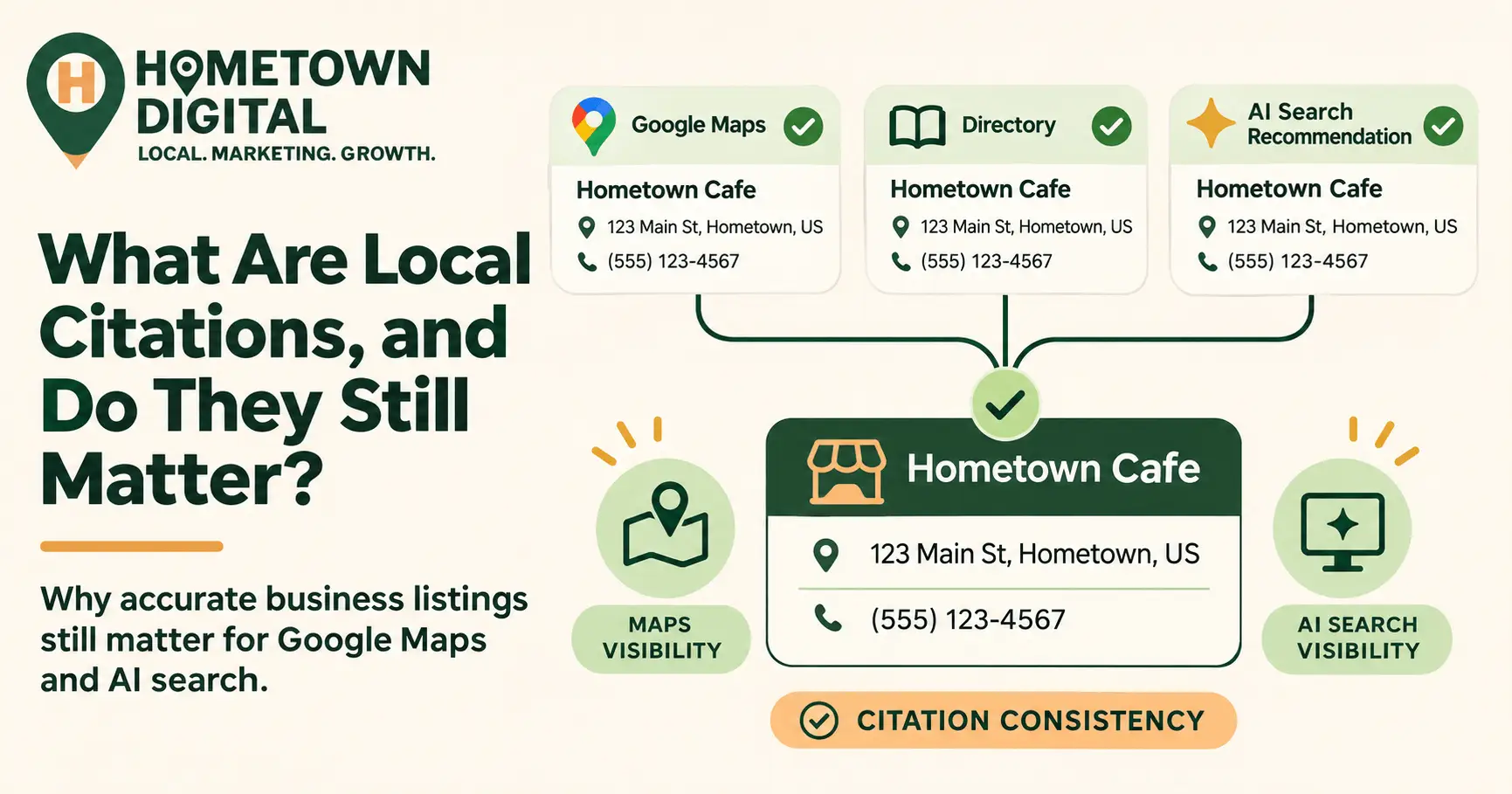
If an agency has ever tried to sell you a package of “200 directory listings” for a few hundred bucks, you’ve already met local citations. Here’s the straight answer. A local citation is any place online that lists your business name, address, and phone number. Yes, local citations still matter in 2026, though not the way they used to. They carry less weight in Google Maps rankings than they did ten years ago. But they’ve become one of the bigger factors in whether AI search tools like ChatGPT and Google’s AI Mode recommend your business at all.
Why does everyone disagree about local citations?
Ask three SEO people about citations and you’ll get three answers. One will tell you they’re dead. Another swears you need hundreds of them. The third, usually, is trying to sell you a listings subscription. The confusion is fair, because the role of citations really has changed over the last decade. Citations are one piece of local SEO for small businesses, and they’re probably the most misunderstood piece.
Here’s what we see when Hometown Digital audits a local business, especially in the trades. The problem is almost never too few citations. It’s messy ones. An address from two moves ago on Yelp. A call-tracking number from a marketing company you fired years ago, still sitting on Yellow Pages. A Bing listing nobody has touched since it was auto-created. That mess costs you more than a missing directory ever will.
What is a local citation?
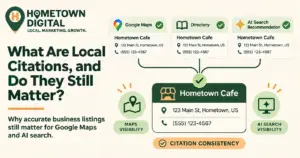
A local citation is any online mention of your business’s name, address, and phone number, often shortened to NAP. Citations show up on directories like Yelp and Angi, map apps like Apple Maps and Bing Places, industry sites, chamber of commerce pages, and local news articles. Search engines and AI tools use them to confirm your business is real and located where you say it is.
Local SEO people split citations into two buckets.
Structured citations
These are formal business listings on platforms built to publish that information: Yelp, Bing Places, Apple Business Connect, the BBB, Angi, Houzz, and industry directories like Avvo for attorneys or Zocdoc for dentists. Each one has fields for your name, address, phone, hours, categories, and a description.
Unstructured citations
These are mentions of your business anywhere that isn’t a directory. A local news story about your crew helping out after a storm. A blog post ranking the best taco spots in town. A supplier’s “where to buy” page. A sponsor listing on the Little League website. They’re harder to earn, and right now they’re worth more than they’ve been in years.
| Citation type | Examples | What it does for you |
|---|---|---|
| Core map platforms | Google Business Profile, Apple Business Connect, Bing Places | Feeds map apps, phones, cars, and voice assistants directly |
| Major directories | Yelp, Facebook, BBB, Yellow Pages, Nextdoor | Trust checks for customers; frequently pulled into AI answers |
| Industry directories | Angi, Houzz, Zocdoc, Avvo, OpenTable, TripAdvisor | Proves you are a real player in your trade or category |
| Local sources | Chamber of commerce, city business directories, local news | Ties your business to your actual service area |
| Unstructured mentions | “Best of” lists, blog posts, sponsorship and event pages | Carries heavy weight in AI search recommendations |
(Quick aside: some local SEOs don’t count your Google Business Profile as a citation, since it’s Google’s own data. Honestly, it doesn’t matter much what you call it. It has to be accurate either way, and our Google Business Profile optimization guide covers that side step by step.)
Do local citations still help you rank on Google Maps?
Yes, but they’re a supporting signal, not a lever that pushes you to the top. In Whitespark’s 2026 Local Search Ranking Factors survey of 47 local SEO experts, citation signals carried roughly 6% of the weight for Google’s local pack. That puts them well behind Google Business Profile signals, reviews, and on-page factors.
Citations have been sliding down that list for years. Whitespark noted they slipped about another half point in the 2026 edition, continuing a long decline. So if someone promises that 300 new listings will put you in the Map Pack, be skeptical.
But look at which citation factors still made the cut. Out of 187 factors in the same survey, consistency of your citations on Google Maps, Bing Maps, and Apple Maps ranked 28th for local pack impact. Having the name, address, and phone on your website match your Google Business Profile ranked 15th. And on the negative side, mismatched NAP or stray tracking phone numbers across the web ranked as the 24th most damaging factor.
Here’s how we explain it to owners. Volume doesn’t move rankings much anymore. Consistency protects them. If Google finds three phone numbers and two addresses for your business, it gets less confident about who you are and where you are, and that confidence is part of what gets you into the Google Maps 3-pack.
One honest caveat. Nobody outside Google knows the exact formula, and these are expert estimates. They do match what we see in real audits, though.
Why do local citations matter more for AI search than for Google Maps?
AI tools like ChatGPT, Gemini, and Google’s AI Mode don’t rank a map pack. They build recommendations from what other websites say about you. That makes third-party listings and mentions far more important for AI visibility. Whitespark’s 2026 survey found that three of the top five AI search visibility factors are citation-related.
Those three factors, in Whitespark’s ranking:
- #1: Being included on expert-curated “best of” lists, like Yelp’s best-of pages or local magazine roundups
- #3: Prominence on key industry-relevant sites, like Houzz for remodelers or Zocdoc for dentists
- #4: The quality and authority of unstructured citations, such as newspaper articles, blog posts, government sites, and industry associations
As a group, citation signals carried roughly 13% of the AI visibility weight in that same survey, about double their weight for the local pack. Whitespark’s founder summed up the shift by saying that in AI SEO, mentions are the new links.
The data from the AI side backs this up. Yext analyzed 6.8 million citations inside AI-generated answers across ChatGPT, Gemini, and Perplexity in 2025 and found that business listings made up 42% of the sources those tools cited, with brand websites making up another 44%. Between the two, that’s most of what AI reads about a local business. And you control both.
So when someone asks ChatGPT for “a reliable emergency plumber near me,” the answer gets assembled from listings, websites, and the places that mention local plumbers. If your sources are thin or contradict each other, you’re easy to skip. We break down the rest of the picture in our guide to getting your local business recommended by ChatGPT and AI search.
What happens when your business information is wrong across the web?
Wrong information costs you customers before it ever costs you rankings. BrightLocal’s 2023 Local Business Discovery and Trust Report found that 62% of consumers would avoid using a business if they found incorrect information about it online. A wrong phone number or old address doesn’t just confuse Google. It sends a ready-to-buy customer to a dead end.
And it’s common. In BrightLocal’s earlier Business Listings Trust Report from 2021, 85% of consumers said they’d run into incorrect or incomplete information on a business listing in the previous year, and 77% had seen conflicting details for the same business on different directories.
Think about who that hits hardest. A homeowner with water on the kitchen floor isn’t going to troubleshoot your Yelp listing. They’ll call the next plumber on the list. We’ve been in the trades ourselves, and we know one missed emergency call can be the biggest ticket of the week.
Which local citations actually matter for a small business?
A small business doesn’t need hundreds of listings. It needs accurate, complete profiles on the platforms customers and AI tools actually use, plus a handful of industry and local sources. In our experience, most local businesses are well covered with a few dozen solid citations, as long as every one of them is right.
Here’s the order we work in:
- The big map platforms. Google Business Profile, Apple Business Connect, and Bing Places. These feed iPhones, car dashboards, voice assistants, and a lot of AI tools.
- The data aggregators. Data Axle, Foursquare, and Localeze push business data out to hundreds of smaller sites. Fix your info here and the corrections spread over time.
- The major directories. Yelp, Facebook, the BBB, Yellow Pages, and Nextdoor.
- Your industry’s directories. Angi, Houzz, and Thumbtack for contractors. Zocdoc and Healthgrades for medical practices. OpenTable and TripAdvisor for restaurants. Avvo for attorneys.
- Local sources. Your chamber of commerce, city or county business directories, local news, and sponsorship pages.
(A free profile on Angi is not the same thing as paying for their shared leads, by the way. You can keep the listing without buying a single lead.)
A quick way to find the ones that matter for your trade: search your business name, then search your main service plus your city, and note which directories show up on the first few pages. Then ask ChatGPT and Gemini which sites they’d check to find a business like yours. If a site shows up in both places, you want to be on it.
How do you clean up and build local citations without wasting money?
Start by fixing what’s already out there, then fill the gaps. Cleaning up wrong or duplicate listings usually does more for a local business than building new ones. Pick one exact version of your business name, address, and phone number, and make every listing match it word for word.
- Lock your NAP. Write down the exact business name, address format, and phone number you’ll use everywhere. Suite numbers and abbreviations included.
- Find your existing citations. Search your business name, every old address, and every phone number you’ve ever used, including old tracking numbers. Tools like BrightLocal, Whitespark’s Local Citation Finder, or Moz Local speed this up.
- Fix or remove the bad ones. Claim each listing, correct it, and merge or close duplicates. Start with Google, Apple, Bing, and the aggregators.
- Fill out every field. Hours, categories, services, photos, your website link, and a plain description of who you are, what you do, and where you work. AI tools read those descriptions.
- Add the industry and local sources you’re missing. Use the priority list above.
- Recheck whenever something changes. New phone number, new hours, a move. Update everything that same week.
One warning. Watch out for listing subscriptions that hold your data hostage. Some services only keep your listings corrected while you’re paying, and the old information creeps back after you cancel. Ask that question before you sign anything. We run into citation problems like this on almost every audit, and they made our list of local SEO mistakes that quietly cost you customers.
What does this look like for a real local business?
Picture an HVAC company that’s been around for 12 years. They moved shops a few years back and switched phone systems after that. Somewhere along the way, a previous marketing company put call-tracking numbers on a few directories. Their Google Business Profile is correct. Everything else is a coin flip.
Now a homeowner searches “AC repair near me” on an iPhone during the first heat wave. Apple Maps shows the old shop address. Yelp shows a tracking number that doesn’t forward anymore. And when the homeowner’s neighbor asks ChatGPT for a reliable HVAC company in town, it finds conflicting details and recommends the competitor whose information lines up everywhere.
The fix isn’t glamorous. Claim Apple Business Connect and Bing Places, update the aggregators, correct the top dozen directories, kill the dead tracking numbers, and rewrite every description to say the same clear thing. That’s a few weeks of cleanup up front, then a quick check whenever something changes. This is the kind of local SEO work Hometown Digital does for contractors, restaurants, and other local businesses. It isn’t flashy. It just stops the leaks.
Common Questions About Local Citations
How many local citations does a small business need?
There’s no magic number. Accurate, complete listings on the major map platforms, the data aggregators, the big directories, and your industry’s top sites matter far more than raw volume. For most local businesses, that means a few dozen quality citations, not hundreds.
Are local citations still a Google ranking factor in 2026?
Yes, but a minor one. Whitespark’s 2026 Local Search Ranking Factors survey put citation signals at roughly 6% of local pack ranking weight. Consistency matters more than quantity, and mismatched information can actively hurt you.
Do I need to pay for a citation building service?
Not necessarily. An owner can claim and fix the major listings by hand over a few weekends. Paid tools save time, especially for finding duplicates, but avoid any service that only keeps your listings accurate while you’re subscribed.
What is NAP consistency?
NAP stands for name, address, and phone number. NAP consistency means those three details match exactly across your website, your Google Business Profile, and every directory. Inconsistent NAP makes it harder for Google and AI tools to trust which information is correct.
Should I use a call-tracking number on my directory listings?
Be careful with it. A tracking number that doesn’t match your main number creates a NAP mismatch, and old tracking numbers left behind after you cancel a service can send callers nowhere. If you use tracking, keep your main number listed as primary wherever the platform allows, and clean up tracking numbers when you stop using them.
Do local citations help me show up in ChatGPT and AI search?
Yes, and more than they help in Google Maps. Whitespark’s 2026 survey found three of the top five AI visibility factors are citation-related, and a 2025 Yext study found business listings made up 42% of the sources ChatGPT, Gemini, and Perplexity cited. Accurate listings and mentions on trusted sites give AI tools something reliable to recommend.
Ready to Find Out Where You Stand?
Want to see where you actually stand in local search? Grab a free website audit. We’ll review your Google presence, check how your business shows up across the web, and tell you exactly what’s keeping you off the first page.