When a local business starts leaking customers to Google, the owner almost never notices. Nothing beeps. No warning pops up. The phone just rings a little less than it used to, and the shop across town picks up the calls that should have been yours. That is the trouble with these mistakes. They stay silent.
After enough audits, you start seeing the same short list of problems on repeat. Not one of them is hard to sort out. Most are an afternoon of work. Leave them sitting, though, and they quietly bleed off revenue month after month.
What are the most common local SEO mistakes small businesses make?
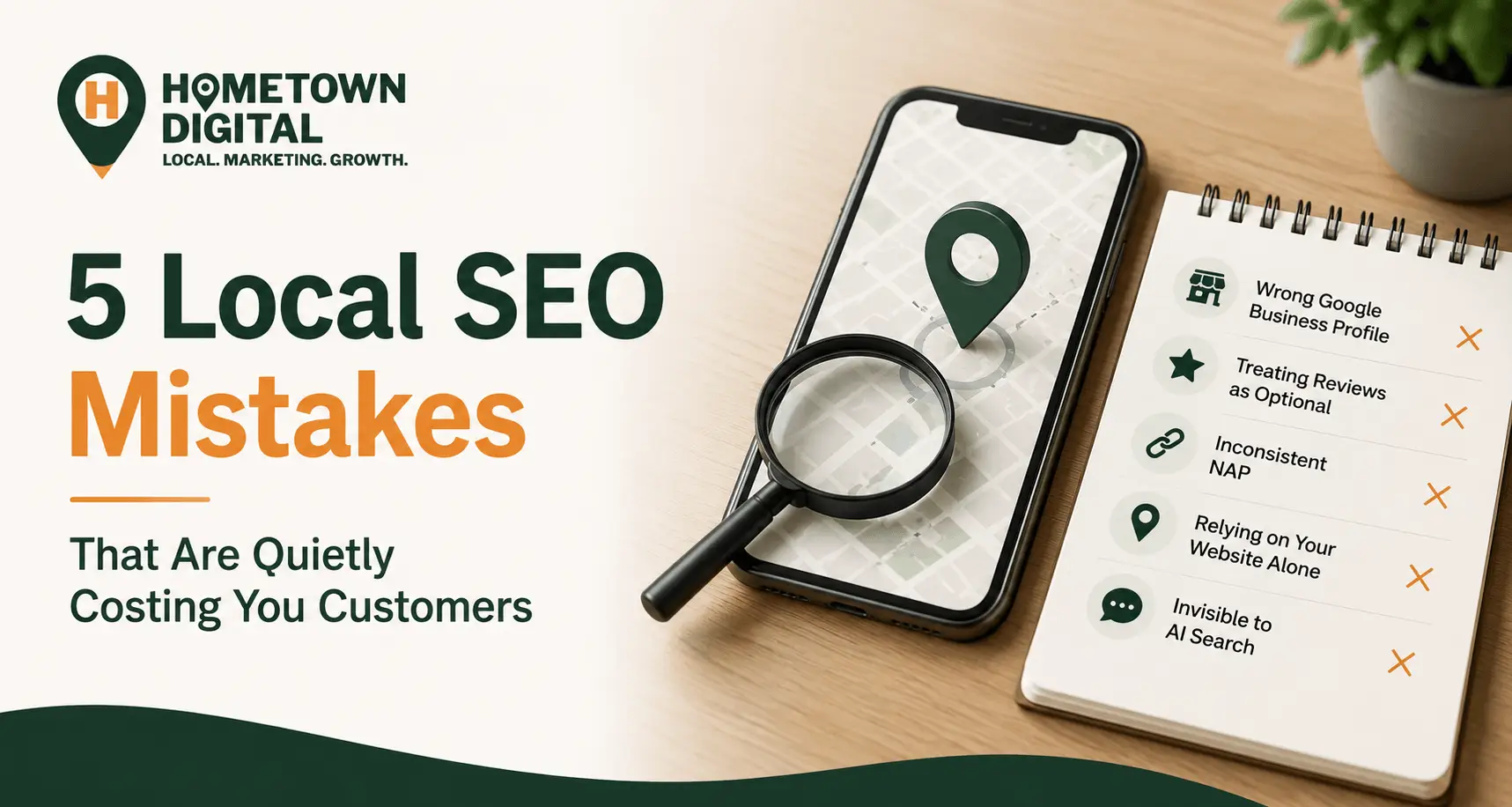
The five that come up most: picking the wrong Google Business Profile category, treating reviews as optional, letting your business name, address, and phone number drift out of sync across the web, ignoring the Google Maps 3-pack, and staying invisible to AI search tools like ChatGPT. Every one of them costs you customers without making a sound, and every one can be fixed.
Here is the part that might sting. You do not need a bigger budget or a rebuilt website to fix any of this. You need to know where to look. Before we get into each one, here is the quick version.
| The mistake | Why it costs you customers | First fix |
|---|---|---|
| Wrong or half-finished Google Business Profile | Your primary category is the No. 1 local ranking factor, and 8 of the top 10 map factors live on your profile | Correct your primary category and complete every field |
| Treating reviews as optional | 97% of consumers read reviews and 31% will not use a business under 4.5 stars | Ask every happy customer, right after good work |
| Inconsistent name, address, phone | Mismatched details create doubt that holds your rankings back | Standardize your NAP and fix every major listing |
| Relying on your website alone | The map 3-pack is driven by your profile, reviews, and proximity, not your site | Build and maintain your Google Business Profile |
| Invisible to AI search | AI jumped to 45% of local discovery in one year | Structure your presence to be found by ChatGPT and AI |
Mistake #1: Getting your Google Business Profile category wrong
Of every local ranking signal, your primary Google Business Profile category matters most. Whitespark’s 2026 Local Search Ranking Factors report, built from 47 local search experts weighing 187 separate factors, puts the primary category at number one for showing up in the Google Maps results. Choose it wrong and you disappear from the searches that pay the bills.
Picture it. An emergency plumber files under “Plumber” when “Emergency Plumbing Service” was sitting right there. A med spa chooses “Spa” instead of “Medical Spa.” That primary category is how Google decides which searches you can even appear in. Choose the loose version and you have shut yourself out of the exact results your best customers are typing.
The primary category is only the start. In the same 2026 data, additional GBP categories land at number eight and overall profile completeness at number sixteen among local pack factors. Eight of the top ten ranking factors for the map results come from your Google Business Profile rather than your website. So a profile with no photos, blank hours, an empty services section, and a single category is throwing away most of its ranking power.
The fix: sign in and hold your primary category up against the words customers actually type. Add every secondary category that applies, then work through the rest of the profile, services, hours, attributes, photos, all of it. Want the full walkthrough? We laid the whole process out in our guide to Google Business Profile optimization. Curious how yours looks today? Our free Google Business Profile checker flags what is missing in about two minutes.
Mistake #2: Treating reviews as a “nice to have”
Reviews are not decoration. They pull double duty, moving your rankings and closing the sale. Whitespark’s 2026 report has review signals at roughly 20% of what sets your position in the local map results, beaten only by the Google Business Profile itself. Skip them and you give up ground twice over.
The buyer side is sharper still. BrightLocal’s Local Consumer Review Survey 2026 found 97% of consumers read reviews before picking a local business, and 31% now say they will not touch one rated below 4.5 stars. A year earlier that figure sat at 17%. The threshold is climbing quickly, and it favors owners who treat reviews as part of the job.
Freshness counts as well. The same BrightLocal survey found 74% of consumers go looking for reviews posted in the last three months. Forty glowing reviews that all date to 2023 make a business look closed. A dozen from the past quarter will often outperform them.
The fix: turn asking into a habit you repeat with every satisfied customer. No bribes, no gift cards, just a request made right after the work lands well. We showed how to do that without tripping Google’s rules in our post on getting more Google reviews. And if your reviews already feel like they are dragging you down, our full guide to online reputation management covers getting the whole thing back in hand.
Mistake #3: Letting your name, address, and phone number fall out of sync
NAP is shorthand for name, address, and phone number, and Google wants yours identical everywhere it shows up. If your address appears one way on your site, another on Yelp, and a third on some directory you forgot about, that gap plants enough doubt to keep you down in the rankings. Whitespark’s 2026 report rates your website NAP matching your Google Business Profile NAP as the fifteenth most important local pack factor.
What makes this one sneaky is that it usually is not your doing. Offices move. Phone numbers change. Directories you never signed up for list you anyway. Over the years the details wander. “Street” here, “St.” there, a suite number that stopped being yours two leases ago. Tiny things. But matching details tell Google you are trustworthy, and mismatches quietly wear that trust down.
At bottom, Google is trying to verify that you are a genuine business sitting at a genuine address. Each mismatch hands it another reason to pause, and that pause is what keeps you off the results page.
The fix: lock in one exact spelling of your name, address, and phone number, and treat it as gospel. Then walk your major listings, Google, Bing, Apple Maps, Yelp, Facebook, plus any industry directories, and fix whatever does not line up. Nailing this foundation is the groundwork we cover in our complete local SEO guide.
Mistake #4: Assuming your website alone will get you found
Here is something we end up telling owners a lot. For most local searches, your website is not the thing ranking you in the map results. The Google Maps 3-pack, those three listings pinned to the map up top, runs mostly on your Google Business Profile, your reviews, and how near you are to whoever is searching. A gorgeous site with none of that behind it will not break in.
Whitespark’s 2026 data spells it out. How close your address sits to the searcher is the number two ranking factor. Whether you happen to be open when they search is number five, a signal that was not even on the list a few years back. Your website has no say over either. They come from your Google Business Profile and the rest of your local footprint.
None of that makes your website pointless. Far from it. Once someone clicks, the site is where you win the call. But dumping all your effort into the site while your Google Business Profile sits half-built is like waxing the showroom floor with the front door still locked.
The fix: think of your Google Business Profile as your true local homepage, then focus on breaking into the 3-pack and holding your spot. We took that apart step by step in our guide to landing in the Google Maps 3-pack.
Mistake #5: Being invisible to AI search
How people track down local businesses is changing quickly, and most owners have not clocked it yet. BrightLocal’s Local Consumer Review Survey 2026 found the share of consumers using AI tools like ChatGPT and Google’s AI Mode to find local businesses leapt from 6% to 45% in one year. AI now ranks as the third most used discovery channel, sitting ahead of Yelp.
In that same stretch, Google’s slice of local discovery dropped from 83% to 71%. Google is not on its way out. What it means is that a big, growing chunk of your future customers are asking an AI “who is the best HVAC company near me?” and running with the two or three names it gives back. If your business is not set up to be read and recommended by those tools, you are simply not in that conversation.
Here is the encouraging part. Much of what earns an AI recommendation is the same work as solid local SEO: a full Google Business Profile, strong recent reviews, listings that agree with each other, and clear, well-organized content on your site. There are a few extra plays that move the needle, and getting out front of this now costs far less than scrambling to catch up later.
The fix: treat AI search as an actual channel rather than a gimmick. We spell out exactly how to get your local business recommended by ChatGPT and AI search in its own guide, and it is fast becoming one of the highest-return moves a local business can make in 2026.
What these mistakes look like for a real local business
Take a plumbing company in a crowded suburb. Solid work, a base of loyal customers, a website that does its job. Yet the primary category reads “Plumber” while half the revenue comes from emergency calls and water heater work. They sit at twenty-two reviews, the freshest one eleven months old. The website carries a suite number that Google never got. And AI search has never once crossed their mind.
Nothing there screams crisis. The phone keeps ringing. But three towns of “emergency plumber near me” searches are landing with the shop two miles up the road, the one with the right category, forty recent reviews, and a profile that is actually finished. Our plumber has not lost the fight. They were never in it. Fix those four things across a couple of weeks and the same business starts turning up for searches it had been missing entirely. We see this play out again and again. The mistakes are quiet. The turnaround rarely is.
Common questions about local SEO mistakes
How long does it take to see results after fixing local SEO mistakes?
It depends. Editing your Google Business Profile category or filling out the profile can move you in the map results inside a few weeks. Growing reviews and cleaning up NAP build slower, over roughly one to three months. Local SEO pays back steady effort far more than any single fix.
What is the single most important local SEO factor?
Your primary Google Business Profile category. Whitespark’s 2026 Local Search Ranking Factors report puts it at number one for showing up in the Google Maps results. If you touch only one thing, make sure that primary category matches what your best customers are actually searching.
Do I need a website for local SEO, or is a Google Business Profile enough?
You want both. The Google Business Profile carries most of the weight for the map results, while the website is where a visitor decides whether to pick up the phone. Your site also feeds ranking signals and, more and more, helps you surface in AI search. Run one without the other and you leave customers behind.
How many Google reviews does a small business actually need?
There is no magic count. How recent and how high they are matters more than sheer quantity. With 31% of consumers ruling out anything under 4.5 stars in BrightLocal’s 2026 survey, and 74% hunting for reviews from the last three months, a steady trickle of recent, positive ones beats a tall stack of old ones.
Is AI search really worth worrying about for a small local business?
Yes, and earlier than most owners expect. With close to half of consumers already using AI tools to find local businesses, being missing from those answers means losing a fast-growing share of demand. The groundwork lines up closely with local SEO, so you are not starting cold.
Ready to find out where you actually stand?
Most of these problems stay hidden until someone shows you where they are. That is the whole point of an audit. To see where you honestly land in local search, grab a free website audit. We will go through your Google presence, your site, and your reviews, then tell you what is holding you off page one and what we would fix first.