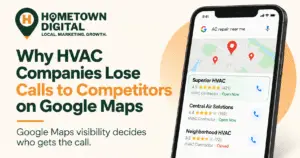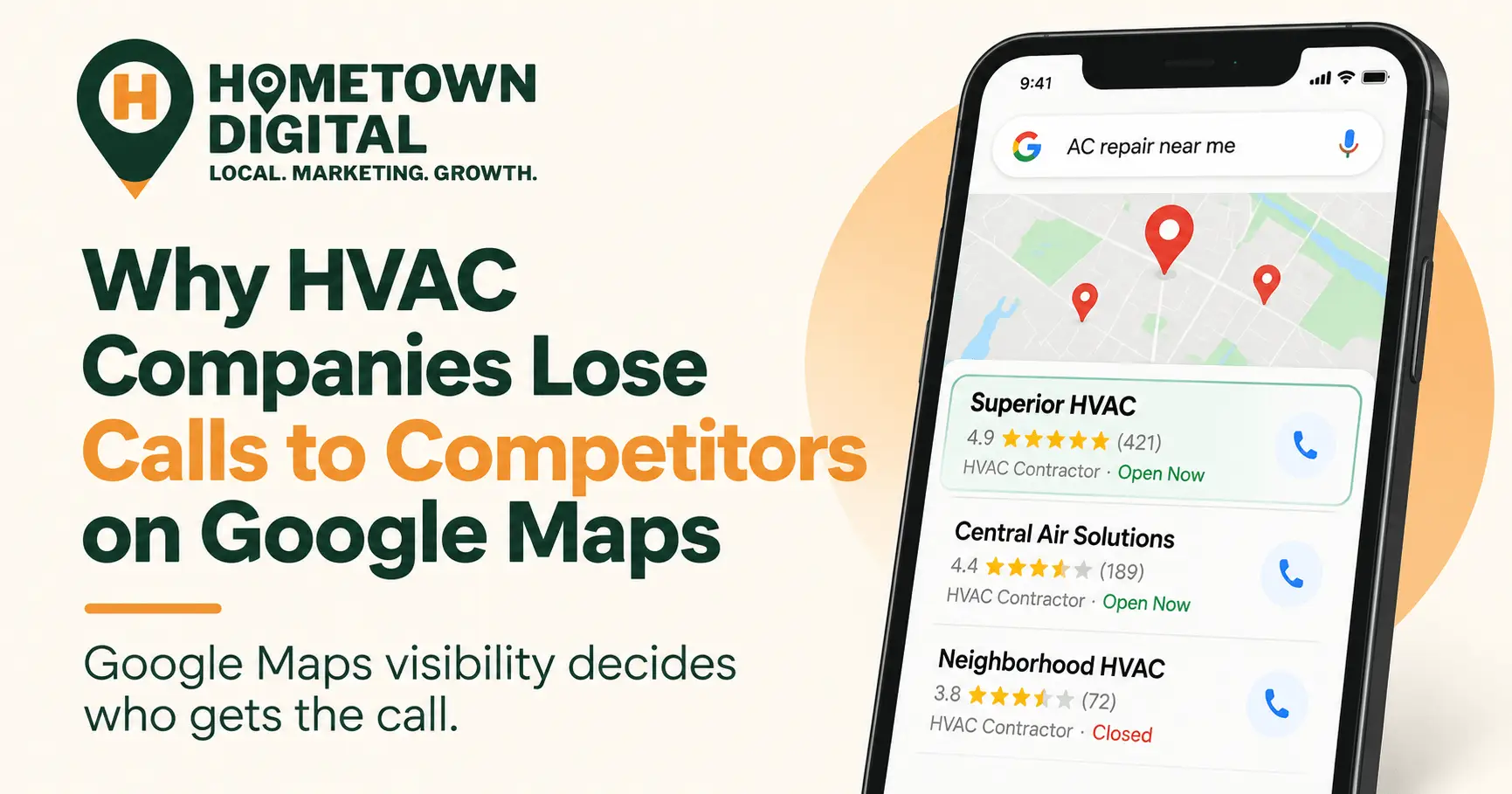
It’s the first 98-degree week of summer. A homeowner’s AC quits at 9 p.m., they type “AC repair near me,” and they call one of the three companies Google Maps shows them. If you’re not one of those three, that call never reaches you.
Here’s the short answer. Your HVAC Google Maps ranking comes down to a handful of signals, and most HVAC companies lose calls because of the same few gaps: the wrong primary category on their Google Business Profile, hours that read “Closed” when emergencies happen, thin or stale reviews, a shaky service area setup, and a website that doesn’t back up the listing. Every one of them is fixable.
Proximity matters too. It’s the one factor you can’t change, which is exactly why the rest matter so much.
Why does the HVAC company down the road get all the Google Maps calls?
Because Google Maps is where most HVAC searches end. In a May 2026 study of 100 home-services keywords, including HVAC terms, WebFX found the Local Pack showed up on about 98% of searches. The three businesses in that pack get first shot at the call, and the company sitting in fourth place usually never hears about it.
The truth is, most of the HVAC owners we talk to don’t have a marketing problem. They have a visibility problem in one specific spot. Their techs are good and their reviews are mostly five stars. But when someone in their own zip code searches for help, a competitor with a weaker reputation shows up first.
We’ve been in the trades ourselves, so we get why this is maddening. You did the work. Somebody else gets the call. If you want the bigger picture, our guide to local SEO for small businesses covers the full system. This post stays focused on HVAC companies and the specific reasons they slip.
What decides who shows up in the Google Maps 3-Pack for HVAC searches?
Google ranks Map Pack results on relevance, distance, and prominence. Whitespark’s 2026 Local Search Ranking Factors survey puts five signals at the top for Maps: your primary Google Business Profile category, proximity to the searcher, keywords in the business name, an address in the city being searched, and whether you’re open at the time of the search.
The survey asked 47 local SEO practitioners to score 187 factors, and review signals landed right behind those top five. Here’s how the top of the list plays out for an HVAC company:
| Rank | Factor | What it means for an HVAC company | Can you control it? |
|---|---|---|---|
| 1 | Primary GBP category | “HVAC contractor” and “Heating contractor” match different searches. Your main category tells Google what you are. | Yes |
| 2 | Proximity to the searcher | Google favors businesses closer to the person searching. | No |
| 3 | Keywords in business name | Names with “AC Repair” in them get a boost, which is why spammers fake them. | Only through your real name |
| 4 | Address in the city searched | Businesses located inside the searched city have an edge. | Partly |
| 5 | Open at time of search | Listings that show “Closed” tend to slide for after-hours searches. | Yes, if the hours are real |
| 6 | High Google rating | A higher average star rating helps you rank. | Yes, over time |
| 9 | Google reviews with text | More detailed reviews signal a real, active business. | Yes |
| 11 | Review recency | Fresh reviews count for more than a pile of old ones. | Yes |
Notice how many of these you control. Only proximity is truly out of your hands. If you want the step-by-step version, we walk through it in how to get into the Google Maps 3-Pack and stay there.
Why do most HVAC companies drop out of the Map Pack?
Most HVAC companies don’t fall out of the Map Pack because a competitor outworked them. They fall out because of small, specific gaps in their Google Business Profile and website that add up over time. When we audit HVAC profiles, the same six problems show up again and again, and most take an afternoon to fix.
1. Your primary category doesn’t match what people search
Your primary category is the strongest ranking signal you control. Plenty of HVAC shops picked “Heating contractor” years ago, back when furnace work paid the bills, and never changed it. Then they wonder why they’re invisible for “AC repair near me” in July.
Pick the primary category that matches most of your revenue and the searches you want most. For a typical full-service shop, that’s “HVAC contractor,” with “Air conditioning repair service,” “Air conditioning contractor,” and “Furnace repair service” added as secondary categories. (Some SEOs swap the primary category by season. We’ve seen it help and we’ve seen it backfire, so we don’t recommend it as a default.)
2. Your hours say “Closed” when the AC breaks
Being open at the time of search is a new top-five factor in Whitespark’s 2026 survey. For HVAC, that’s a big deal. Emergency calls don’t wait for business hours, and a listing that reads “Closed” at 9 p.m. tends to slide down the pack right when the most urgent searches come in.
If you really answer the phone after hours, list those hours. If you don’t, don’t fake them. Google’s guidelines require accurate hours, and a homeowner who calls a “24 hours” listing and gets voicemail will call the next company. Maybe after leaving you a one-star review.
3. Your reviews are thin, old, or unanswered
Homeowners screen HVAC companies hard on reviews, and the bar keeps rising. BrightLocal’s 2026 Local Consumer Review Survey of 1,002 U.S. consumers found that 68% won’t use a business rated under four stars. It also found 74% only pay attention to reviews from the last three months, and 47% won’t use a business with fewer than 20 reviews.
So 140 reviews with the newest one from last spring? That reads like a company that slowed down. The same survey found 89% of consumers expect owners to respond to reviews, too. A steady system beats a once-a-year push, and our guide to getting more customer reviews shows how to build one without breaking Google’s rules.
4. Competitors are stuffing keywords into their business names
Keywords in the business name rank third in Whitespark’s survey, which explains why your Maps results are full of names like “Best AC Repair Houston 24/7.” Unless that’s the name on your license and your trucks, it breaks Google’s Business Profile guidelines.
Don’t copy it. Fake names can get a listing suspended, and a suspended profile ranks nowhere. Instead, use “Suggest an edit” on the competitor’s listing, and file Google’s Business Redressal Complaint Form for repeat offenders. Whitespark’s experts ranked spam fighting #19 among Maps factors, because every fake listing that gets pulled moves real companies up a spot.
5. Your service area setup is working against you
Most HVAC companies are service-area businesses. You drive to the customer, so Google lets you hide your street address and list service areas instead. That’s the right setup for a shop run out of a home or a yard. Whitespark’s 2026 survey flags showing a home address on a service-area business as a suspension risk.
Two things trip HVAC owners up here. The first is service areas drawn too wide; the same survey flags areas bigger than a two-hour drive as a suspension risk. The second is expecting to rank in a town 25 miles away. Listing a service area doesn’t change where Google thinks your business is, and an address in the searched city is a top-five factor. For those outlying towns, city pages on your website and paid ads do more than your profile can.
6. Your website doesn’t back up your listing
Google cross-checks your profile against your website. If your site doesn’t mention the services and cities in your profile, or your name, address, and phone number don’t match, the listing has less to stand on. Dedicated pages for AC repair, furnace repair, and installs, plus a page for each main city you serve, give Google something to confirm. We cover what that site needs in HVAC website design: 9 things every contractor site needs.
Why does your HVAC Google Maps ranking matter most during heat waves and cold snaps?
HVAC demand doesn’t build slowly. It spikes on the first hot week and the first hard freeze, and the companies already sitting in the Map Pack catch most of that surge. During a June 2021 heat wave, Google reported that searches for “air conditioner installation service” jumped more than 2,150% in a single month.
You can’t fix your HVAC Google Maps ranking in the middle of that spike. Reviews take weeks to build, and Google takes time to process category and website changes. The shops that win July did their homework in March. The shops that win January started in October (which, if you’re reading this in the fall, means you’re right on time).
Can Local Services Ads get you calls if you’re not in the Map Pack?
Yes, but they work best alongside a strong Maps listing rather than as a replacement. In WebFX’s May 2026 study, Local Services Ads appeared on about 28% of home-services searches and held the top position every time they showed. On searches that named a city, like “hvac repair dallas,” that rose to 49%.
Local Services Ads charge per lead and carry the Google Guaranteed badge. They also lean on many of the same things Maps does, like reviews and an accurate profile, so a thin profile hurts you in both places. For most HVAC shops, our order is simple: fix the Google Business Profile first, then add Local Services Ads to cover towns where distance works against you. Our playbook on marketing for home service businesses shows how the channels fit together.
What does fixing this look like for a real HVAC shop?
Picture a three-truck HVAC company in a suburb outside a big metro. Good techs, 4.8 stars, about 60 reviews. But they’re stuck at fifth or sixth in Maps for “AC repair” in their own town, while the calls go to two franchise operations and a keyword-stuffed listing nobody has ever heard of.
We see this pattern constantly at Hometown Digital. Here’s the order we’d work it in:
- Change the primary category to “HVAC contractor” and add the specific AC and furnace categories underneath.
- Set the hours to match when the phone really gets answered, including after-hours emergency coverage if they offer it.
- Start a review system: a text request after every completed job, and a reply to every review within a couple of days.
- Report the fake listing through “Suggest an edit,” then the redressal form if it sticks around.
- Add service and city pages to the website, with the name, address, and phone number matching the profile exactly.
- Turn on Local Services Ads for the two neighboring towns where they can’t win on distance.
None of that requires a full rebuild or a bigger ad budget. It’s maintenance, the same as a spring tune-up. And because we’ve worked in the field, we know an owner running jobs all day doesn’t have time to babysit it, which is a big part of why HVAC companies hand this work to us.
Common Questions About HVAC Google Maps Rankings
How long does it take an HVAC company to move up in Google Maps?
Category and hours fixes can show movement within a few weeks, once Google processes them. Review growth and website changes build over two to three months. In crowded metros with franchise competition, give it a full season before you judge results.
Should I show my address on Google if I run my HVAC business from home?
No. If customers don’t come to your location, Google treats you as a service-area business, so hide the address and list service areas instead. Whitespark’s 2026 survey lists showing an address on a service-area business as a suspension risk.
Can I add “AC Repair” to my business name on Google?
Only if it’s part of your real business name, the one on your license, signs, and trucks. Adding keywords that aren’t in your actual name breaks Google’s Business Profile guidelines and can get your listing suspended. It’s a short-term bump with long-term risk.
Do I need to be open 24/7 to rank for emergency HVAC searches?
No, but being open when someone searches helps. Whitespark’s experts ranked “open at time of search” fifth among Maps factors in 2026. If you offer real after-hours emergency service, list those hours; if you don’t, keep your hours accurate and compete hard on daytime searches.
Will running Google Ads or Local Services Ads improve my Maps ranking?
No. Paid ads and organic Maps rankings are separate systems, and Google doesn’t move you up in Maps because you advertise. Ads can put you above the Map Pack while your organic ranking improves, which is why plenty of HVAC shops run both for a while.
Ready to Get More Calls From Google Maps?
If you run an HVAC company and want to see exactly where you stand online, get a free website audit. We’ll look at your site, your Google presence, and tell you what we’d focus on first. Better to find the gaps now than in the middle of the next heat wave.