It’s 9:40 on a Tuesday night. A homeowner is standing in an inch of water with a phone in one hand, typing “emergency plumber near me.” Who gets that call?
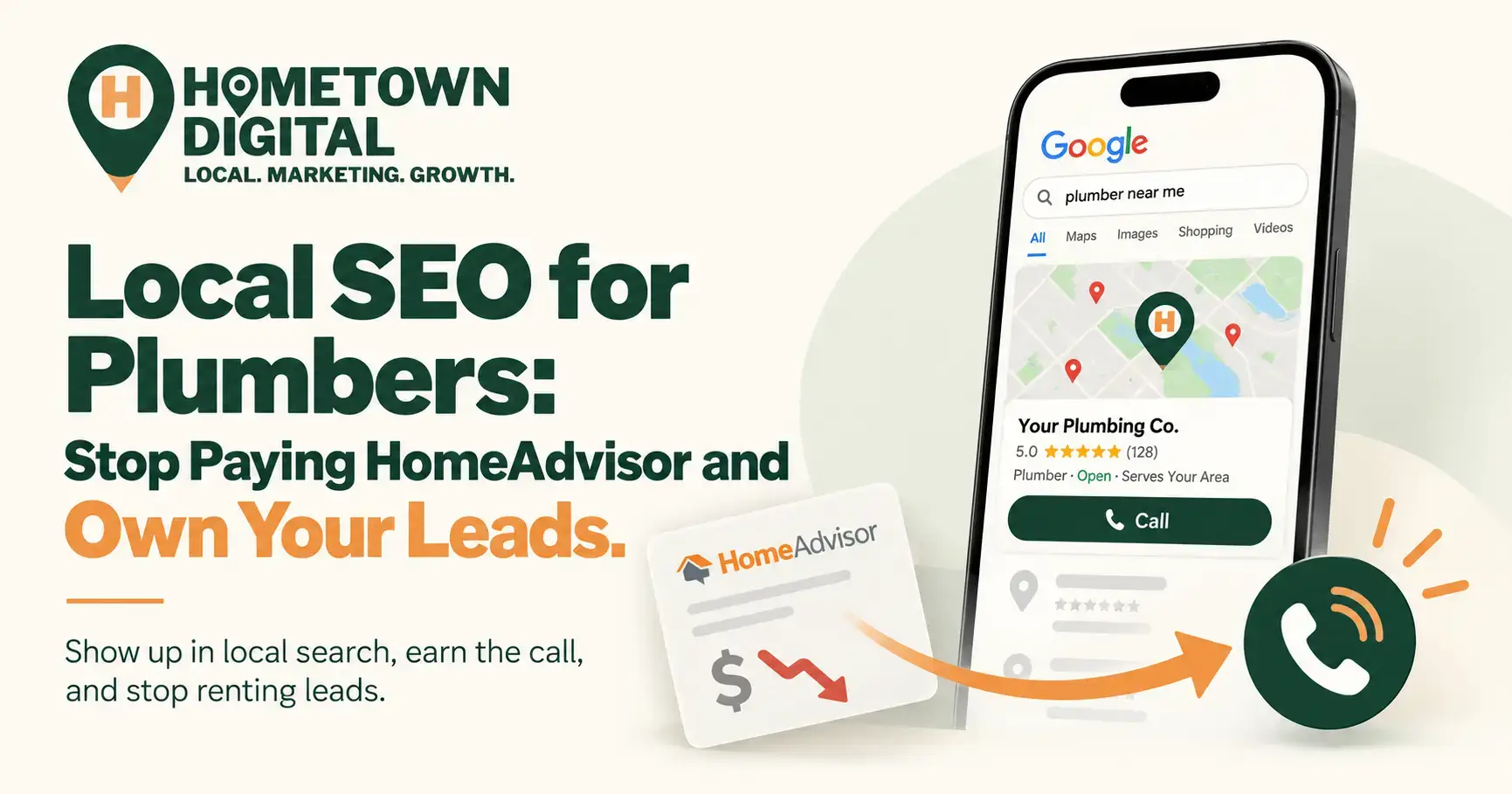
Local SEO for plumbers is how you make sure it’s you. It means ranking in Google’s Map Pack and local results for searches like “plumber near me,” so the homeowner calls your number directly, with no middleman. Compare that to a HomeAdvisor or Angi lead, which Angi’s own help center says can go to as many as four pros at once, and which you pay for whether you win the job or not.
Here’s what actually moves a plumbing company up in local search in 2026, and how to make the switch without your phone going quiet.
Why are so many plumbers still paying HomeAdvisor for leads?
Most plumbers use HomeAdvisor or Angi because it’s fast. You sign up, pay the fee, and leads show up the same week. The catch is that you’re renting customers. Every lead costs money, a lot of them are shared with competitors, and the day you stop paying, that source of work disappears.
The fees add up, too. According to the Federal Trade Commission’s 2022 complaint against HomeAdvisor, service providers paid an annual membership fee of $287.99 on top of a separate charge for every lead. The FTC also alleged that HomeAdvisor misrepresented lead quality, including leads outside a provider’s service area and homeowners who weren’t ready to hire. HomeAdvisor disputed the claims, but in 2023 the FTC finalized an order requiring the company to pay up to $7.2 million in redress to affected service providers.
We’ve been in the trades ourselves, so we get the appeal. When you’re running two trucks and a full schedule, you just want the phone to ring. But we’ve worked with enough plumbing owners to know how this usually plays out: the lead bill creeps up every year, and none of that money builds anything you keep. (If you want the fundamentals of how local search works for any business, our complete guide to local SEO for small businesses covers them. This post is about plumbers.)
What’s the difference between a HomeAdvisor lead and a lead you own?
A HomeAdvisor or Angi lead is a contact you buy, often alongside other plumbers. A lead you own comes from your own Google Business Profile, website, or reviews, and it calls you alone. Bought leads stop the moment your budget does. Owned leads keep coming from assets that stay in your name.
Here’s how the three most common plumbing lead sources compare:
| Angi / HomeAdvisor leads | Google Search Ads | Local SEO | |
|---|---|---|---|
| How you pay | Annual membership plus a fee for every lead | Per click | Monthly investment in your own profile, website, and reviews |
| Who else gets the lead | Up to four pros on Angi Market Match leads | Nobody. The call is yours | Nobody. The call is yours |
| Typical cost | $287.99 a year membership (FTC, 2022) plus per-lead fees | About $129 per plumbing lead (LocaliQ, 2025) | No per-lead fee; cost per call falls as rankings grow |
| When you stop paying | Leads stop right away | Calls stop right away | Rankings, reviews, and pages keep working |
| Time to results | Days | Days | Months to build, then it compounds |
That last row is the honest tradeoff. Local SEO is slower to start. But a call from the Map Pack doesn’t come with a per-lead invoice, and it doesn’t come with three other trucks racing you to the driveway. It’s the core idea behind our marketing playbook for home service businesses: own the channels that compound, and rent only what fills the gaps.
What actually gets a plumber into the Google Maps 3-Pack?
Google ranks plumbers in the Map Pack on relevance, distance, and prominence. In practice, that comes down to your Google Business Profile category, how close you are to the person searching, your business name, whether you’re open when they search, and the strength of your Google reviews. Your website and listings back all of it up.
Whitespark’s 2026 Local Search Ranking Factors report, which surveyed 47 local search specialists on 187 factors, ranked these as the top six signals for Map Pack rankings:
- Primary Google Business Profile category
- Proximity of the business to the person searching
- Keywords in the Google Business Profile business name
- A physical address in the city being searched
- Being open at the time of the search
- High Google star ratings (4 to 5 stars)
You can’t move your shop closer to every customer. But your category, hours, and reviews are fully in your hands, and that’s where most plumbing profiles we audit leave rankings on the table.
One warning on number three. Keywords in your business name help only when they’re actually part of your real name. Google’s guidelines prohibit stuffing extra words into the name field, so turning “Miller Plumbing” into “Miller Plumbing Best Emergency Plumber Dallas” can get your profile suspended. We’ve watched competitors try it. It works right up until it doesn’t.
How should a plumber set up their Google Business Profile?
A plumber’s Google Business Profile should use “Plumber” as the primary category, list every service you actually offer, show accurate hours, set a realistic service area, and include real photos of your trucks, crew, and work. Completeness and accuracy are what Google rewards, and they’re also what gets a homeowner to tap the call button.
Pick the right primary category
Your primary category is the biggest ranking factor you control. For most shops, that’s “Plumber.” Add secondary categories only for work you genuinely do, such as “Drainage service” or “Septic system service.” Don’t add categories for work you’d turn down. They’ll just bring in calls you don’t want.
Set hours you can actually back up
Being open at the time of a search jumped into Whitespark’s top five ranking factors for 2026, which matters for plumbers because so many searches happen at night and on weekends. If you genuinely answer the phone around the clock (or use an answering service that books jobs), set your hours to match. If you don’t, don’t fake it. A homeowner who calls your “24/7” line at midnight and hits voicemail is writing a one-star review before breakfast.
List your services and a realistic service area
Use Google’s predefined services, like drain cleaning and leak detection, plus custom ones for anything missing. Whitespark’s experts ranked the presence of predefined services 22nd out of 187 factors, which is higher than most owners would guess. Most plumbers run as service area businesses, meaning the address is hidden and you list the towns you cover. Keep that area honest. Whitespark’s report flags service areas wider than a two-hour drive as a negative factor.
Add real photos
Your trucks, your crew, a finished water heater install. Stock photos of a smiling model holding a wrench don’t build trust with anybody. Our step-by-step Google Business Profile optimization guide goes deeper on every field in the profile, including posts, attributes, and Q&A.
Does a plumber’s website still matter for local SEO?
Yes. Your website is what Google reads to confirm what you do and where you do it, and it’s where homeowners go to double-check you after reading reviews. The single strongest local organic ranking factor in Whitespark’s 2026 report is a dedicated page for each service. For plumbers, one generic “Services” page doesn’t cut it.
Nobody types “plumbing services.” They type “water heater repair near me” or “drain cleaning in [their town].” Each of those deserves its own page that explains the service, shows your work, names the areas you cover, and puts your phone number where a thumb can hit it. Geographic relevance, meaning you mention the actual towns and neighborhoods you serve, ranked second on Whitespark’s local organic list.
Which pages should a plumbing website have?
- Emergency plumbing
- Drain cleaning
- Water heater repair and installation
- Leak detection and repair
- Sewer line repair and replacement
- Repiping
- One page for each main city or suburb you serve, written for that area instead of copied and pasted with the town name swapped
BrightLocal’s 2026 Local Consumer Review Survey found that 54% of consumers visit a business’s website after reading positive reviews. So your site has two jobs: help you rank, then close the deal. We broke down what a high-converting plumbing website looks like in a separate post.
How many Google reviews does a plumbing company need?
More than most plumbers think, and they need to be recent. BrightLocal’s 2026 survey of 1,002 US consumers found that 47% won’t use a business with fewer than 20 reviews, and 74% only pay attention to reviews written in the last three months. A stack of reviews from 2021 isn’t doing much for you today.
The bar for star ratings keeps climbing as well. In the same survey, 31% of consumers said they’ll only use a business rated 4.5 stars or higher, up from 17% a year earlier. Reviews feed your rankings directly, too: star rating, review count, and review recency all landed in Whitespark’s top 11 Map Pack factors.
The fix isn’t complicated. It’s a habit. Here’s the routine we recommend for plumbing crews:
- Have the tech ask in person at the end of the job, when the homeowner is relieved and the floor is dry.
- Text your direct Google review link within the hour.
- Follow up once, two or three days later, if they haven’t left one.
- Respond to every review within a few days, good or bad. BrightLocal found 89% of consumers expect business owners to respond.
- Never offer discounts or gifts for reviews. Google’s policies prohibit it, and the FTC’s 2024 rule makes incentives for positive reviews illegal.
Can local SEO help plumbers show up in ChatGPT and AI search?
Yes, and it’s turning into a real source of calls. BrightLocal’s 2026 survey found that 45% of consumers now use ChatGPT or other AI tools for local business recommendations, up from 6% the year before. Those tools pull from the same signals local SEO builds: accurate listings, consistent business information, and reviews on more than one site.
In Whitespark’s 2026 report, three of the top five AI search visibility factors were citations, meaning your directory listings. Your name, address, and phone number should match exactly across Google, Apple Maps, Bing, Yelp, the BBB, and Nextdoor. Here’s the funny part: your Angi profile counts as one of those listings. You don’t have to delete it. You just shouldn’t depend on it.
How long does local SEO for plumbers take, and should I quit HomeAdvisor right away?
In our experience, most plumbing companies see meaningful movement in local rankings within three to six months, depending on how competitive the market is and how much groundwork is missing. That’s why we don’t tell plumbers to cancel HomeAdvisor or Angi on day one. Use paid leads as a bridge while your owned channels grow, then cut back as the calls shift.
Here’s what a lot of agencies won’t say out loud: the first few weeks often feel like nothing is happening, because Google needs time to recrawl your site and see new reviews come in. The plumbers who get burned are usually the ones who quit after six weeks.
The way to stay sane is to track it. Use a call tracking number on your website, check your Google Business Profile calls monthly, and ask every new customer how they found you. Then compare sources by cost per booked job instead of cost per lead. A $40 shared lead you win one time in five costs you $200 per booked job. That math changes how most owners look at their lead bill.
What does this look like for a real plumbing shop?
Here’s a scenario we run into all the time. A four-truck plumbing company in a mid-size suburb gets most of its work from shared leads. Its Google Business Profile has 23 reviews, the newest from last spring. The website is a single page with a phone number and a contact form, and two directories still list an address from two moves ago.
The first 90 days usually mean cleaning up the Google Business Profile, building pages for the top five services and three biggest towns, fixing the listings with the old address, and starting the review habit so the profile goes from one review a month to a few every week.
None of that requires canceling anything. Once the Map Pack and the website are producing steady calls, the owner trims the lead budget a piece at a time and watches what happens. After 25+ years of combined experience in web design, SEO, and paid advertising, it’s the sequence we trust most, and it’s the same one we follow in our work with plumbing companies at Hometown Digital.
Common Questions About Local SEO for Plumbers
How much does local SEO cost for a plumbing company?
It depends on your market and how much work your profile and website need. At Hometown Digital, growth services like Local SEO start at $195 a month, and website packages start at $295 for setup plus $45 a month. The better comparison is cost per booked job, because local SEO doesn’t bill you every time the phone rings.
Is HomeAdvisor the same as Angi?
Yes. HomeAdvisor’s pro side now operates as Angi Leads, so the same lead model applies under either name. According to Angi’s own help center, Market Match leads can be sent to as many as four service pros.
Should plumbers run Google Local Services Ads instead of Angi?
Local Services Ads are worth testing for most plumbers, since the customer contacts your business directly and your listing carries the Google Guaranteed badge. They’re still paid, though, and they stop when your budget does. Whitespark’s 2026 report ranked reviews as the second biggest factor in Local Services Ads placement, so the review work you do for local SEO helps both.
Can I do local SEO for my plumbing business myself?
You can handle the basics: fill out your Google Business Profile completely, ask every customer for a review, and keep your hours accurate. Most owners stall on the website pages, listing cleanup, and call tracking, which is usually when outside help makes sense.
Do I need a separate Google Business Profile for every town I serve?
No. Google allows one profile per real business location, and creating profiles at fake or virtual addresses is a fast way to get suspended. Cover additional towns with your service area settings and dedicated city pages on your website instead.
Ready to Stop Renting Your Leads?
If you run a plumbing company and want to see exactly where you stand online, get a free website audit. We’ll look at your site, your Google presence, and your reviews, then tell you what we’d focus on first. No pressure, and no shared leads.