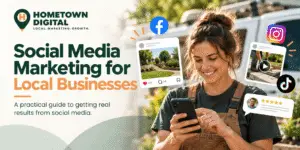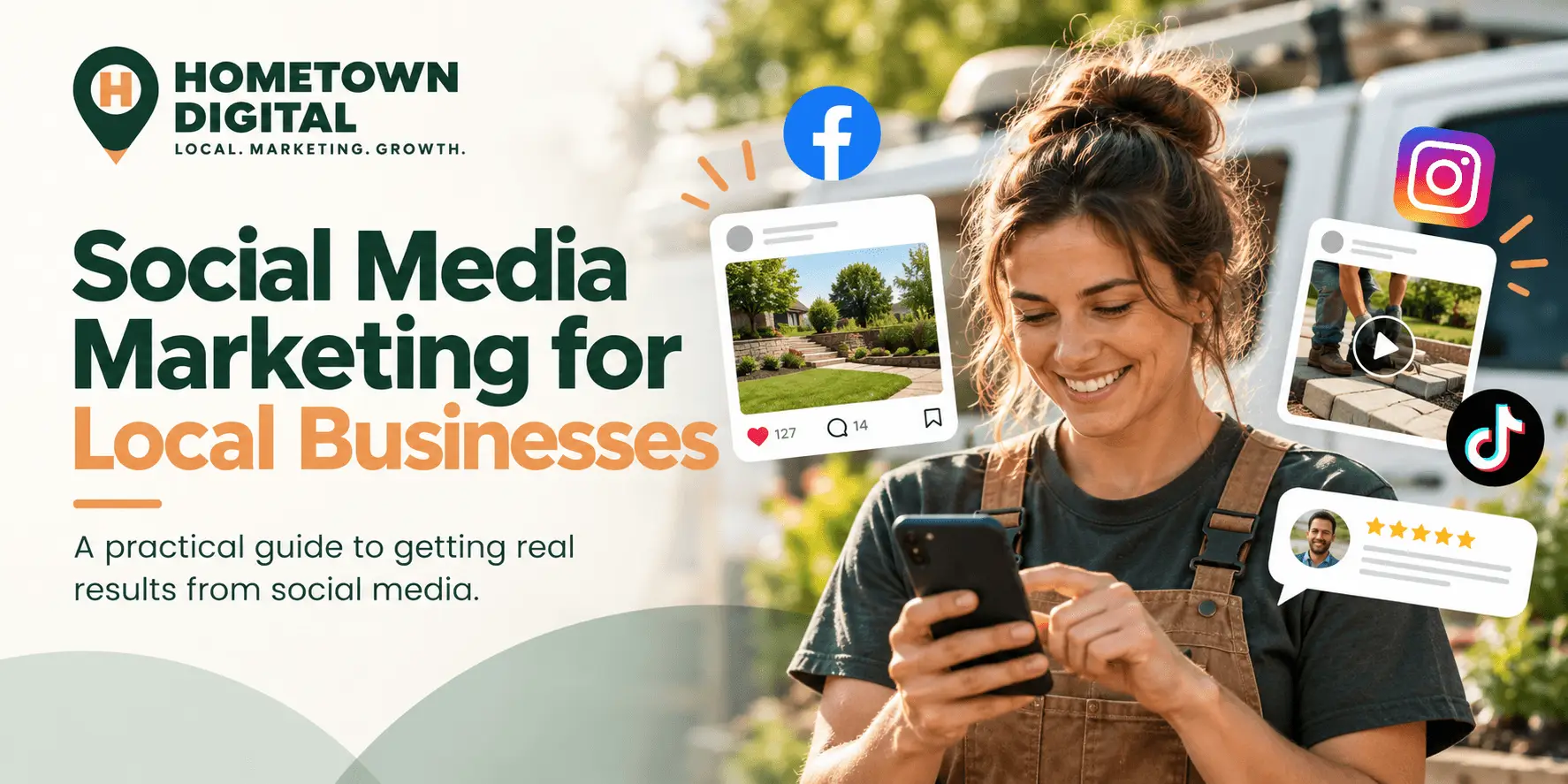
Social Media Marketing for Local Businesses: The Practical Guide (2026)
You posted three times last week. A photo of the storefront, a holiday graphic, a reminder that you’re open Saturdays. Eleven likes, two of them from your cousin, and the phone didn’t ring once.
Here’s the straight answer. Social media marketing for local businesses works when you treat it as proof, not as a lead machine. Pick one or two platforms your customers already use, post real work from real jobs two or three times a week, answer every comment and message fast, and point people back to your website and Google profile. That’s most of it. The rest of this guide shows you how to do it without losing your evenings.
Why isn’t social media bringing in customers for my business?
Most local businesses struggle on social media because they post like a national brand. Generic graphics, stock photos, and “Happy Monday” posts give nobody a reason to call. Customers check your social pages to see whether you’re real, active, and good at the work. If your feed can’t answer those questions in ten seconds, it isn’t doing its job.
We’ve worked with enough local owners to know how this usually plays out. Somebody tells you that you need to be on social. You open five accounts, post hard for a month, see nothing, and quit. Now there’s a Facebook page with a last post from 2023 sitting in your search results. (Honestly, that’s worse than no page at all. It looks like you closed.)
The problem is rarely effort. It’s that nobody explained what social media is actually for when you’re a plumber, a salon, or the family restaurant everyone in town knows.
How does social media marketing help a local business?
For a local business, social media is mainly a proof channel. People find you on Google or hear about you from a neighbor, then check your social pages for recent work, real faces, and how you treat customers. Social media rarely starts the sale on its own. It confirms the decision, and that’s worth more than most owners realize.
The data backs this up. In BrightLocal’s 2026 Local Consumer Review Survey of 1,002 U.S. consumers, 66% said they keep researching after reading a positive review, and 24% go on to check the business’s social media channels. A separate BrightLocal study, its 2026 Consumer Search Behavior survey, found that 75% of consumers used more than one channel during their most recent search for a local business.
So the typical path looks something like this. A homeowner searches, finds your Google Business Profile, reads a few reviews, then taps over to Facebook or Instagram to see if you’re legit. If your last post is eight months old, that’s where you lose the job. Nobody calls to tell you, either.
Facebook still carries real weight in that moment. BrightLocal found that Google, Facebook, and AI tools like ChatGPT are the most commonly used sources for local recommendations in 2026, and 34% of consumers wrote a review on Facebook in the past year, second only to Google. That’s why the Organic Social Media service we run at Hometown Digital starts from one question: what does a skeptical customer need to see before they pick up the phone?
Which social media platforms should a local business use?
Most local businesses should start with Facebook and add Instagram if their work is visual. According to Pew Research Center’s 2025 survey, 71% of U.S. adults use Facebook, including 80% of adults ages 30 to 49. That’s the crowd buying homes, raising kids, and hiring local help. Add other platforms only when you can keep them active every week.
Pew’s numbers for the rest of the field: YouTube reaches 84% of U.S. adults, Instagram 50%, and TikTok 37%. Daily habits matter too. Pew found 37% of adults visit Facebook several times a day, which explains why it’s still the default local platform even though it isn’t the trendiest one.
| Platform | U.S. adults who use it (Pew, 2025) | What it’s best for | Strongest fit |
|---|---|---|---|
| 71% | Recommendations, reviews, community groups, Messenger inquiries | Nearly every local business, especially home services and restaurants | |
| 50% | Visual proof of work, short video, stories | Salons, restaurants, landscapers, boutiques, remodelers | |
| YouTube | 84% | How-to and explainer videos that keep getting found in search | Trades that answer lots of “how do I” questions, like HVAC and plumbing |
| TikTok | 37% | Short, personality-driven video that reaches younger buyers | Food, beauty, fitness, and owners who are comfortable on camera |
| Nextdoor | Not measured in Pew’s survey | Neighbor-to-neighbor recommendations | Home services, cleaning, pet care |
Notice what’s missing from that table: a row that says “all of them.” Two platforms you post on every week will beat five you abandoned in March.
What about Facebook Groups and Nextdoor?
This is where “anyone know a good electrician?” posts live. Don’t spam these spaces with ads, because most local groups will boot you, and they should. Join as a real member, answer questions when you can genuinely help, and ask happy customers to tag your page when someone asks for a recommendation. One tag from a neighbor carries more weight than ten posts from you.
What should a local business post on social media?
Post proof. That means photos and short videos of real jobs, real food, real results, and the real people doing the work. In Rival IQ’s 2025 Social Media Industry Benchmark Report, photo posts earned the highest Facebook engagement in nearly every industry it tracked. People trust what they can see, and your phone camera is the best marketing tool you already own.
Finished work and before-and-afters
The single best post a contractor can make is a before-and-after from this week’s job with the town named in the caption. “New 200-amp panel in Springfield, replacing a 1970s fuse box” tells a homeowner exactly what you do and where you do it. Restaurants get the same effect from a plate that just left the kitchen. Salons, from a fresh cut photographed in good light by the window.
The people behind the business
Show the crew, the stylist, the owner behind the counter. Sprout Social’s 2025 Index, which surveyed 4,044 consumers, found authenticity and relatability are the two traits people value most from brands on social, and about half said original content is what makes their favorite brands stand out. A 15-second clip of your tech explaining a repair beats any stock photo you could buy.
Reviews and customer shout-outs
Screenshot a fresh five-star Google review and thank the customer by first name (ask first). It’s free proof, and it quietly reminds everyone else that you want reviews too. If your review count is thin, start with our guide on how to get more customer reviews.
Answers to the questions you hear every week
Every business gets the same handful of questions on repeat. “How often should I change my furnace filter?” “Do you take walk-ins?” “Can you match this paint color?” Turn each one into a short video or a simple graphic. These posts keep working long after you publish them, especially on YouTube.
What to stop posting
Generic holiday graphics with nothing local in them. Motivational quotes. Stock photos of smiling people who’ve never set foot in your shop. And trend videos that don’t fit your business. Sprout Social found about a third of consumers think it’s embarrassing when brands jump on viral trends, so skip the dance unless it’s genuinely you.
How often should a small business post on social media?
Two to three posts a week on one or two platforms is plenty for most local businesses. Consistency matters far more than volume. Even big national brands have pulled back: Rival IQ’s 2026 benchmark report found the median brand now posts about three times a week on Facebook and under four times a week on Instagram.
And the payoff from posting more keeps shrinking. That same 2026 report found Instagram’s median engagement rate slipped about 17% year over year to 0.30%, while Facebook held flat. Those benchmarks come from national brands with large followings, so treat them as a direction, not a target. A local page with 600 engaged neighbors can do more for your business than a regional chain’s page with 60,000 followers who never think about it.
Here’s a realistic weekly rhythm for a busy owner:
- One job, product, or plate photo with the town or neighborhood in the caption
- One short video or a people post, ideally answering a question customers ask you all the time
- A review shout-out or a community post when you have one worth sharing
- Comments and messages answered the same business day, every day
That’s maybe an hour a week if you batch the photos. Most of it happens on the job anyway.
How do you get local people to actually see your posts?
Make every post obviously local. Tag your location, name the town or neighborhood in the caption, tag local partners and customers who are happy to be tagged, and show up in community spaces where your neighbors already talk. Local signals give both the platforms and the people scrolling a clear reason to connect your post to your area.
Set up your profile like a storefront
Before you post anything, fix the basics. Your business name, address, phone number, hours, and service area should match your Google Business Profile exactly. Add a website link, a booking or “Get a quote” button, and a short bio that says what you do and where. That’s the stuff a customer looks for first. It’s also what AI tools read when they’re deciding whether to recommend you.
Lean into short video
Short video still earns the most interaction. Rival IQ’s 2026 report put TikTok’s median engagement rate at 2.01%, far ahead of every other platform it measured. You don’t need to be on TikTok to benefit. The same 30-second clip can go up as an Instagram Reel, a Facebook Reel, and a YouTube Short in five minutes.
Reply fast in the first hour
Comments and replies right after you post signal that people care about it. So stick around for a few minutes after you hit publish and answer anyone who comments. It’s a small habit. It adds up.
Know when to put money behind a post
Organic reach on Facebook and Instagram is limited, especially for pages with small followings. When you have a post that’s clearly working, or a seasonal push like spring cleanups or holiday catering, a small boosted post aimed at a tight radius around your service area can get it in front of the right neighbors. Our guide to Meta Ads for small businesses explains when that money is well spent.
Do you really need to respond to every comment and message?
Yes. Social media is a customer service channel now, whether you planned it that way or not. In Sprout Social’s 2025 Index, 73% of consumers said they’ll buy from a competitor if a brand doesn’t respond on social. A missed Facebook message is a missed phone call, and you’d never let your shop phone ring out on purpose.
Expectations are getting faster, too. BrightLocal’s 2026 survey found 89% of consumers expect business owners to respond to reviews, and 19% expect a reply the same day, up from 6% the year before. Social messages follow the same pattern. A homeowner with a leaking water heater isn’t waiting until Monday.
A few simple habits handle most of this:
- Turn on Facebook and Instagram message notifications on your phone, and decide who on your team owns them
- Set an instant auto-reply with your hours, phone number, and a link to request a quote
- Save replies for the questions you answer every week, like pricing ranges and service areas
- Take complaints offline politely, with a phone number and a name, instead of arguing in the comments
That last one matters more than people think. Everybody reading the thread is judging how you handle the problem, not the problem itself.
Should a local business pay for social media ads or stay organic?
Do both, in that order. Organic posting builds the proof people check before they call. Paid Meta Ads put that proof in front of people who don’t follow you yet. Running ads to an empty page wastes money, because the first thing a curious customer does is tap your profile to see if you’re real.
| Organic social | Paid social (Meta Ads) | |
|---|---|---|
| What it costs | Your time, or a monthly management fee | Ad spend plus setup and management |
| What it’s good for | Trust, repeat customers, word of mouth | Reaching new customers in a set radius, seasonal pushes, promotions |
| Who sees it | Mostly people who already follow you | Anyone you target by location, age, and interests |
| How fast it works | Builds over months | Can drive messages and calls within days |
| Most common mistake | Posting in bursts, then going quiet | Boosting random posts with no clear offer |
If you’re ready to test paid, our walkthrough on using Facebook and Instagram ads to get more local customers covers targeting, budgets, and what a sensible first campaign looks like.
How do you know if social media is working for your business?
Judge social media by actions, not applause. Likes and follower counts feel good but don’t pay the bills. Track what does: messages and calls that came from social, clicks to your website, booking requests, and the answer to one simple question every new customer should hear. “How did you find us?”
What to track each month:
- Messages and quote requests that came in through Facebook or Instagram
- Website visits from social, using tagged links (called UTM links) so Google Analytics can tell you a visit came from Instagram
- New customers who mention seeing you on social when you ask how they found you
- Reviews or referrals that mention a post, a video, or your page
Give it 90 days before you judge. Social proof builds slowly, and the first month is mostly you finding your rhythm. If nothing has moved after a full quarter of steady posting, the problem is usually the content or the profile setup, rarely the platform.
Can social media replace a website or an email list?
No, because you don’t own it. Facebook and Instagram can change what your followers see, restrict your account, or bury your posts overnight, and there’s nothing you can do about it. Your website, your Google Business Profile, and your email list are assets you control. Social media should feed them, not replace them.
We’ve seen owners lose access to a business page after a hacked login or a mistaken policy flag and spend weeks trying to get it back. The ones with a working website and a customer email list kept booking work in the meantime. The ones who ran everything through Facebook went quiet.
BrightLocal’s 2026 survey found 54% of consumers visit a business’s website after reading positive reviews, more than double the share who check social channels. So every post should point somewhere you own, like your quote form, booking page, or menu. If that click lands on a site that loads slowly or buries the phone number, our post on why your website isn’t bringing in customers walks through what to fix first.
Email is the other half. We compared the two head to head in email vs. social media for local businesses, and the short version is that email reaches people you already know without an algorithm in the way. Our email marketing guide for small businesses shows how to start a list, including how to use your social following to grow it.
What does this look like for a real local business?
Picture a two-truck landscaping company that’s been working the same few towns for eight years. The owner doesn’t have time for social media, and he’s tried before. Here’s what a sustainable version of social media marketing for a local business like his looks like.
On Monday, the crew lead snaps a before-and-after of a backyard cleanup. It goes up Tuesday with the neighborhood named in the caption. Thursday, the owner records a 30-second video from the truck about when to aerate a lawn in the fall. Saturday, a fresh five-star Google review gets screenshotted and thanked. Messages get answered between jobs, and an auto-reply covers the rest with a phone number and a quote link. In March, a small boosted post aimed at a 10-mile radius promotes spring cleanup slots.
Ninety days in, he’s not famous on Instagram. But when a homeowner gets three quotes and checks everyone’s Facebook page, his shows a dozen recent jobs around her neighborhood, and the competitor’s last post is from last spring. That’s the job he wins. We’ve been in the trades ourselves, and this is what it looks like when it works: no viral moment, just a steady stack of proof.
Common Questions About Social Media Marketing for Local Businesses
Is social media worth it for a small local business?
Yes, as long as you treat it as a trust and repeat-business channel rather than your main source of new leads. Most customers find you through Google or word of mouth, then check your social pages before they call. An active page with recent work helps close that decision. An abandoned one quietly loses it.
What is the best social media platform for a local business?
For most local businesses, Facebook. Pew Research Center’s 2025 survey found 71% of U.S. adults use it, including 80% of adults ages 30 to 49. Add Instagram if your work is visual, like food, hair, or landscaping, and consider YouTube if customers ask you a lot of how-to questions.
How much time does social media take each week?
About one to two hours a week for most owners, if you batch it. Take photos on the job as you go, schedule two or three posts at once using Meta Business Suite (it’s free), and spend a few minutes each day answering messages. The daily replies matter more than the posting.
Should I hire someone to manage my social media?
If you can’t keep up with two or three posts a week and same-day replies, yes. Look for someone who asks about your customers and your service area before they talk about follower counts. Hometown Digital’s Organic Social Media service is built for local owners who want consistent, real-work content without running it themselves.
Do hashtags still matter for local businesses?
A little, but they’re not where the results come from. Two or three hashtags with your town and trade are enough. Location tags, captions that name your service and neighborhood, and a properly filled-out profile do much more to help local customers find you.
Can social media help my business show up in AI search like ChatGPT?
Indirectly, yes. BrightLocal’s 2026 survey found 45% of consumers now use ChatGPT or other AI tools for local business recommendations, up from 6% the year before. Those tools pull from many sources, so keeping your business name, hours, and services consistent across your social profiles, website, and Google Business Profile makes it easier for AI to describe you accurately.
Ready to Get More Customers?
Social media marketing for local businesses works best when the website and Google profile behind it are pulling their weight. If you want a full picture of where your marketing stands, start with a free website audit. It’s the fastest way to find out what’s working and what’s quietly costing you customers.