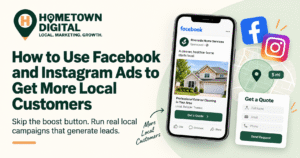
You boosted a post once. It picked up a few likes, maybe a comment from someone you already know, and then nothing happened. No calls. No bookings. No new faces walking through the door. If that has been your whole experience with Facebook and Instagram ads, you are not bad at marketing. You just reached for the wrong tool.
To get more local customers from Facebook and Instagram ads, you run real campaigns inside Meta Ads Manager instead of hitting the boost button, aim them at a tight geographic area, pick one clear goal like leads or calls, lead with a single strong offer, and show real photos or video of your work. Then you follow up with the people who paid attention but did not act yet. That is the whole approach, and the rest of this post breaks down each piece.
Why do Facebook and Instagram ads work for local businesses?
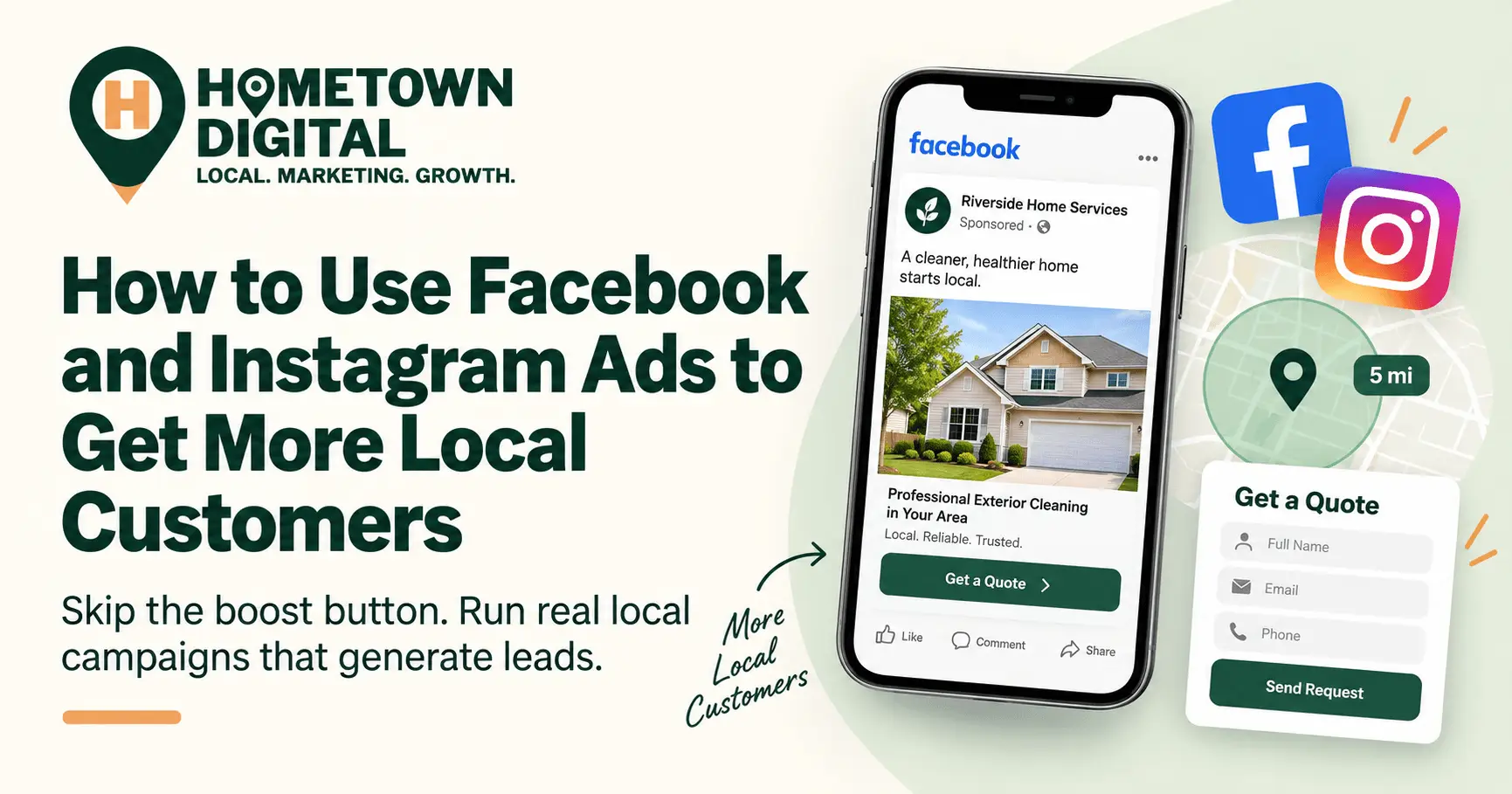
Facebook and Instagram ads work for local businesses because Meta knows where people live and can put your offer in front of them for a few dollars a day. You draw a radius around your service area, and your ad shows up in the feeds of the people inside it. That is targeting most local advertising channels cannot match.
The reach is real. Meta reports Facebook has more than 3 billion monthly active users, and across all of its apps, roughly 3.58 billion people use them every day according to its full-year 2025 results. People are not just scrolling, either. Instagram says more than 200 million users visit at least one business profile every single day. Your future customers are already on these platforms, checking out businesses like yours.
And the ads are efficient. According to WordStream by LocaliQ’s 2025 Facebook Ads benchmarks, lead campaigns on Facebook convert at an average of 7.72% with an average cost per lead of $27.66, and they usually cost less per lead than Google Ads. For a local shop working on tight margins, that is a channel worth understanding. If you want the full picture of costs and campaign types, we cover it in our guide to Meta ads for local businesses.
Isn’t boosting a post the same as running an ad?
No. Boosting a post pushes one piece of content to a wide audience and optimizes for likes and comments. A real campaign in Meta Ads Manager lets you pick an objective (leads, calls, or website visits), build a precise local audience, test different images, and retarget people later. One chases engagement. The other chases customers.
Here is why almost everyone gets this wrong: the boost button is right there, glowing blue, one tap away. Ads Manager takes a few more minutes to learn. But those few minutes are the difference between paying for vanity likes and paying for a phone that rings. Boosting has its place for building awareness. When you want actual leads, though, you need the campaign tools, not the shortcut.
How do you target the right local customers?
Start with location. Set a radius around your shop or service area, and for most local businesses 10 to 20 miles covers it. Then add a sensible age range and maybe one or two relevant interests. Do not slice the audience too thin. Meta’s system finds buyers better when you give it room to work.
- Set your radius first. Draw it around your location or the area you actually serve. A tree service that only works one county should not be paying to reach the next one over.
- Keep the audience broad, not tiny. A common mistake is stacking so many filters that the audience shrinks to a few thousand people. A wide local audience with a strong offer beats a hyper-narrow one almost every time.
- Let Meta’s AI help. Its Advantage+ audience tools use machine learning to find likely customers, and Meta says this AI targeting can lower cost per action by up to 20%. Give it a broad starting point and let it optimize.
- Build retargeting audiences. Set up audiences of people who visited your website, watched your video, or engaged with your profile. You will use these to follow up, and they are some of the cheapest leads you will ever get.
For home service businesses especially, where a customer might only need you once every few years, your radius and your offer matter far more than clever interest targeting. We get into that in more depth in our post on marketing for home service businesses.
What should your local ad actually say and show?
Your ad needs one clear offer, a real photo or video of your work, and text a busy person can read in about three seconds. Show the finished job, the crew, the before and after, the storefront. Skip the stock photos. And because most people scroll with the sound off, put captions on any video so the message lands without audio.
We have spent years on job sites ourselves, and we will tell you straight: a real photo of a finished roof or a freshly cut lawn beats a polished stock image every time. People can smell staged marketing from a mile off, and they trust it less. Give each ad one job. A single offer and one obvious next step. If you cram three promotions into one ad, people tend to pick none of them.
Where should your Facebook and Instagram ads send people?
Send clicks to a fast, mobile-friendly page built around one action, or use a Meta lead form that captures the inquiry right inside the app. Never point paid traffic at your homepage and hope for the best. Whatever page or form you use should match the ad’s offer exactly, load in under three seconds, and make calling or booking obvious.
This is where a lot of ad money quietly disappears. You can run a great ad, get the click, and still lose the customer because your site is slow or your phone number is buried three scrolls down. If that sounds like your website, it is worth fixing before you spend more on ads. We walk through the usual culprits in why your website isn’t bringing in customers.
Lead forms are worth a mention here. They are fast for the user and often cheaper per lead, though the leads can be a little less qualified than someone who clicks through to your site and calls. Test both and see which one brings you the customers you actually want.
Why retargeting is where local ads pay off
Most people will not call the first time they see your ad. Retargeting shows a follow-up ad to people who already visited your site, watched your video, or interacted with your profile, and those warm audiences convert far better than cold ones. For a local business, re-reaching interested people in your own area is often the lowest-cost customer you will find.
Think about how buying decisions actually happen. Someone sees your ad, thinks they should finally get that gutter cleaning handled, then gets pulled back into real life. A retargeting ad a few days later is the nudge that turns that thought into a booking. Without it, you are paying to make a first impression and then walking away.
How much should a local business budget for Facebook and Instagram ads?
Most local businesses can start testing with $10 to $20 a day, or roughly $300 to $600 a month, on a single well-built campaign. That is enough to gather real data and generate leads without gambling the month’s cash flow. With Facebook lead campaigns averaging a $27.66 cost per lead in WordStream by LocaliQ’s 2025 data, even a modest budget can produce a countable number of inquiries.
A few rules that save money. Run one campaign, not five. Give it two to four weeks before you judge it, because the system needs time to learn. And resist the urge to fiddle with it every day, since every change resets that learning. Before you spend a dollar, though, it is worth knowing whether your site can even convert the traffic you send it. A free website audit will tell you where you stand.
What this looks like in practice
Say you run a landscaping company and spring is a few weeks out. You set a 15 mile radius around your service area, build a campaign with a lead objective, and run one offer: a free quote on spring cleanups booked before April. Your creative is three real before and after photos from last season, plus a short video clip with captions. The ad points to a simple lead form.
Over the next few weeks, some people fill out the form and some open it but bail halfway. So you build a retargeting audience of the ones who bailed and show them a second ad with a small deadline. By the time spring hits, you have a list of local homeowners who raised their hand, at a cost per lead you can actually track. That is the difference between boosting a post and running a campaign, and it is the kind of local ad work we do for businesses every day at Hometown Digital.
Common Questions About Facebook and Instagram Ads for Local Businesses
Should I run Facebook and Instagram ads or Google Ads first?
It depends on how your customers find you. Google Ads reach people who are already searching for your service, which is powerful for urgent needs. Facebook and Instagram ads put you in front of local people before they start searching, which is better for offers and building demand. Plenty of local businesses run both, but if money is tight, start with whichever matches how people usually discover you.
Do Facebook and Instagram ads work for service businesses, not just retail?
Yes. Service businesses often do very well because the geographic targeting is so precise. A plumber, an electrician, or a med spa can put an offer in front of homeowners inside their exact service area, which cuts out the wasted spend that hurts broader campaigns. The key is a clear offer and a fast way to respond to the lead.
How long before I see results from Facebook or Instagram ads?
You will usually see clicks and early leads within the first week, but give a campaign two to four weeks before judging it. Meta’s system spends the early days learning who responds to your ad, so performance tends to improve after that learning period. Judging a campaign after three days is the fastest way to kill something that was about to work.
Are Facebook and Instagram ads separate campaigns?
Not necessarily. Both platforms run through the same Meta Ads Manager, and you can show one campaign across both or choose a single platform. For most local businesses, letting Meta place your ad wherever it performs best across Facebook and Instagram gets more out of the budget than forcing it onto one platform.
How much do I need to spend to get real leads?
Around $300 to $600 a month on one focused campaign is a reasonable starting point for most local businesses. That range gives Meta enough budget to optimize and gives you enough volume to tell whether the campaign is working. You can scale up once you see which offer and audience produce leads worth having.
Ready to Get More Local Customers?
Facebook and Instagram ads can bring you a steady stream of local leads, but only when the targeting, the offer, and the page behind the click all line up. If you are not sure paid advertising makes sense for your business right now, book a free 30-minute strategy call. We will look at your market, your margins, and give you an honest answer about whether these ads are worth your money.