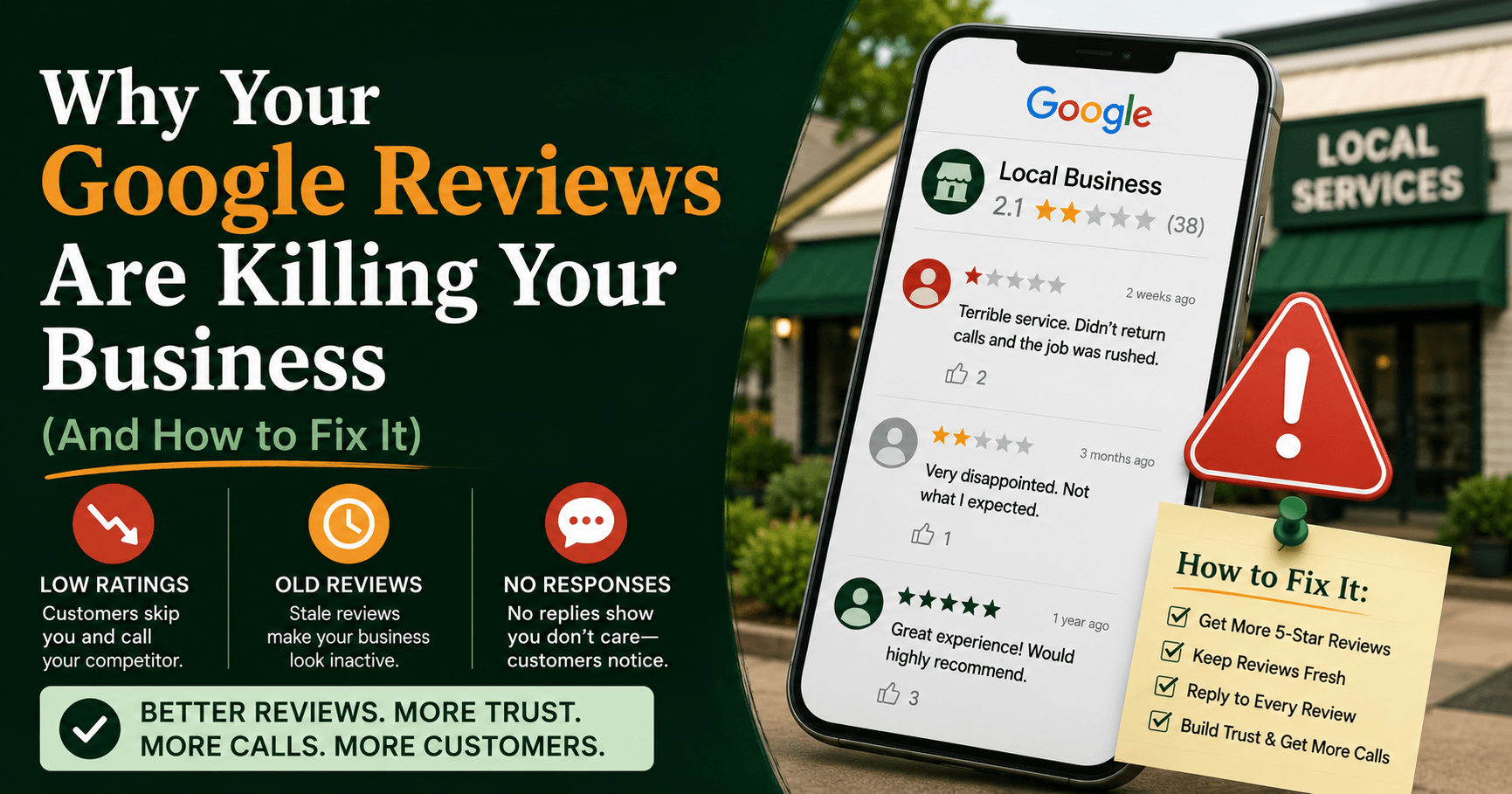
A homeowner needs a plumber right now. Water is on the floor. They grab their phone, search, and three businesses come up. Yours sits at 4.1 stars with a newest review from fourteen months ago. The company above you has 4.7 stars and a review from Tuesday. You already lost that job, and because the phone never rang, you will never know it happened.
Your Google reviews are costing you customers when three things are true at once: your rating is under 4.5, your newest reviews are months old, and you never reply. Research from Harvard Business School found that a one-star difference in rating moves revenue by 5 to 9 percent. Reviews are not a vanity metric. They are the filter people run before they decide whether you are worth a phone call.
Why does this problem stay invisible for so long?
Because the damage shows up as an absence. A bad review profile does not generate an angry email or a complaint. It generates silence. The calls you never got, from people who compared you to two competitors and quietly picked someone else, leave no trace in your books.
That is what makes this different from almost every other marketing problem. When a website is slow, you can see the bounce rate. When ads underperform, you can see the spend. But when your rating is filtering people out, all you notice is that things feel slower than they used to. We have audited enough local businesses to know that owners usually blame the season, the economy, or a new competitor in town long before they think to look at their own star rating. If you want the full picture of how this works across every platform, our complete guide to online reputation management for small businesses covers the whole system. This post is about the part that costs you money fastest.
What is a low Google rating actually costing you?
A one-star difference in rating is worth roughly 5 to 9 percent of revenue. That figure comes from a Harvard Business School study by Michael Luca, which matched review data against state tax records to isolate the causal effect of ratings on demand. The effect was strongest for independent businesses, which is exactly what most local companies are.
Run that against your own numbers. A business doing $600,000 a year is looking at somewhere between $30,000 and $54,000 riding on a single star. That is not a marketing budget line. That is a truck payment, a hire, or the difference between a good year and a tight one. And the study found this held regardless of whether the underlying quality of the business actually changed. Customers were responding to the number, not the reality behind it.
The uncomfortable part: this cuts both ways. If a competitor with worse crews and slower response times has a better rating than you, they are earning more than you on work you could do better. The rating is the product as far as the customer is concerned, right up until they hire someone.
What star rating do customers actually require in 2026?
Most consumers now require at least 4 stars, and a fast-growing segment will not consider anything under 4.5. BrightLocal’s Local Consumer Review Survey 2026, based on a panel of 1,002 US adults, found that 31 percent of consumers will only use a business rated 4.5 or higher. That figure was 17 percent the year before.
That jump is the single most important number in this post. The bar nearly doubled in twelve months. A rating of 4.3 that was perfectly competitive in 2025 is now invisible to roughly a third of the people searching for what you sell. The same survey found 68 percent require a minimum of 4 stars, and 97 percent read reviews before choosing a local business at all.
| Your Star Rating | Who You Are Still Visible To | What It Means for Your Phone |
| 4.5 and above | Everyone, including the 31% who filter hardest | You clear every threshold customers set |
| 4.0 to 4.4 | The 68% who require at least 4 stars | You lose the strictest third of your market before the call |
| 3.5 to 3.9 | A shrinking pool of price-driven shoppers | Most people skip you and call the business above you |
| Below 3.5 | Almost nobody comparing options | You are effectively invisible in a competitive search |
Why do old reviews hurt almost as much as bad ones?
Reviews expire in the customer’s mind. BrightLocal’s 2026 survey found that 74 percent of consumers look for reviews written in the last three months, and 32 percent want them from the last two weeks. A wall of glowing five-star reviews from 2022 tells a shopper that you were good three years ago, which is not the question they are asking.
This is where a lot of businesses get blindsided. They did a review push once, hit forty reviews and a 4.8, and considered the job finished. Two years later the rating still says 4.8 but the newest review is from last spring. To a customer scanning three options on a phone, that profile reads as a business that might not even be operating anymore.
Velocity beats volume. A business bringing in four or five new reviews a month will out-convert a business with three times the total count sitting stale. It also happens to be what Google rewards, which brings us to the second half of the problem.
Does it really matter if you never reply to reviews?
Yes, and more than most owners expect. BrightLocal’s 2026 survey found 80 percent of consumers are more likely to use a business that replies to all of its reviews. Replies are read as evidence that someone is paying attention, which is precisely what a homeowner is trying to establish before letting a stranger into their house.
But there is a trap here, and it is a big one. That same survey found 50 percent of consumers are actively put off by generic, templated responses. Fifteen identical “Thank you for your feedback, we appreciate your business!” replies in a row does more harm than saying nothing, because it signals that a tool is running your profile and nobody is actually reading. Meanwhile, 19 percent now expect a same-day reply, up from just 6 percent a year earlier.
So the standard has moved in two directions at once. Faster, and more human. That is annoying, and it is also an opportunity, because most of your competitors will do exactly one of those two things.
How do reviews affect whether Google shows you at all?
Reviews are the second-heaviest category of local ranking weight. Whitespark’s 2026 Local Search Ranking Factors report, published in November 2025 and compiled from 47 local search professionals scoring 187 individual factors, puts review signals at roughly 20 percent of what determines Local Pack placement, behind only Google Business Profile signals.
This is the compounding part. A weak review profile does not just lose you the customers who see it. It keeps you out of the Google Maps 3-Pack where most local searches get decided, which means fewer people see your profile in the first place, which means fewer reviews, which drops you further. The businesses that pull ahead in local search are usually not doing anything exotic. They are just feeding the two heaviest signals consistently, which starts with a properly built and fully optimized Google Business Profile.
Ratings, review count, recency, and whether you respond all feed into that 20 percent. None of them require a budget. All of them require a system.
Are reviews affecting whether AI recommends your business?
They are, and this is the newest wrinkle. BrightLocal’s 2026 data shows 45 percent of consumers now use AI tools like ChatGPT to find local businesses, up from 6 percent the year before. When someone asks an AI assistant for a good electrician nearby, the model is drawing heavily on review content and ratings to decide who to name.
The practical upshot is that your reviews are now doing double duty. They persuade the humans who read them and they feed the systems that decide whether a human ever sees you. We cover how that process works in our guide to getting your local business recommended by ChatGPT and AI search. The short version: businesses with thin, old, or unanswered review profiles are getting filtered out of AI answers the same way they get filtered out of the Map Pack.
How do you fix a damaged review profile?
You fix it with volume and consistency, not with tricks. Here is the sequence we run with local businesses, in order. Most see their rating move meaningfully within 60 to 90 days, because new reviews carry more weight in the average than you would guess once they start arriving steadily.
- Find out where you actually stand. Pull your current rating, your total count, the date of your newest review, and your response rate. Then do the same for the two competitors who outrank you. You can check how your profile stacks up with our free Google Business Profile checker. Most owners are surprised by the recency number more than the rating.
- Do the math on the gap. If you sit at 4.2 with 40 reviews and you want 4.6, you need roughly 40 new five-star reviews. That sounds brutal until you realize it is about seven a month for six months. Write the number down. A vague goal to “get more reviews” never survives a busy week.
- Fix whatever the bad reviews are telling you. Read the one-star and two-star reviews you already have and look for the pattern. If four people mention that nobody called them back, no amount of review generation solves that. We have watched businesses run a review campaign on top of an unaddressed scheduling problem and generate more one-star reviews faster.
- Build the ask into the job, not into a campaign. The request has to happen at the moment the customer is happiest, which is usually right when the work is finished and they can see it. A tech asking in person, on site, converts far better than an email sent three days later.
- Make it take under a minute. Use a short link or a QR code that opens straight to the review form. Every extra tap costs you a meaningful chunk of the people who genuinely intended to follow through.
- Reply to everything, in your own words. Reference the specific job. “Glad the panel upgrade went smoothly, Dave” beats a template every time, and it takes about the same twenty seconds. For negative reviews, respond quickly, stay calm, and take the conversation offline without sounding defensive.
- Do not stop when you hit the number. Recency decays. A business that hits 4.7 and then quits asking is right back where it started in eighteen months, with a good-looking average and nothing recent behind it.
What does this look like in practice?
Picture an HVAC company with two trucks, sitting at 4.2 stars with 38 reviews, the newest one from ten months ago. The owner is convinced the problem is Google Ads, because the calls dropped off and the ads are the thing he is paying for. The ads are fine. The clicks are coming. People land on the profile, see a 4.2 with nothing recent, and call the 4.8 down the road instead.
The fix is not complicated. Every tech asks at the end of every install, using a QR code on the back of the invoice. The office replies to every review within a day, by name, referencing the actual job. At about six a month, the rating crosses 4.5 in roughly four months and the newest review is never older than a week. The ad spend never changed. The conversion on that spend did.
That is the pattern we see over and over at Hometown Digital. Because we have spent time in the trades ourselves, we know the ask feels awkward the first dozen times you do it. It stops feeling awkward once you watch what it does to the phone.
Common Questions About Google Reviews and Your Business
How many Google reviews do I actually need?
Enough to look established and enough to keep the newest one recent. For most local businesses that means clearing 25 to 50 total, then adding four or more a month indefinitely. The ongoing flow matters more than the total, since 74 percent of consumers specifically look for reviews from the last three months.
Can I offer a discount for leaving a review?
No. Incentivizing reviews violates Google’s policies and can get your reviews removed or your profile suspended, and the FTC’s 2024 rule on consumer reviews put real penalties behind it. Asking is completely fine. Paying, discounting, or entering people into a drawing is not.
Can I get a bad review removed?
Only if it violates Google’s content policies, meaning it is spam, off-topic, contains profanity or personal attacks, or comes from someone who was never a customer. A negative review from a real customer who had a bad experience will not be removed, no matter how unfair it feels. Your best move there is a good public reply.
Is a 5.0 rating better than a 4.7?
Usually not. A perfect score with meaningful review volume reads as filtered or fake to a lot of shoppers, and only about 10 percent of consumers actually require five stars. A 4.7 with 120 recent reviews and thoughtful owner responses is a stronger asset than a 5.0 with 15.
How fast should I respond to a negative review?
Same day if you can, and within 48 hours at the outside. Nineteen percent of consumers now expect a same-day response, up from 6 percent the year before. Respond calmly, acknowledge the specific issue, and move the conversation to a phone call. You are not writing to the angry reviewer. You are writing to the next hundred people who read it.
How long does it take to fix a bad rating?
With a consistent system, most businesses see real movement in 60 to 90 days. How fast depends on your starting count. A profile with 20 reviews moves quickly because each new one carries weight, while a profile with 300 reviews and a low average takes considerably longer to shift.
Ready to find out what your reviews are costing you?
Your rating is doing one of two things right now. It is either bringing you customers or quietly handing them to the business ranked above you. Want to know where your reputation stands and what it might be costing you? Start with a free website audit. We will take a look at your reviews, your profile, and what is driving customers toward you or away.