A pipe bursts at 11 p.m. Water is spreading across the kitchen floor. The homeowner grabs their phone, types “emergency plumber near me,” and starts tapping. In the next 90 seconds, they will pick someone. If your site loads slow, looks dated, or makes it hard to just call you, they are already dialing the next plumber on the list. Most plumbing websites lose that customer without the owner ever knowing it happened.
Why don’t most plumber websites turn visitors into calls?
Most plumber websites don’t convert because they were built to look acceptable, not to move a stressed homeowner from panic to phone call. They load slowly, bury the phone number, skip proof that the plumber is licensed and reviewed, and fall apart on mobile, which is where nearly every emergency search happens.
Plumbing is not a bakery or a law firm. The buying decision happens fast, often under stress, and usually on a phone. Between 70% and 80% of plumbing service calls are urgent or emergency in nature, according to RevenueMemo. That one fact should change how the whole site is built. A visitor with a flooding bathroom is not reading your company story. They are scanning for two things: can this person help me right now, and can I trust them enough to let them in my house? We build sites for plumbing companies, and the same gaps show up again and again. The design might look fine on a laptop in the office. It just doesn’t do the one job it has when a real customer lands on it.
What does a plumbing customer actually want from your website?
A plumbing customer wants three things, fast: proof you can help, a reason to trust you over the other guy, and a one-tap way to call. According to BrightLocal’s 2024 Local Consumer Review Survey, 94% of homeowners start their search for a contractor online, and 81% read reviews before they ever pick up the phone.
So the site is not the last step before a call. It is the whole audition. If a homeowner lands on your page and can’t immediately see that you are local, licensed, and well reviewed, they bounce back to the search results and try the next name. And here is the part that stings: most of these plumbers are getting traffic. People are finding the site. They just aren’t calling. If that sounds familiar, the problem is almost never traffic. It is conversion. We broke down why a website stops bringing in customers in more detail, but for plumbers it usually comes down to speed, trust signals, and how easy it is to make contact.
Why is mobile the whole game for plumbers?
For plumbers, mobile isn’t part of the picture. It is the picture. Nearly 60% of all web traffic now comes from phones (Statista, 2025), and for emergency home services that share runs even higher, because people search mid-crisis and on the move. If your site is clumsy on a phone, you are losing the exact customer you most want to win.
Speed is the first thing that kills these sites. Google’s research found that 53% of mobile visitors abandon a page that takes more than three seconds to load. Three seconds. A homeowner standing in an inch of water does not have the patience your laptop preview suggests they do. The second killer is the phone number. On too many plumber sites, the number is a tiny image at the top that can’t be tapped, or it is stuck in a footer three scrolls down. It should be a big, tappable, click-to-call button on every screen. If you are not sure how your own site holds up, here is how to find out whether your website actually works on mobile.
What makes a plumber’s site look trustworthy in the first five seconds?
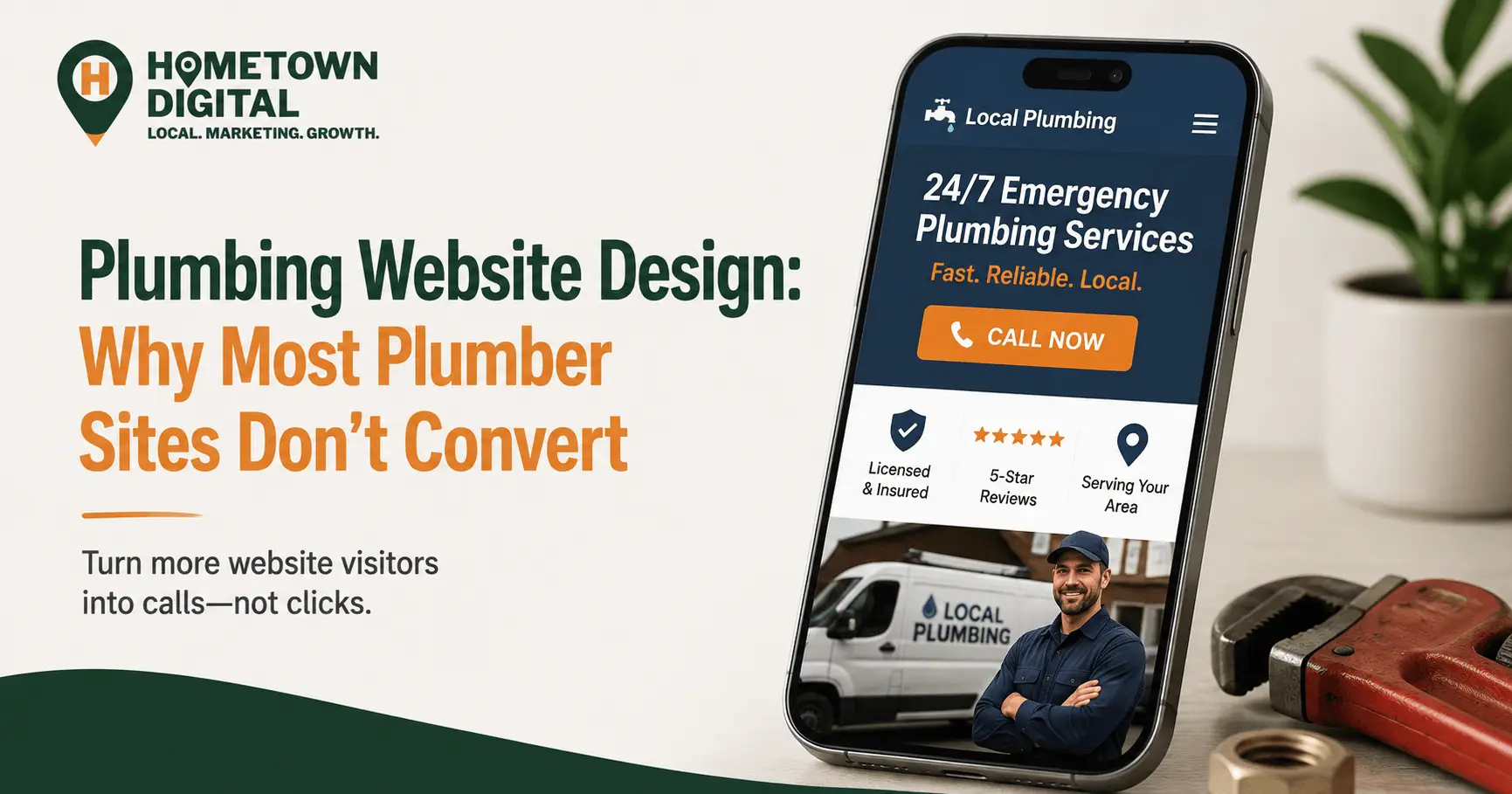
Trust gets decided in seconds, mostly before anyone reads a full sentence. Research from Stanford found that 75% of people judge a company’s credibility based on website design alone. For a plumber, that means clean design, a visible license number, star ratings near the top, your service area, and real photos of your team and trucks do more work than any paragraph of copy.
Think about what a nervous homeowner is really asking. Is this a real local company or some national lead service pretending to be local? Are they licensed and insured, so I am not liable if something goes wrong? Have other people in my town used them and been happy? A generic template with a stock photo of a shiny wrench answers none of that. It actually raises suspicion. Real photos, a local phone number, an address or service area map, and reviews you can see without hunting for them do the opposite. They make you the safe choice in a moment when nobody wants to gamble.
The 7 things every plumbing website needs to convert
A plumbing website that converts does a handful of specific things well. It makes calling effortless, proves you are legitimate, and answers the homeowner’s fear before they have to ask it. Here are the seven elements we build into every plumber site we touch.
- A tap-to-call phone number in the header, visible on every page and every screen size.
- A clear service area, so a visitor knows in one glance whether you even cover their town.
- Real reviews and star ratings near the top, not buried on a separate testimonials page.
- Your license number, insurance, and any certifications shown plainly, not hidden in fine print.
- Fast load speed, especially on mobile. Aim for under three seconds.
- Emergency or same-day availability stated up front if you offer it, since that is what the urgent searcher is scanning for.
- Actual photos of your team, trucks, and finished work. Not stock images anyone can spot in a second.
None of these are fancy. That is the point. The plumbers who win online aren’t the ones with the flashiest site. They are the ones whose site removes every reason to hesitate.
But a great website isn’t enough if nobody finds it
Here is the hard truth. The best plumbing website in your town does nothing if it never shows up when someone searches. For urgent trades, most jobs go to whoever appears in the Google Maps 3-pack at the top of local results. Your site converts the click, but local search has to earn that click first.
This is where a lot of plumbers get it backwards. They spend on a nice site and then wonder why the phone is quiet. A site and local visibility are two halves of one machine. If you want to understand the piece that gets you seen, start with how to get into the Google Maps 3-pack and stay there. And because the site, the Google profile, reviews, and ads all feed each other, we treat them as one system rather than separate projects. Our marketing playbook for home service businesses walks through how those pieces fit together for trades. For the design fundamentals that apply to any local business site, our complete guide to small business website design covers the groundwork.
What this looks like in practice
Take a plumber with a site that looks perfectly fine. Clean enough, a few pages, a services list. But the calls aren’t coming, and they can’t figure out why. When we audit a site like that, the problems are almost always the same handful. The phone number is an image, not a tappable link, so every mobile visitor has to memorize it and dial manually. Half of them don’t. There are no reviews visible anywhere on the homepage, so a first-time visitor has no reason to trust them over the competitor one search result away. The page takes six seconds to load on a phone, which means a chunk of visitors leave before they see anything. And there is no service area listed, so people two towns over can’t tell if they should even bother calling.
Fixing that usually doesn’t take a full rebuild. Make the number tappable. Pull the best Google reviews onto the homepage. Compress the images and clean up the code so it loads fast. Add a simple service area line and an emergency callout. We have watched changes that small turn a quiet site into one that books jobs, because the traffic was already there. It just had nowhere good to land.
Common Questions About Plumbing Website Design
How much does a plumbing website cost?
It varies widely, from a few hundred dollars for a simple managed site to a few thousand for a custom build. What matters more than the sticker price is whether the site is built to convert. A cheap site that loads fast, works on mobile, and makes calling easy will out-earn an expensive one that looks pretty and does nothing. Ask what the site is designed to do, not just what it costs.
Do I need a brand-new website or can I fix my current one?
Often you can fix what you have. If your site looks reasonable but isn’t generating calls, the issue is usually a few specific things: slow load speed, a phone number that can’t be tapped, missing reviews, or a weak mobile layout. Those are fixes, not rebuilds. A full rebuild makes sense when the site is genuinely outdated, not mobile friendly at its core, or built on a platform that can’t be improved.
What is the single most important thing on a plumber’s website?
A tap-to-call phone number that is visible on every page and every screen size. Plumbing is an urgent, phone-driven business. Most of your customers want to call, not fill out a form. If the number is hard to find or can’t be tapped on a phone, everything else you did to the site is working against a locked door.
How fast should my plumbing website load?
Under three seconds on mobile, and faster is better. Google’s research found that 53% of mobile visitors leave a site that takes longer than that. For emergency searches, where the homeowner is stressed and comparing options quickly, a slow site loses the job before your services page even appears.
Should my plumbing website focus on emergency work?
If you offer emergency or same-day service, say so clearly and near the top, because that is what a large share of your searchers need. Between 70% and 80% of plumbing calls are urgent or emergency, according to RevenueMemo. That said, don’t hide your other services. Lead with the urgent work that drives the call, then make it easy to see everything else you handle.
Do plumbers really need a website if they already have Google and Angi?
Yes. Your Google Business Profile helps you get found, but the website is where a homeowner decides whether to trust you, and it is an asset you own. Lead services like Angi rent you access to customers and charge per lead, often for shared leads that go to several plumbers at once. A strong site plus your own Google presence lets you own those customers instead of paying for them every time.
See what your plumbing website is actually doing
If you run a plumbing company and want to see exactly where you stand online, get a free website audit. We’ll look at your site, your Google presence, and your reviews, then tell you what we’d fix first to turn more visitors into booked jobs. No pressure, just an honest look at what’s working and what’s quietly costing you calls.