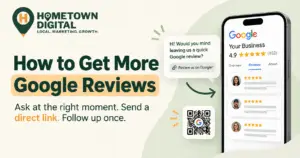
Asking for reviews is the single most effective thing you can do for your online reputation. But the way a lot of local businesses ask, offering a discount, handing over a tablet, only messaging the customers who seemed happy, is now against the rules. And in 2026, Google is actually enforcing it. Here’s how to get more customer reviews the right way, without risking a fine or a profile that gets wiped clean.
Why is getting reviews suddenly so risky?
Getting more reviews isn’t risky. How you ask can be. Google now classifies incentivized reviews, review gating, and on-premises pressure as “Fake Engagement,” and its automated systems are actively removing violating reviews and restricting profiles. The FTC added federal penalties on top of that in 2024. The old shortcuts didn’t just get riskier, they became punishable.
For years, the common advice was “offer 10% off for a review” or “only send the link to the customers who seemed happy.” That advice is now a liability. In early 2026, Google tightened its review policies and started going after practices that had been standard operating procedure in home services, healthcare, and retail for years. Pair that with the FTC’s 2024 rule and you’ve got two separate authorities that can penalize the same move. This post is part of our larger guide to online reputation management for local businesses, focused on the one question owners ask most: how to get customer reviews without stepping on a landmine.
What’s the fastest way to get more customer reviews?
The fastest way to get more customer reviews is to ask every customer, every time, right after you’ve done the work. According to BrightLocal’s 2026 Local Consumer Review Survey, 83% of people who were asked to leave a review went on to leave one, and only 6% of consumers say they’d never write one. The demand is there. Most businesses just don’t ask.
That same BrightLocal survey found 78% of consumers were asked to leave feedback in the last 12 months, and 65% wrote a review after being asked. Willingness is climbing, too: 28% of people now say they’ll “always” write a review when prompted, up from 16% the year before. The average consumer writes four to six reviews a year, so these aren’t people who hate leaving feedback. They’re waiting to be asked. The real mistake most owners make isn’t asking the wrong way. It’s not asking at all, or asking once and quietly giving up.
One more thing worth knowing: volume isn’t the whole game. A steady flow of recent reviews carries more weight than a big one-time batch that then goes stale, because both customers and Google pay attention to how fresh your feedback is. That’s the real argument for a simple, always-on asking habit rather than a review “push” once a year. Ask a little, all the time, and the reviews keep coming without you thinking about it.
When should you ask?
Ask when the experience is still fresh. For quick services, the same day works best. For bigger jobs, a day or two later gives the customer time to see the result. BrightLocal’s data shows people expect faster review prompts from some industries than others, so match the timing to the work. A roofer can wait a couple of days. A coffee shop shouldn’t.
What review practices actually break Google’s rules?
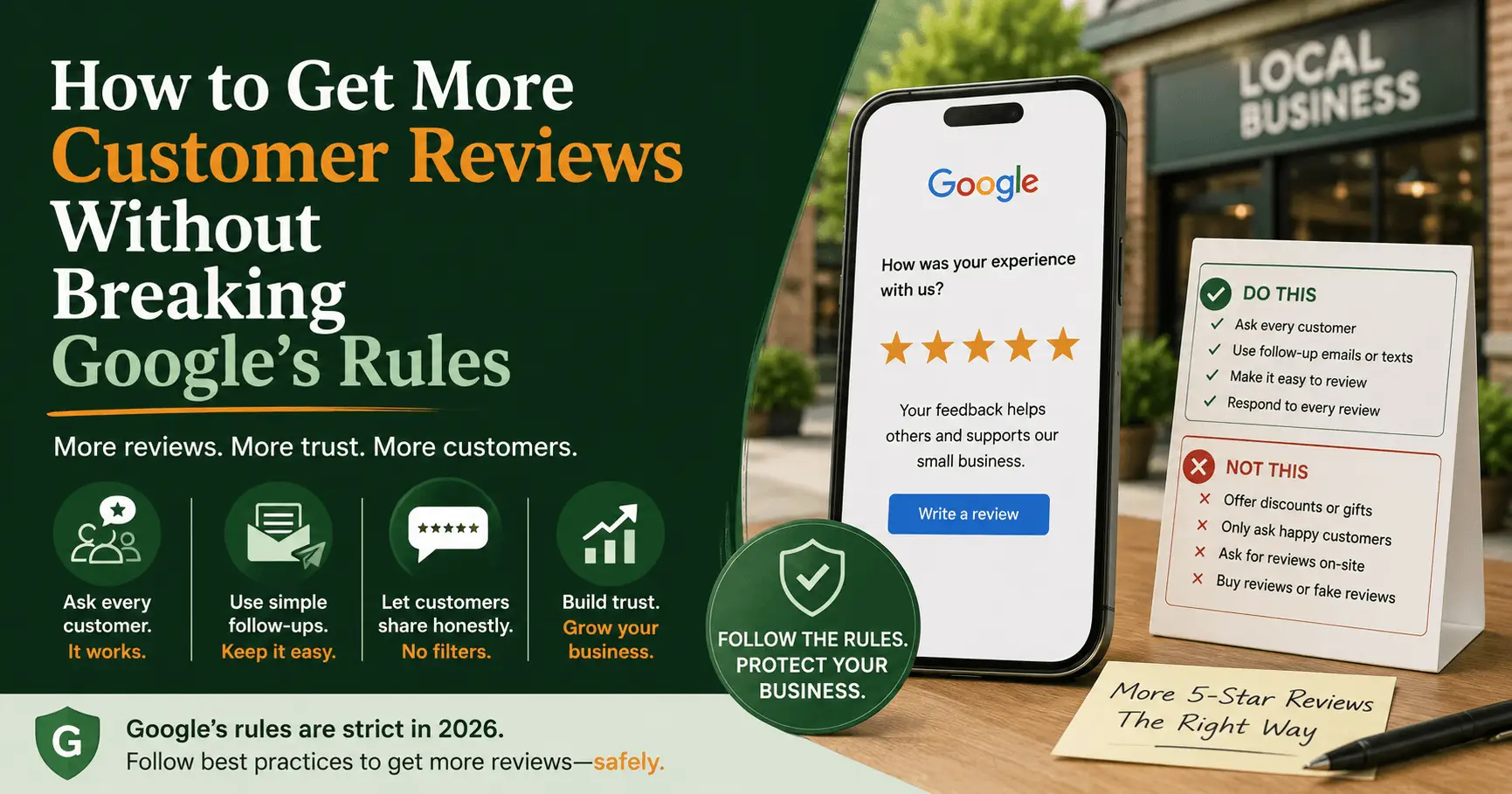
Google prohibits any review obtained through incentives, pressure, or selective targeting under its Fake Engagement policy. That covers paying for reviews, offering discounts or freebies, gating out unhappy customers, pressuring people to review on-site, setting staff review quotas, and asking customers to name a specific employee. Any one of these can get reviews removed or your profile restricted.
Here’s the clearest way to see the line. The left column is fine. The right column can cost you your reviews, or your visibility.
| Allowed | Against Google’s rules |
| Asking every customer to leave an honest review | Offering a discount, gift, or perk in exchange for a review |
| Sending a review link by email or text after the job is done | Sending the link only to customers you expect to be happy (review gating) |
| Reminding a customer once or twice | Pressuring a customer to review while they’re still on your premises |
| Responding to every review, good or bad | Asking customers to mention a staff member by name or include specific wording |
| Making it easy with a direct Google review link or QR code | Buying reviews, or posting them from employee or family accounts |
If you’ve been handing customers a tablet at the counter, telling your crew to “get five reviews this week,” or asking people to “mention Dave when you leave the review,” you’re squarely in the zone Google started cleaning up in 2026. None of it feels like cheating. All of it is now a policy violation.
What happens if Google catches it?
Enforcement runs on a ladder, and it’s largely automated now. The first step is usually removal of the offending reviews, which means the reviews you worked to collect simply vanish. Repeat or serious violations move up to profile restrictions, where you temporarily can’t receive new reviews at all, and at the top of the ladder is suspension, where your listing disappears from Maps and Search entirely. For a local business, that last one is brutal, because your Google Business Profile is functionally your storefront. Chasing a few extra stars is not worth going invisible for a month.
Is offering a discount for a review against the rules?
Yes. Offering any incentive for a review, whether it’s a discount, a gift card, a free service, or loyalty points, violates Google’s policy and, since October 2024, federal law. The FTC’s fake-review rule bans compensation conditioned on a review expressing a particular sentiment, positive or negative, with civil penalties of up to $51,744 per violation for knowing offenders.
The common misread is “it’s fine as long as I don’t ask for five stars.” It isn’t. Both Google and the FTC put the prohibition on the incentive itself, not on whether you specify a rating. The moment a reward is attached to the review, the review is compromised. BrightLocal’s numbers show businesses are already backing away from this: the share of consumers offered a discount for a review fell from 45% in 2024 to 27% in 2026, largely because owners realized it breaks platform guidelines. You can still thank a loyal customer after the fact. What you can’t do is make the reward the reason they left the review.
What is review gating, and why is it now a violation?
Review gating is the practice of screening customers before you ask, so only the ones you expect to be happy get a review request. It used to be sold as smart “reputation management.” Google now bans it outright, and its 2026 enforcement can remove every review tied to a gating process, not just the gated ones.
The logic sounds reasonable: survey people first, send the Google link to the five-star crowd, and steer unhappy customers to a private complaint form instead. But that’s exactly what Google calls selective solicitation, and it’s deceptive by design because it manipulates your public rating. Requests have to go to everyone equally. That feels scary if you’re worried about a bad review, but it shouldn’t. A wall of nothing but flawless five-star reviews reads as fake to customers anyway. A few honest three- and four-star reviews actually make the good ones believable. What matters far more is how you respond to the negative reviews when they show up.
How do you ask for reviews the right way?
Ask every customer, at the right moment, through a channel they’ll actually use, with a link that takes one tap. Then respond to what comes in. A compliant review system isn’t complicated. It just has to be consistent and open to everyone, instead of quietly steered toward the outcome you want.
- Ask everyone, not just your favorites. Send the same request to every customer once the work is done. Equal treatment is the rule, and it’s also what keeps your rating honest.
- Time it right. Ask while the experience is fresh, same day for quick services, a day or two later for bigger jobs. The closer to the moment, the higher the response.
- Make it one tap. Use your Google Business Profile’s direct review link or a QR code so nobody has to hunt for your listing. Friction kills follow-through. If your profile itself isn’t fully set up, start there first.
- Pick the channel your customers use. BrightLocal found the most common ways businesses ask are by email, on receipts, in person, and by text. For local service work, text and email tend to convert best.
- Keep the ask open-ended. Ask for an honest review of their experience. Don’t script the wording, don’t request a star count, and don’t ask them to name an employee. That last one became a violation in 2026 and a lot of businesses still miss it.
- Respond to every review. Replying to the good and the bad shows you’re paying attention and nudges the next person to write one. BrightLocal found the vast majority of consumers expect owners to respond to reviews, so silence costs you.
Reviews don’t just build trust with the people reading them. They’re one of the strongest signals in local search, which is a big part of why they help you show up in the Google Maps 3-Pack. Do this consistently and you get two wins from one habit: more trust and better visibility.
What does a compliant review system look like in practice?
Picture a plumber wrapping up a water-heater install. Before packing up, they let the homeowner know a quick text is coming with a link to leave a review, and that honest feedback helps other people in the neighborhood find them. An hour later, an automated text goes out with a one-tap Google link, the same message every customer gets, whether the job went perfectly or not. No discount. No “can you mention me by name?” No pre-screening survey.
Over a few months, that plumber goes from a handful of stray reviews to a steady stream, because they finally asked everyone, every time. When a three-star review lands, they respond politely, fix what they can, and move on. That’s the entire system. It’s boring, it’s repeatable, and it’s completely within the rules. It’s also the kind of setup we build for the local businesses we work with at Hometown Digital, because after years in the trades ourselves, we know owners want more calls and more booked jobs, not another clever tactic that gets them penalized. Not sure your Google profile is even set up to collect reviews properly? Our free GBP checker will tell you where you stand in a couple of minutes.
Common Questions About Getting More Reviews
Can I offer a discount to customers who leave a review?
No. Any incentive tied to a review, a discount, gift card, free service, or loyalty points, violates Google’s Fake Engagement policy and the FTC’s 2024 rule. It doesn’t matter whether you ask for a specific star rating. The reward itself is the problem. You can thank customers, but the thank-you can’t be the reason they reviewed.
Is it OK to only ask my happy customers for reviews?
No. That’s review gating, and Google explicitly prohibits it. Screening customers by expected sentiment manipulates your public rating, and in 2026 the penalty can include removing all of your reviews, not just the gated ones. Send the same request to every customer.
Can my employees leave reviews for my business?
No. Reviews from employees, family members, or business partners are conflict-of-interest reviews. Google removes them, and the FTC requires any insider review to clearly disclose the relationship. It’s not worth the risk to your credibility or your profile.
How many reviews do I actually need?
There’s no magic number. Volume, recency, and your average rating all matter, and consumers are increasingly willing to choose a business with fewer reviews as long as they’re recent and honest. Consistency beats chasing a target. A steady trickle of new reviews signals an active, trustworthy business better than a one-time pile.
What’s the best way to ask, email or text?
Both work well and both are among the most common methods businesses use. Text often gets faster responses for local service work, while email gives you room for a friendly note and a clear link. The best channel is the one your customers already use. Whatever you pick, make the review link one tap.
What should I do about a bad review?
Don’t panic, and never try to bury it with incentivized or fake positives. Respond professionally, acknowledge the issue, and offer to make it right. A few honest negatives make your positive reviews believable, and a calm, helpful response often does more for your reputation than the review itself did damage.
Ready to get more reviews the right way?
Getting more reviews is the highest-return reputation move most local businesses still aren’t making, and doing it the honest way is simpler than the workarounds ever were. Want to know where your reputation stands and what it might be costing you? Start with a free website audit. We’ll take a look at your reviews, your Google profile, and what’s quietly driving customers toward you or away.