A homeowner leaves you a one-star review at 9 p.m. It is the first thing you see when you grab your phone in the morning, and your stomach drops. Maybe the complaint is fair. Maybe it is not. Either way, it is sitting there in public, where every future customer can read it before they decide whether to call you.
Here is the good news. How you respond matters more than the review itself. To respond to a negative review, stay calm, reply publicly within a few days, thank the person for the feedback, acknowledge their experience, apologize where an apology is warranted, and then move the details into a private conversation. Keep it short. Stay professional. Never argue in public. Done right, a good response does not just settle one upset customer. It tells everyone else reading that you stand behind your work, and over time it can actually raise your rating.
Why bother responding to negative reviews at all?
Responding to negative reviews is worth your time because it changes two things at once: how future customers judge you, and how Google ranks you. The person you are replying to has usually made up their mind already. The audience that matters is everyone else reading the thread, and they are watching how you handle criticism.
The numbers back this up. Research from Harvard Business School found that a one-star increase in a business’s online rating can lift revenue by 5 to 9 percent. So anything that protects or improves your rating has real money attached to it. And responding does improve it. A study of TripAdvisor hotels, published in Harvard Business Review, found that when businesses started responding to reviews, they earned 12 percent more reviews and their average rating climbed by about a tenth of a star. That sounds small until you learn that one-third of those businesses pushed their rounded star rating up by half a star or more within six months of their first reply.
Customers notice too. According to BrightLocal’s Local Consumer Review Survey, 88 percent of consumers would use a business that replies to all of its reviews, compared to just 47 percent who would use a business that never responds at all. Read that again. Silence roughly cuts your consideration in half. If you want the full picture on what a stack of unanswered one-star reviews is quietly costing you, we broke it down in our guide to what bad Google reviews do to your business. For now, just know that ignoring reviews is a decision, and it is an expensive one.
What does a good response to a negative review actually include?
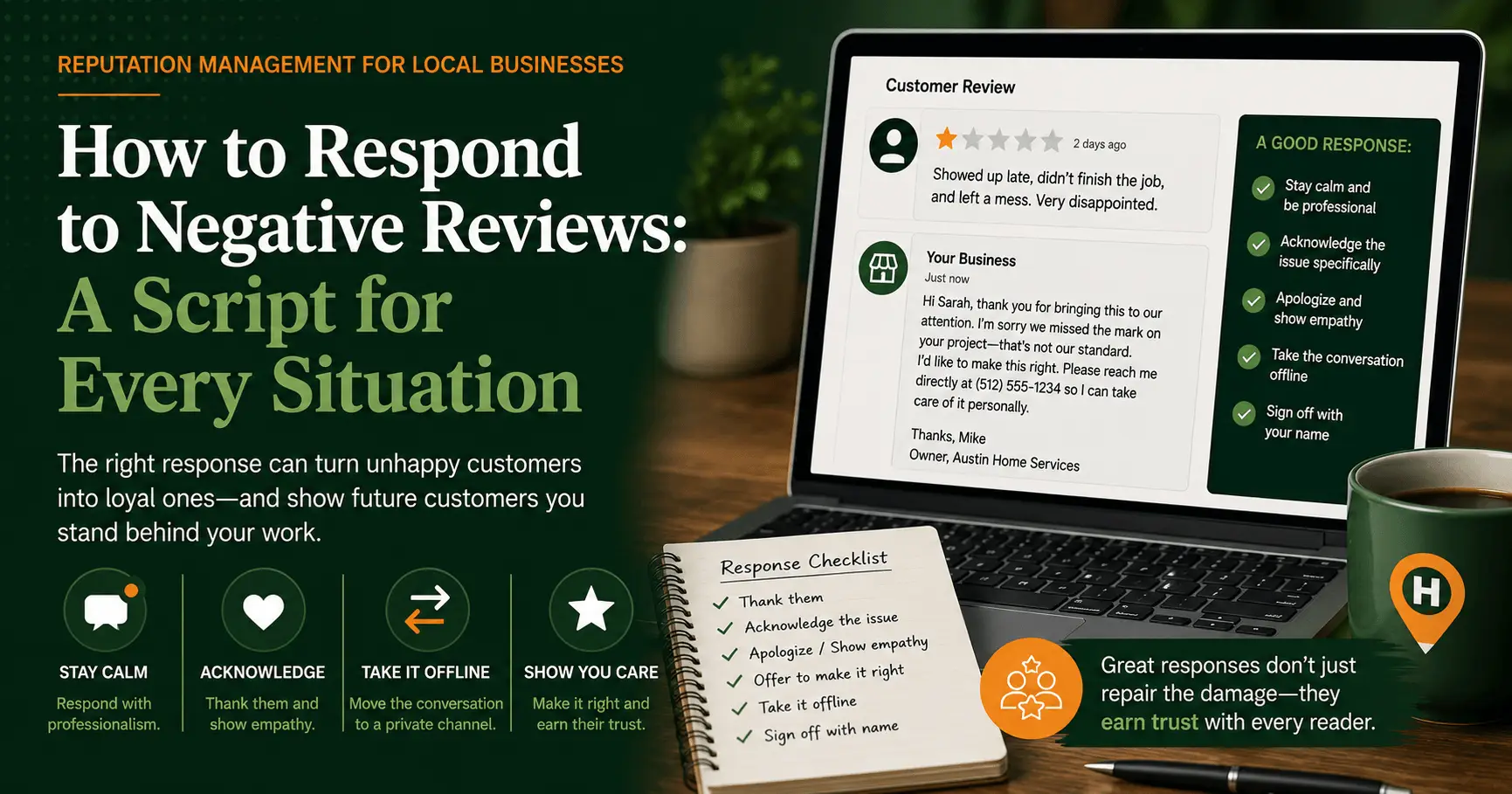
A good response to a negative review has six parts: a calm opening, a specific acknowledgment of what went wrong, an apology or a note of empathy where it fits, a brief and factual account of your side only if it is needed, an invitation to continue privately, and a sign-off with your name. Skip the acknowledgment or the take-it-offline step and the whole thing falls flat.
Most of these reviews are going to land on your Google Business Profile, which is where the majority of local customers read and leave feedback in the first place. If your profile is not fully set up, responding well will not carry as much weight, and we walk through fixing that in our Google Business Profile optimization guide. Once you are set up, here is the anatomy of a reply that works:
- A calm, professional opening. Thank the person for taking the time. No sarcasm, no defensiveness, even if the review stings.
- A specific acknowledgment. Reference the actual issue they raised so it is clear you read it and you are not pasting a canned reply.
- An apology or genuine empathy where it fits. You do not have to grovel. “I am sorry your install ran late” is plenty.
- Your side, briefly, and only if the facts need correcting. State it as fact, not as an argument. One sentence, not three paragraphs.
- A move to take it offline. Give a name, a direct phone number, or an email so the rest of the conversation happens privately.
- A sign-off with a real name and your business. It reads as human, and it tells the next reader a real person stands behind the company.
That is it. You are not writing a legal brief. You are showing a hundred silent readers how you treat people when something goes wrong.
How to respond to negative reviews: a script for every situation
The right response depends on the situation. A legitimate complaint calls for ownership. An unfair or fake review calls for a calm, factual correction. Below are field-tested scripts for the six situations local businesses run into most, written so you can adapt each one in about two minutes. Swap in the bracketed details and you are done.
When the complaint is legitimate and you dropped the ball
This is the easiest one to get right, and the one owners most often get wrong by going on the defensive. Own it, apologize, and show you are already fixing it.
A response that works: “Hi [Name], thank you for letting us know, and I am sorry we missed the mark on your [job type]. That is not the standard we hold ourselves to. I would like to make it right. Please reach me directly at [phone] and I will take care of it personally. Thanks, [Your name], [Business].”
When the review is unfair or exaggerated
Stay calm. The reader can usually spot an overblown review, but only if you do not match the reviewer’s tone. Correct the record gently and move it to a private channel.
A response that works: “Hi [Name], I appreciate the feedback, though our recollection of the visit is a little different. We arrived on the scheduled day and completed the work as quoted. I would genuinely like to understand where things went sideways for you. Could you call me at [phone]? I want the chance to sort this out. [Your name], [Business].”
When the customer is wrong about the facts
Correct the specific fact plainly, without making the person feel foolish. State what actually happened, offer the proof, and stop there.
A response that works: “Hi [Name], thanks for reaching out. I want to clear up one thing: the [part or service] you mentioned was actually covered under the original quote, and we have that in writing from [date]. I am happy to walk through the paperwork with you anytime at [phone]. [Your name], [Business].”
When it is a fake review or from someone who was never your customer
First, flag it with Google for removal, since reviews from non-customers violate the platform’s policies. Then post a short, calm public reply so future readers see you are on top of it. Do not accuse or insult, even if you are certain it is bogus.
A response that works: “Hi [Name], we take every review seriously, but we do not have any record of doing work for you and cannot find your name in our system. If we have made a mistake, please contact us at [phone] so we can look into it. If this was posted in error, we would appreciate you removing it. [Your name], [Business].”
When they are angry about the price
Do not relitigate the invoice in public. Acknowledge the concern, restate that the price was agreed up front, and invite a private conversation to go through the numbers.
A response that works: “Hi [Name], I understand price is always a real consideration, and I am sorry you felt the final cost was high. Everything was quoted and approved before we started the work, but I am glad to walk through the invoice line by line with you. Give me a call at [phone] and we will go through it together. [Your name], [Business].”
When it is something outside your control
Weather delays, a manufacturer’s backorder, a supplier who let you down. You still respond, because the reader does not know the backstory. Explain it briefly and show you did what you could.
A response that works: “Hi [Name], I am sorry the project ran long. The delay came from a [supplier or manufacturer] backorder that was out of our hands, and we kept working to get your job finished as fast as possible. I would still like to make the wait up to you. Please reach me at [phone]. [Your name], [Business].”
Notice what all six have in common. They are short. They stay calm. And they push the messy part of the conversation off the public page and onto a phone call. That is the whole game.
Does responding to reviews actually help you show up on Google?
Yes. Responding to reviews is one of the signals Google weighs when it decides who shows up in the local map results. According to Whitespark’s 2026 Local Search Ranking Factors survey, review signals account for roughly 20 percent of what determines local pack rankings, and how a business responds to reviews is part of that mix.
So responding is not just customer service. It is local SEO. The businesses that consistently reply, keep a steady flow of fresh reviews, and hold a strong rating are the ones that tend to lock down the top three spots in the map pack, which is where most of the clicks and calls concentrate. We get into how that map ranking actually works in our guide to getting into the Google Maps 3-pack. The short version: an active, well-managed review profile helps you rank, and a neglected one holds you back.
What about the reviews you genuinely cannot fix?
Some negative reviews will not come down and cannot be resolved. The customer never calls back, or Google will not remove it. When that happens, the answer is not to obsess over the one bad review. It is to make it a smaller and smaller share of your total by earning a steady stream of new, positive ones.
Think about it in terms of averages. One one-star review sitting under ten reviews drags your rating hard. That same review under two hundred reviews barely moves the needle. This is why the businesses that handle criticism best are also the ones actively asking happy customers for feedback. We cover exactly how to do that without breaking Google’s rules in our post on getting more customer reviews.
Here is what this looks like in practice. Say you run a landscaping crew and a customer blasts you over a miscommunication about cleanup. You reply within a day, own the part that was on you, and offer to send a crew back out. Whether or not they take you up on it, the next homeowner comparing three landscapers sees a company that answers, takes responsibility, and does not panic. Meanwhile you keep asking your happy clients to leave a quick review, so your rating stays where it should be. That is not luck. That is a system, and it is the core of what real online reputation management actually is.
We have spent years in the trades ourselves, so we know the instinct is to fire back when someone trashes work you are proud of. Resist it. The calm reply almost always wins the reader, and the reader is the one who becomes your next customer.
Common Questions About Responding to Negative Reviews
How quickly should I respond to a negative review?
Within a few days at most, and sooner is better. BrightLocal’s 2026 Local Consumer Review Survey found that 81 percent of consumers expect a response within a week, and 19 percent now expect one the same day they post. A fast, calm reply shows you are paying attention. Set up email alerts so a new review never sits unseen for a week.
Should I respond to every negative review, or just some?
Respond to every one you reasonably can. Consumers notice when businesses cherry-pick which reviews to answer, and a pattern of ignored complaints reads worse than the complaints themselves. Even a short, professional reply to an older review beats silence.
Can I get a fake or unfair review removed?
Sometimes. If a review violates Google’s policies, for example it is from someone who was never a customer, contains hate speech, or is spam, you can flag it for removal through your Google Business Profile. Genuine but negative reviews usually will not be removed, so plan to respond to those rather than fight them.
Should I offer a refund or discount in my public reply?
No. Keep the money talk private. In the public reply, acknowledge the issue and invite the customer to contact you directly. Offering refunds in public can invite bad-faith complaints from people fishing for freebies. Handle the resolution offline.
What if responding just makes the customer angrier?
Sometimes it will, and that is okay, because you are not really writing for that customer. You are writing for the hundreds of future customers reading the exchange. As long as you stay calm, factual, and professional, an angrier reply from them tends to make you look better by comparison, not worse.
Is it worth responding to negative reviews that are months old?
Yes. A thoughtful reply to an older review still reassures new readers, and it signals to Google that your profile is active. If you are not sure how healthy your current profile and reviews look, our free Google Business Profile checker will show you where you stand in a couple of minutes.
Ready to turn your reviews into an advantage?
Handling reviews well is one piece of a bigger picture, and it is hard to see that picture clearly from the inside. Want to know where your reputation stands and what it might be costing you? Start with a free website audit. We will take a look at your reviews, your Google profile, and what is driving customers toward you or away, and tell you exactly what we would fix first.