You open your phone on a Monday morning and there it is. A one-star review from someone you’ve never done a job for. Your rating dips, and all you can think about is the next customer who scrolls past it.
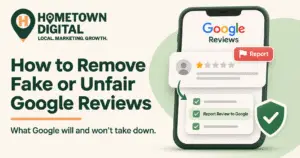
Here’s the straight answer. Google will only take down a review that breaks one of its content policies, like fake engagement, conflicts of interest, harassment, hate speech, personal information, or off-topic rants. It won’t remove a review just because it’s negative or feels unfair. To remove fake Google reviews, you report each one against a specific policy, track it in Google’s Reviews Management Tool, and use your one-time appeal if the first answer is no.
Why does one fake Google review feel like such a big deal?
Because people read them, and they read the newest ones first. BrightLocal’s 2026 Local Consumer Review Survey found that 97% of consumers read reviews for local businesses. If you’re a small shop with 30 or 40 reviews, one fake one-star can visibly drag your average down and sit at the top of the “newest” sort for weeks.
And it isn’t a rare problem. According to Google, its systems blocked or removed more than 292 million policy-violating reviews in 2025, up from more than 240 million in 2024. That’s a staggering amount of junk getting caught. It also means some of it slips through, and when it lands on your profile, you’re the one who has to deal with it.
Reviews are only one part of your broader online reputation management picture. But they’re the part customers see first, which is why it pays to know exactly what Google will and won’t do about them. (We’ve spent time in the trades ourselves. A bad word-of-mouth story used to stay at the supply house. Now it’s pinned to your listing.)
Which Google reviews can actually be removed?
Google removes reviews that violate its Maps user-generated content policy. For local businesses, the categories that matter most are fake engagement, conflict of interest, harassment, hate speech, personal information, profanity used to attack, unsupported accusations of crimes, and off-topic content. If you can’t tie a review to one of these, it’s very unlikely to come down.
Here’s how that plays out with the reviews owners actually run into:
| The review you’re dealing with | Removable? | Policy to cite |
|---|---|---|
| Someone who was never your customer | Often, but proof is the hard part | Fake engagement (not based on a real experience) |
| A competitor trashing your business | Yes | Conflict of interest |
| A current or former employee | Yes | Conflict of interest (includes former employment) |
| Several reviews from one person using multiple accounts | Yes | Fake engagement |
| Threats, slurs, or personal attacks | Yes | Harassment or hate speech |
| Accuses you of a crime with nothing to back it up | Possibly | Offensive content (unsubstantiated allegations of criminal wrongdoing) |
| Posts someone’s last name, phone number, or home address | Possibly | Personal information |
| A political rant or complaint unrelated to your business | Yes | Off-topic |
| Profanity used to hammer home a complaint | Yes | Obscenity and profanity |
| A review someone got a discount or freebie to write | Yes, and it can get your profile restricted | Rating manipulation (incentivized review) |
Two policy details most owners miss
First, the conflict of interest rule covers former employees as well as current ones. So the one-star from the tech you let go last spring is fair game to report.
Second, the personal information rule has an exception for professionals who do business under their own name, and Google specifically lists contractors. A review that says “Mike from the plumbing company was rude” will usually stay. A review that posts Mike’s last name and home address is a different story.
What reviews will Google refuse to take down?
Google won’t remove a review because it’s negative, because you think it’s unfair, or because you and the customer remember the job differently. Google’s own help page says it doesn’t get involved in conflicts between businesses and customers. If a real customer described a real experience without breaking a policy, the review stays.
That includes reviews like these:
- A real customer who’s angry about your price, even if the price was fair and agreed to up front
- A review that gets details wrong, like the date of the job or how long it took
- Harsh but civil criticism. Google’s policy explicitly allows reviews that describe negative experiences in a respectful way.
- Old reviews about problems you’ve since fixed
- A bare star rating with no text, unless it’s part of an obvious pattern of fake activity
This is the part nobody likes hearing. The truth is, the review that stings the most is usually from a real customer, and the fix for that isn’t removal. It’s a calm public reply (we cover how in our guide to responding to negative reviews) and a steady flow of newer, better reviews. If that second part is your weak spot, here’s how to get more Google reviews without breaking any rules.
How do you report a fake Google review?
Report it from your Business Profile or, better, through Google’s Reviews Management Tool. Pick the policy the review violates and submit. Google says evaluation typically takes several days. The Reviews Management Tool is the route we recommend, because it’s where you check the status and where your appeal option lives if Google says no.
- Screenshot the review first. Capture the reviewer’s name, the date, the star rating, and the full text before anything changes.
- Check your own records. Search your invoices, CRM, or booking system for the reviewer’s name. If there’s no match, write that down. You’ll want it for an appeal.
- Open the Reviews Management Tool. Confirm you’re signed in with the email that manages your Business Profile, select your business, and choose to report a new review.
- Pick the reason that actually fits. Match the review to the real violation. Calling a rude-but-real review “spam” is an easy rejection.
- Report the reviewer’s profile too. If the account looks like a throwaway, open the Google Maps app, tap the reviewer’s name, and report the profile itself.
- Check back in a few days. The tool will show your report as pending, reviewed with no violation found, or escalated to a final decision by email.
One honest note from experience: flagging the same review from five family members’ accounts doesn’t speed anything up. Google is weighing the policy, not counting flags. It also helps to have your Google Business Profile verified and managed from a single owner account, so you aren’t hunting for the right login when something like this hits.
What can you do if Google rejects your report?
You get one appeal per review. In the Reviews Management Tool, choose the option to check the status of reviews you reported, select the eligible reviews (up to 10 at a time), and submit the appeal form. Google emails you the final decision. If it still finds no violation, the review stays live.
Because it’s a one-shot deal, make the appeal count:
- Name the exact policy. “Conflict of interest: this reviewer is a former employee” beats “this review is unfair.”
- Give facts, not feelings. No invoice, no booking, no phone record for this name. Say so plainly.
- Point out patterns. Several one-stars within an hour, or a reviewer who left one-stars for businesses in other states the same morning, are the kinds of signals that help.
- Keep it short. A few clear sentences get read. A page of frustration doesn’t help your case.
A separate issue worth knowing about: sometimes Google’s automated spam filter removes legitimate reviews from your real customers. Google acknowledges this happens. That isn’t something the appeal handles, so contact Business Profile support directly.
What should you do if you’re being review-bombed or extorted?
If a wave of one-star reviews shows up and someone then demands money, goods, or services to make them go away, that’s extortion, and Google treats it as its own case. Google added a dedicated merchant extortion report form in October 2025. Don’t pay and don’t negotiate. Collect the evidence, then submit the form.
Google’s guidance is direct here. Paying can encourage more attempts and doesn’t guarantee the reviews come down. What it wants from you:
- Screenshots of every demand (email, text, WhatsApp, Telegram, social messages) showing the date, time, and sender
- Direct links to each suspicious review
- Any names, usernames, phone numbers, or emails tied to the people making demands
- When you first noticed the spike and when the first demand arrived
Google also says that when its systems catch a sudden spike in spam reviews, it can remove them, pause new reviews on the profile, alert the owner, and show customers a banner explaining why reviews are paused. Keep in mind the extortion form is only for cases with an actual demand. Ordinary fake reviews still go through the normal reporting steps above.
Can you take legal action over a false Google review?
Sometimes, but it’s slow, expensive, and a last resort. Google lets you report content you believe violates local law, such as defamation, through its legal removal process. A court order against the reviewer carries far more weight than a policy report. If you’re considering this route, talk to a local attorney first.
There’s also a hard line on the other side. The FTC’s rule on consumer reviews, in effect since October 21, 2024, bans businesses from using groundless legal threats, intimidation, or false public accusations to stop or remove negative reviews. When the rule took effect, civil penalties could reach $51,744 per violation. So a “take it down or I’ll sue” message to a real customer can turn a bad review into a much bigger problem.
We’re a marketing team, not lawyers. Treat this section as a map of your options, not legal advice.
What should you never do to get rid of a bad review?
Never pay for removal, never offer a customer something in exchange for deleting or changing a review, and never buy positive reviews to bury a bad one. Google bans incentives tied to posting, revising, or removing reviews. Businesses caught with fake engagement can be blocked from new reviews, have existing reviews unpublished, and get a public warning on their profile.
The specific moves to avoid:
- Paying a “guaranteed removal” service. Legitimate help uses the same report and appeal tools you have. Nobody outside Google can guarantee a takedown.
- Making a refund conditional on deletion. Refund an unhappy customer if it’s the right call. Just don’t tie it to the review.
- Buying five-star reviews. That violates Google’s policy and the FTC rule, and it’s exactly what Google’s profile restrictions are built to punish.
- Review gating. Asking only your happiest customers for reviews counts as selectively soliciting positive reviews, which Google prohibits.
- Review quotas for staff. Google’s current policy bars businesses from asking staff to collect a set number of reviews or to request reviews that mention specific content, including an employee’s name.
What does this look like in practice?
Picture a plumbing company with 46 reviews and a 4.8 rating. On a Tuesday morning, three one-star reviews land within an hour. Two have no text. The third just says “Terrible service, never again.” None of the names match an invoice, and two of the reviewer profiles left one-stars for plumbers in other states that same morning.
Here’s what we’d do. Screenshot everything. Report all three in the Reviews Management Tool as fake engagement, and report the reviewer profiles in the Maps app. Reply publicly to the one with text, calmly: we can’t find a record of working with you, so please give us a call and we’ll look into it. If a message shows up asking for money, stop and file the extortion form instead. If the reports come back with no violation, file one appeal covering all three, with the invoice search and the same-morning pattern spelled out.
Meanwhile, keep asking every real customer for a review. Three bad ones hurt a lot less when ten good ones show up the same month. This is the same playbook Hometown Digital runs when a client’s profile gets hit, and if your rating has already taken damage, our guide to fixing bad Google reviews covers the recovery side.
Common Questions About Removing Fake Google Reviews
How long does it take Google to remove a reported review?
Google says review evaluation typically takes several days. If you appeal, the final decision comes by email and can take longer. There’s no paid option to speed it up, so start the report as soon as you spot the review.
Can I delete a Google review from my own Business Profile?
No. Only the person who wrote a review can edit or delete it. As the owner, you can report it for a policy violation and reply to it publicly.
Will Google remove a review from someone who was never my customer?
It can, because Google requires reviews to reflect a genuine experience. The hard part is proof. Show that no invoice, booking, or call record exists for that name, and point out any suspicious patterns in the reviewer’s activity.
Can a former employee leave a Google review of my business?
Google treats reviews based on current or former employment as a conflict of interest. Report it under that policy and note the person’s former role in your appeal if the first report is denied.
Should I reply to a fake review while I wait for Google?
Usually, yes. A short, calm reply shows future customers your side and costs you nothing if the review is removed later. If the review is part of an extortion attempt, document everything and file the extortion report first, and never respond to the person making demands.
Do review removal companies actually work?
Legitimate ones use the same report and appeal tools you have access to for free. Be wary of anyone who guarantees removal or suggests threatening the reviewer, since that can break Google’s policies and the FTC’s rule on review suppression.
Want a Second Set of Eyes on Your Reviews?
Want to know where your reputation stands and what it might be costing you? Start with a free website audit. We’ll take a look at your reviews, your profile, and what’s driving customers toward you or away.