You’ve got a few hundred dollars set aside, and you’re ready to flip on Google Ads. Stop for a second. The fastest way to burn that money is to send paid traffic to a business that isn’t set up to catch it.
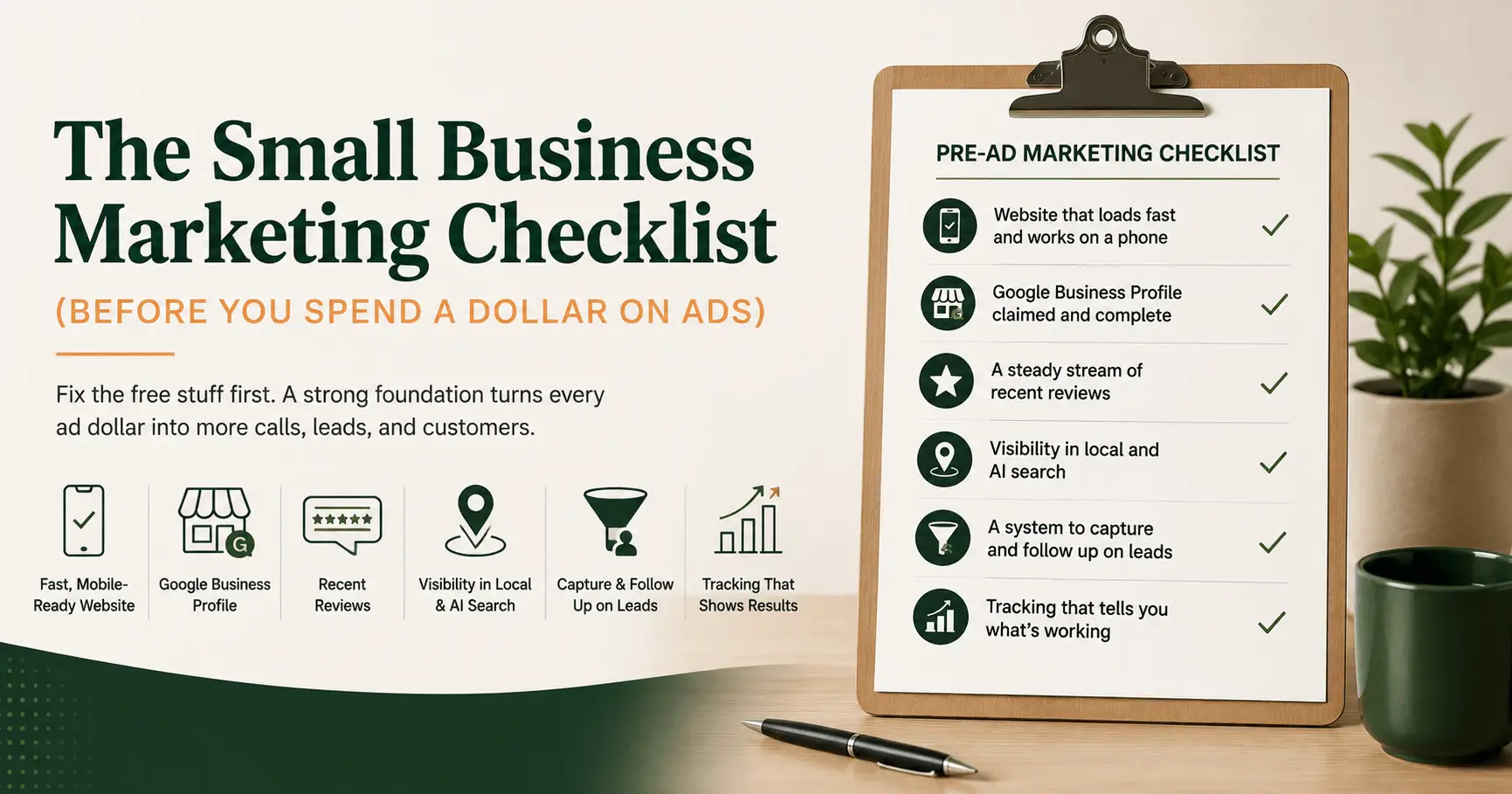
Before you spend a dollar on ads, work through this checklist: make sure your website loads fast and works on a phone, claim and fill out your Google Business Profile, gather a handful of recent reviews, confirm you show up in local and AI search, set up a simple way to capture the leads you already get, and put basic tracking in place. Ads amplify whatever you already have. If the foundation is cracked, you’re just paying to lose faster. This checklist is part of a bigger idea we cover in our guide to getting more customers without a big marketing budget. Fix the free stuff first.
Why run this checklist before you spend a dollar on ads?
Paid ads don’t fix a weak business. They expose it. Every click you buy lands on the same website, the same profile, and the same reviews a free visitor sees. If those aren’t ready to convert, you pay full price for traffic that bounces. The problem is rarely the ad. It’s what happens after the click.
Here’s the uncomfortable part. According to Constant Contact, 73% of small businesses aren’t confident their current marketing strategy is working. And when we audit accounts, the reason usually isn’t the ad copy or the bid. It’s that money went to ads before the foundation could hold it. In one WordStream study of 500 small business Google Ads accounts, fewer than half had conversion tracking installed, which means most of those owners had no way of knowing whether their ads produced a single lead. You can’t fix what you can’t see, and you shouldn’t scale what you can’t measure.
We’ve been on the tools ourselves, so we’ll say it plainly. Spending on ads with a broken foundation is like buying a truck wrap before the truck runs. Looks busy. Goes nowhere.
The pre-ad marketing checklist at a glance
Before any paid campaign, six things should be in place: a fast, mobile-ready website, a complete Google Business Profile, recent reviews, visibility in local and AI search, a way to capture and follow up with leads, and basic tracking. Each one is free or close to it, and each one makes every future ad dollar work harder.
- Website that loads fast and works on a phone — turns a click into a call, form, or booking.
- Google Business Profile claimed, verified, and filled out — your best free spot in local search.
- A steady stream of recent reviews (and replies to them) — the deciding factor for most local buyers.
- Visibility in local and AI search you didn’t pay for — free traffic before ads enter the picture.
- A simple system to capture and follow up with leads — stop leaking the customers you already reach.
- Tracking that tells you what’s actually working — so you never scale a guess.
Work top to bottom. The order matters, because each item makes the next one pay off more.
Is your website ready to turn a click into a call?
Before you send paid traffic anywhere, your website has to do one job: turn a visitor into a call, a form, or a booking. If it’s slow, hard to use on a phone, or missing an obvious way to contact you, ads just deliver more people to a dead end. First impressions here are fast and almost entirely visual.
Research from Stanford found that 75% of people judge a business’s credibility based on its website design. And speed decides whether they stick around at all. Google’s data shows 53% of mobile visitors leave a page that takes longer than three seconds to load. Since roughly 60% of web traffic is now mobile, according to Statista, a site that only works well on a desktop is a site that fails most of your visitors.
Run through this before you advertise:
- Your phone number is visible at the top of every page and tappable on mobile
- The site loads in under three seconds on a phone, not just your office wifi
- There’s a clear next step above the fold: call, book, or request a quote
- Nothing is broken, outdated, or pointing to a service you no longer offer
If you’re not sure your site is pulling its weight, we walk through the most common culprits in our post on why your website isn’t bringing in customers, and you can gut-check the phone experience with our guide to whether your website actually works on mobile.
Have you claimed and filled out your Google Business Profile?
Your Google Business Profile is the single most valuable piece of free marketing real estate you own, and most local businesses never finish setting it up. It’s what shows up in the map results when someone searches for your service nearby. Claiming it, verifying it, and filling out every field costs nothing and often does more than a month of ads.
A complete profile earns far more attention than a bare one. Businesses with fully filled-out profiles get roughly 7 times more clicks than those with partial information, according to research compiled by Bazaarvoice. Categories, hours, service areas, photos, and a real description all feed how Google ranks and shows you.
Make sure you’ve handled the basics:
- Claimed and verified the profile
- Picked the most accurate primary category, plus relevant secondary ones
- Added hours, service area, phone, and website
- Uploaded real photos of your work, your team, and your trucks
- Kept it current whenever anything changes
We break the whole process down step by step in our Google Business Profile optimization guide, and you can see where yours stands right now with our free Google Business Profile checker.
Do you have enough recent reviews to win the click?
Reviews are the deciding factor for most local buyers, and they’ve only gotten more important. Before someone calls you, they’re reading what other people said, and they’re checking how fresh those reviews are. If a competitor has 40 recent five-star reviews and you have six from two years ago, you’ll lose the click even if you’re the better business.
The 2026 BrightLocal Local Consumer Review Survey found that 97% of consumers read reviews before choosing a local business, and 41% now say they always read reviews when browsing, up from 29% just a year earlier. Standards are rising too. 31% of consumers say they’ll only use a business rated 4.5 stars or higher, nearly double the share from 2025. And recency counts: 74% look for reviews written in the last three months.
Before you advertise, get a simple review habit going:
- Ask every happy customer, in person or by text, right after the job
- Make it one tap with a direct Google review link
- Reply to every review, good or bad, within a day or two
- Aim for a steady trickle, not a one-time pile
You don’t need gimmicks or incentives to do this well. Our guide on how to get more customer reviews the right way covers exactly what to say and what to avoid.
Can people find you in local and AI search without paying?
Plenty of the traffic you’d pay Google Ads for is available for free if you show up in local search and, increasingly, in AI answers. When someone searches “plumber near me” or asks ChatGPT for a recommendation, the businesses that appear are the ones with a strong profile, consistent information, and content that answers real questions. None of that requires an ad budget.
This channel is shifting fast. The 2026 BrightLocal survey found that 45% of consumers now use AI tools like ChatGPT to find local businesses, up from just 6% a year earlier, while Google’s share of local discovery slipped from 83% to 71%. If your business isn’t set up to be found in both places, you’re invisible to a growing slice of buyers before ads even enter the picture.
Cover the free foundation first:
- Consistent name, address, and phone number everywhere online
- Service pages that answer the questions customers actually ask
- A Google Business Profile that reinforces what you do and where
- Clear, factual content that AI tools can quote
Our local SEO guide for small businesses lays out the ranking basics, and our post on getting recommended by ChatGPT and AI search covers the newer half of this equation.
Are you capturing the leads and customers you already have?
Before you spend to find new customers, make sure you’re not leaking the ones you already reach. Most local businesses have no system to follow up with a lead who didn’t book, or to bring a past customer back. That’s money left on the table, and ads make the leak bigger by pouring more water into a bucket with a hole in it.
The math favors the customers you already have. The average local business earns 52% of its revenue from returning customers, according to BIA Advisory Services. A simple email list, a follow-up text, or even a spreadsheet of past jobs can outperform a cold ad campaign, because these people already know you.
Put something basic in place:
- A way to collect emails or phone numbers from every lead and customer
- A short follow-up for quotes that didn’t close
- An occasional email or text to past customers with a reason to call again
It doesn’t have to be fancy. Our guide to email marketing for local businesses shows how to start from zero without a big tool or a big list.
Can you actually tell what’s working?
If you can’t measure it, you can’t improve it, and you definitely shouldn’t scale it with ad spend. Before you advertise, set up simple tracking so you know where calls and leads come from. Otherwise you’re guessing, and guessing with a credit card attached gets expensive fast.
This is where most small campaigns quietly fail. Remember that WordStream finding: more than half of small business ad accounts had no conversion tracking at all. Those owners were spending real money with no idea which clicks turned into customers. You don’t need an enterprise dashboard to avoid that trap. You need to know your numbers.
At a minimum, track:
- How many calls and form fills you get each month, and where they came from
- Which channel each new customer heard about you through (just ask)
- What a customer is worth, so you know what a lead is worth
- Whether the number of leads is trending up over time
Once these basics are running, you’re finally in a position to spend on ads with your eyes open. If you’re weighing paid search against free search, our comparison of Google Ads versus local SEO walks through which to prioritize first.
What this looks like in practice
Picture two plumbers in the same town, each with $1,000 a month to spend. The first turns on Google Ads immediately. His site takes six seconds to load on a phone, his Google Business Profile is half empty, and he has four reviews. He pays top dollar for clicks that bounce, and after two months he’s convinced “ads don’t work.”
The second plumber spends the first month on the checklist instead. He speeds up his site and adds a tappable phone number, finishes his Google Business Profile, and asks every customer for a review until he has twenty recent ones. Then he turns on the same ads. His clicks land on a fast site, backed by a strong profile and real reviews, and they convert. Same budget, same town, completely different result. The only difference was the order of operations.
We’ve seen this pattern with enough trade businesses to know it isn’t luck. Ads reward a strong foundation and punish a weak one. Home and home improvement is one of the pricier categories to advertise in, with an average cost per click of $7.85 according to WordStream’s 2025 benchmarks, so every wasted click stings more. Get the free foundation right, and those clicks finally pay.
Common Questions About Your Small Business Marketing Checklist
Do I really need to skip ads until everything is perfect?
No. You don’t need perfect, you need functional. If your site loads fast on a phone, your Google Business Profile is complete, and you have a handful of recent reviews, you’re in good enough shape to start testing ads. The checklist is about avoiding obvious leaks, not chasing perfection.
How many reviews do I need before running ads?
There’s no magic number, but you want enough recent reviews to look active and trustworthy next to your competitors. Since 31% of consumers now say they’ll only use a business rated 4.5 stars or higher, aim for a steady stream of fresh reviews and a rating that clears that bar. Ten to twenty recent reviews beats a hundred old ones.
What is the cheapest item on this checklist to fix first?
Your Google Business Profile. Claiming and completing it is free, takes an afternoon, and often produces more calls than a paid campaign. It’s the highest-return, lowest-cost move most local businesses can make, which is why it sits near the top of the list.
Should I do local SEO or ads first?
For most local businesses, the free foundation comes first, then ads to fill the gaps. Local search and a strong profile bring in steady, no-cost leads, while ads are best for slow seasons or fast growth once your foundation already converts.
How do I know if the checklist is actually working?
Track your leads before and after. Count the calls and form fills you get each month, note where new customers heard about you, and watch whether that number climbs as you complete each item. If leads go up before you’ve spent a dollar on ads, the foundation is doing its job.
Ready to see where you stand?
Working through this checklist on your own is a solid start. But it helps to have a second set of eyes on what’s actually costing you customers. If you want a full picture of where your marketing stands, start with a free website audit. It’s the fastest way to find out what’s working and what’s quietly costing you customers, before you spend a dollar on ads.