You’re posting on Facebook. You’ve got a website. You even ran some Google Ads last spring. So why is the phone still quiet?
For a lot of local business owners, the problem isn’t effort. It’s that the pieces aren’t connected. Marketing that actually brings in calls isn’t a pile of separate tactics. It’s a path, one that carries a stranger from a quick Google search all the way to a booked job.
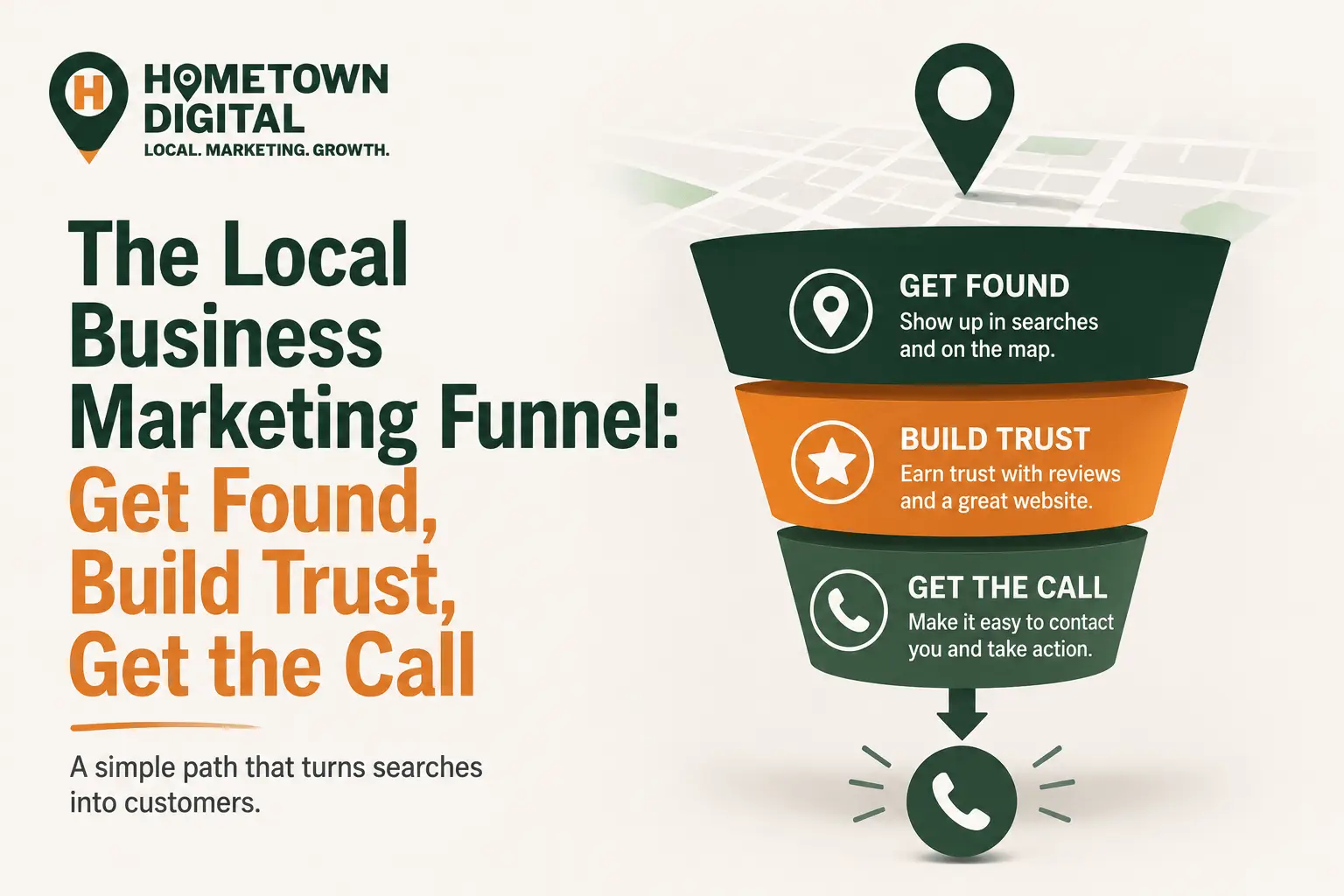
The local business marketing funnel is that path. It has three stages: get found, build trust, and get the call. Get found means showing up when someone searches. Build trust means giving them a reason to pick you over the shop next door. Get the call means making it dead simple to take the next step. Skip any one of those stages and the whole thing leaks. Below, we’ll walk through all three, what wins at each, and where local businesses quietly lose customers they already earned.
What is the local business marketing funnel?
The local business marketing funnel is the journey a potential customer takes before they ever contact you. They find you, they check you out, and then they decide to call, book, or walk in. For a local business, that whole journey often plays out in a few days, sometimes in a few minutes, spread across Google, online reviews, and your website.
Most owners picture marketing as a set of separate channels. SEO over here, ads over there, social somewhere else. But your customer doesn’t see it that way. They see one experience: they searched, they looked you up, they decided. When those channels don’t hand off to each other cleanly, you pay to bring people in and then lose them before they call. If you want the bigger-picture version of this, we cover it in our guide on how to get more customers without a big marketing budget. The funnel is the engine underneath all of it.
Here is the whole thing in one table.
| Funnel Stage | What the customer is doing | What wins them | Where businesses lose them |
|---|---|---|---|
| Get Found (Awareness) | Searching Google or Maps, or asking an AI tool | Map Pack visibility, an optimized Business Profile, local SEO | Not ranking, an incomplete or missing profile |
| Build Trust (Consideration) | Reading reviews and checking out your website | Strong recent reviews, a credible and fast site | Few reviews, a low rating, a dated or slow site |
| Get the Call (Conversion) | Deciding whether to contact you right now | A clear call to action, easy contact, fast mobile pages | No obvious next step, a slow site, no one answering |
Stage 1: How do customers find your local business?
Getting found means showing up at the exact moment someone is looking for what you do. That happens in three main places now: Google’s regular search results, the Google Maps pack, and increasingly, AI tools like ChatGPT and Google’s AI Overviews. Nearly half of all Google searches have local intent, according to Google, which means the demand is already there. The only question is whether you’re visible for it.
The Map Pack, that little box of three businesses sitting under a map, does most of the heavy lifting for local searches. Businesses that land in it get 126% more traffic and 93% more customer actions like calls, clicks, and direction requests than businesses ranked below it, according to SOCi. That’s not a small edge. That’s the difference between a ringing phone and a quiet one.
Two things drive most of your visibility here: local SEO for small businesses and optimizing your Google Business Profile. Your Business Profile feeds the Map Pack directly, and your site’s local SEO tells Google which searches you should show up for. And there’s a newer wrinkle worth knowing about. In Yext’s 2026 consumer research, 28% of people said they’d tried a new local business in the past six months specifically because an AI tool recommended it. Getting found isn’t just Google anymore.
Stage 2: How do you build trust before someone calls?
Once someone finds you, they size you up before they ever reach out. This is the build-trust stage, and it runs on two things: your reviews and your website. According to BrightLocal’s 2026 Local Consumer Review Survey, 97% of consumers read online reviews before choosing a local business, and 54% go on to visit that business’s website after reading positive ones, up from just 32% back in 2019.
So reviews and your website aren’t separate projects. They’re a relay. Good reviews send people to your site, and your site has to catch them. But the bar has moved. That same BrightLocal survey found 68% of consumers now require a business to have at least a 4-star rating before they’ll even consider it. A thin review profile isn’t neutral. It’s a stop sign.
Your website carries the other half of the trust load. Research from Stanford found that 75% of people judge a company’s credibility based on its website design. For a local business, that usually comes down to one gut check: does this look like a real, established operation, or does it look like it was thrown together in a weekend? We’ve been in the trades ourselves, and we know homeowners vet hard before they let a crew on the property. If you’re getting the reviews but still losing people, the fix is almost always the site. That’s why we push clients toward a small business website built to convert and a steady system for getting more customer reviews the right way, not one or the other.
Stage 3: How do you actually get the call?
The last stage is conversion: turning an interested visitor into an actual call, form fill, or booking. This is where a surprising amount of money leaks out. In BrightLocal’s 2026 survey, after reading positive reviews, only about 20% of consumers went on to contact the business and another 20% booked an appointment. The rest drifted off, often because the next step wasn’t obvious or easy.
A few things move this number. First, make the action clear. Websites with clear calls to action generate twice as many leads as those without, according to HubSpot. Your phone number should be tappable on mobile, your “get a quote” button should be impossible to miss, and there shouldn’t be three competing things to click. Second, speed. Google found that 53% of mobile visitors abandon a site that takes more than three seconds to load, and most local searches happen on a phone. A slow site loses the call before the page even finishes.
And here’s a gap most owners never see: only about 40% of local businesses have a dedicated website at all, per BrightLocal. If people are reading your reviews and then hitting a dead end, that’s a leak you can close this month. When we audit a site that gets traffic but no calls, this stage is almost always the culprit, which is exactly what we dig into in why your website isn’t bringing in customers. Paid ads can speed the whole funnel up once the trust and conversion pieces are solid, though it helps to know whether to invest in Google Ads or local SEO first before you spend a dollar.
Why the funnel breaks when you skip a stage
Each stage depends on the one before it. Get found but look untrustworthy, and people bounce. Build trust but make calling a chore, and they call someone easier to reach. Nail conversion but stay invisible, and there’s no one to convert. That’s why scattered tactics so often disappoint. It’s not that Facebook or ads or SEO don’t work. It’s that one channel can’t carry the whole journey by itself.
The data backs this up. According to Constant Contact, 73% of small business owners aren’t confident their marketing is actually working, and it’s usually because they’re running disconnected pieces. The same research found that multi-channel small businesses outperform single-channel ones by 53% in email, 43% in paid social, and 21% in search. The businesses that win treat their marketing as one system, not a to-do list.
Here is where local businesses most often lose customers:
- They never show up. No Map Pack presence, an incomplete Business Profile, no local SEO. The funnel never even starts.
- They show up but look risky. Too few reviews, a low star rating, or a dated website that fails the credibility gut check.
- They earn interest but make it hard. No clear call to action, a slow or clunky mobile site, or a contact form nobody checks.
- They convert once and stop. No follow-up and no repeat-customer system, so every month starts from zero.
What the local marketing funnel looks like in action
Picture a homeowner whose AC quits on a 98-degree July afternoon. They grab their phone and search “AC repair near me.” Three businesses show up in the Map Pack. Yours is one of them, because your Business Profile is complete and your local SEO is dialed in. Stage one just did its job.
They tap your listing and see 140 reviews at 4.8 stars, then click through to your site, which loads fast and says right at the top that you offer same-day service. Stage two built trust in about fifteen seconds. Then they spot a big, tappable “Call Now” button, press it, and you’re on the phone with a booked job. Stage three closed the loop.
Now change one thing. Say your site takes six seconds to load on their phone, or the number is buried at the bottom of the page. That homeowner is already back on the search results, calling the competitor whose site worked. Same demand, same reviews, one weak link, no call. That’s the whole game. The funnel is only as strong as its leakiest stage.
Common Questions About the Local Business Marketing Funnel
What’s the difference between a marketing funnel and a sales funnel for a local business?
For most local businesses, they’re nearly the same thing, just different ends of one path. The marketing funnel gets a stranger to find you and trust you. The sales funnel is the short stretch at the end where they contact you and you close the job. Because local buying decisions happen fast, the two blur together far more than they do for big companies with long sales cycles.
Which stage of the funnel should I fix first?
Start wherever you’re leaking most. If you’re not showing up in local search or the Map Pack, fix get-found first, because nothing downstream matters if no one sees you. If you get traffic but no calls, the problem is trust or conversion, which usually means your reviews or your website. A quick audit will tell you which one is bleeding.
How long does it take to see results from fixing the funnel?
It depends on the stage. Conversion fixes, like a clearer call to action or a faster site, can lift calls within days. Trust fixes, like building a steady flow of reviews, take a few weeks to a couple of months. Local SEO is the slowest, usually three to six months to move rankings in a meaningful way, but it also compounds the longest.
Do I need paid ads to make the funnel work?
No. Plenty of local businesses fill their funnel entirely with local SEO, reviews, and a strong website. Ads simply speed things up by buying visibility at the top of the funnel. But running ads to a weak website or thin reviews just means paying to send people into a leak. Fix the funnel first, then decide whether ads make sense.
Does the funnel change now that people use AI to search?
The stages don’t change, but the get-found stage now includes AI tools alongside Google. The good news is that the same things that earn trust with customers, strong reviews and clear, well-structured content, are also what get you recommended by AI. Build the funnel right and you’re covering both at once.
Where does your funnel leak?
Most local businesses don’t have a marketing problem. They have a funnel problem, one weak stage quietly costing them calls they already earned. The fix starts with knowing which stage it is. Our small business marketing checklist is a good place to map out all three, and if you would rather have us look at yours directly, get a free website audit. We’ll review your Google presence, your reviews, and your site, then tell you exactly where you’re losing customers and what we’d fix first.